Mayasabha: The 35mm Isolation Ward
Rahi Anil Barve’s film turns a defunct cinema hall into an architecture of control, where objects, memory and inheritance quietly train people to stay


Film: Mayasabha - The Hall of Illusion
Language: Hindi
Director: Rahi Anil Barve
Cast: Jaaved Jaaferi, Mohammad Samad, Veena Jamkar, Deepak Damle
Genre: Psychological thriller/fantasy drama
Runtime: 104 minutes
Release: Theatrical - January 30, 2026 (details about future OTT availability not confirmed at the time of writing)
In the stagnant air of ‘Mayasabha’, time doesn’t pass; it accumulates. ‘Mayasabha’, a defunct cinema hall that doubles as a home, functions as a piece of encasement architecture, where trauma is a material weight. At the centre of this rot is Parameshwar Khanna, the failed producer who forgot to yell ‘cut’. His bankruptcy forces his son to inhabit the sets of a movie that will never be released.
The most tragic ‘casting’ is reserved for the feminine. Jaymala, the mother, exists only as a framed film poster. As a ‘35mm ghost’, she is the only source of colour in a grey world, yet she is immobile. She is worshipped, but she is also a two-dimensional wall that hides the gold and the truth of what happened with Sohrab.
This architecture of encasement is the film’s central trap. Every object is a cage, and every cage carries history. The architecture is designed to hold people exactly where they are. In fact, the props of ‘Mayasabha’ tell this story before the characters ever can.
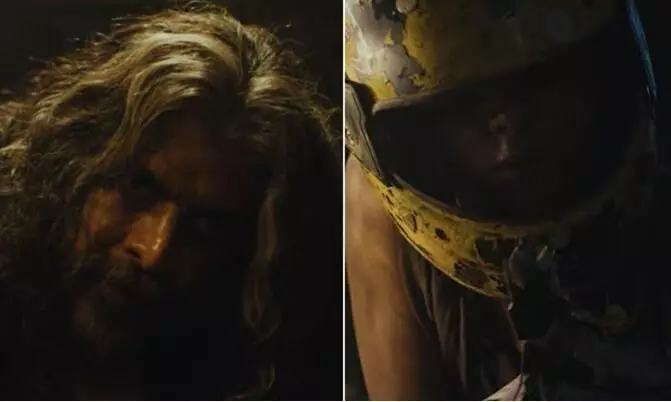
We see this most clearly in Vashusen’s (Parmeshwar’s son, Vashu) helmet. It is not permanent skin. He reaches for it only when Parmeshwar becomes a threat, retreating into the yellow plastic as a sensory shield against a father who has spent decades muffling his son's identity. Inside it, the world turns hot, heavy and strangely quiet for a boy taught to fear the very air he breathes.
The ‘India Post’ scene makes it clear that the delay persists beyond the cinema hall. Like undelivered mail, Vashu has no address beyond the home. Leaving the house does not mean arrival.
When Zeenat arrives with Ravarana at Vashu’s place, she is vibrant and moving with a fluidity that feels violent in a house of statues. However, when Vashu puts on his father’s oversized coat to welcome her, the architecture of his cage shifts. He trades the protection of a child’s armour for the suffocating weight of a failed man’s skin. This is distrust, not rebellion. ‘Mayasabha’ doesn’t just present a villain. It teaches the viewers how to recognise one without protest. A bow feels like tenderness and danger at once. Makeup reads like a warning sign.
Parameshwar has converted the cinema hall into a liveable archive of himself. Outside of it, he is a failed producer and a punchline told by others. Inside it, he is a man with stories and a past that refuses to end. If he can control air, light, insects and movement, maybe he can keep shame and desire from leaking in. Control becomes the only authorship he has left.
Even our memory of the past is framed through Parmeshwar’s bitterness. We never truly see Sohrab. We only see the fragments that Parameshwar allows us to justify his own brokenness. Much like Jaymala, Sohrab is a ghost silenced by a narrative he can no longer contest.
The gold behaves like a MacGuffin, changing shape with the desperation of whoever looks at it. It is a crude exit for Ravarana and a calculated prize for Zeenat. But for Parameshwar, the gold is material proof of a status he no longer holds, hidden away as if to prove that he is a king who chose to be a pauper. For Vashu, the gold is the only proof that his father’s life and, by extension, his childhood, wasn't a total loss. It is an invisible anchor that helps him believe that the years of isolation weren’t futile, but a guarding of treasure.
What finally distinguishes Vashu from Parameshwar isn’t courage, but imagination. Where his father clung to obscurity, Vashu dreams of excess clarity from the start. His ambition for a Rolls-Royce painted yellow, inside and out, isn’t materialistic but architectural transparency. He wants a world where the inside matches the outside.
The production reaches its delayed finale when Vashu provides Parameshwar with his final ‘fade to black’, shrouding him in the obscurity he needed to survive. But when the cut is finally called, the script does not end. When the smog thins, Vashu is left suspended between a structure he survived and a world the film refuses to imagine for him.
Darshim Saxena writes on cinema and culture