Assi: Counting Without Looking
In ‘Assi’, violence is not merely committed. It’s administratively managed through selective sight by families, institutions and even the camera itself
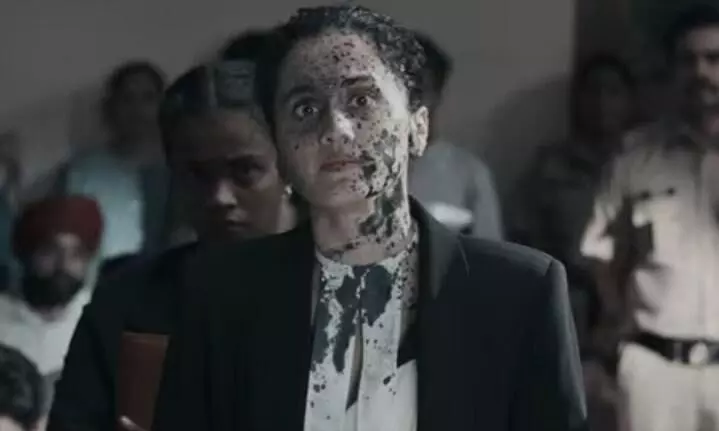


Film: Assi
Language: Hindi
Year: 2026
Director: Anubhav Sinha
Cast: Kani Kusruti (Parima), Taapsee Pannu (Advocate Raavi), Mohammed Zeeshan Ayyub (Vinay), Kumud Mishra (Kartik), Manoj Pahwa (Deepraj), Revathy (Vasudha), Satyajit Sharma (Opposition Counsel), Advik Jaiswal (Dhruv), Vipul Gupta (Ballu), Sahil Sethi (Sameer), Akanksha Choudhary (Kaveri)
Genre: Courtroom Drama / Social Drama / Thriller
Runtime: 133 minutes
Release: Theatrical (February 20, 2026)
“I was stupid.” The first person who taught Parima how to see the world wasn’t the state. It was her mother.
The lesson was simple: never step out without a man. This isn’t cruelty, it’s inheritance. She wasn’t taught how to be safe. She was taught how to blame herself when safety failed. ‘Assi’ is a film about who is allowed to see clearly, who chooses not to and who is punished for insisting on sight.
In the car, brutality unfolds alongside something quieter, refusal. The driver keeps the car moving while murmuring in protest. Another man watches his peers for approval instead of looking at the woman in front of him. Care is reserved for kin. A stranger doesn’t qualify.
The same logic governs institutions. The police officer doesn’t recognise injustice in principle. Empathy in ‘Assi’ travels through familiarity - someone’s daughter, someone’s wife, never simply a citizen. When asked to identify the men, she says she can’t recognise them clearly and apologises. The system demands precision, while trauma has already reorganised perception. The rest is institutional theatre, as CCTV footage lost to monkeys, as if the state must borrow wildlife to excuse its own disappearance.
The accused are ordered to uncover their faces. Parima wraps herself in a white floral dupatta before entering. No one asks her to unveil. She must decide to expose herself. When she finally does, the prosecutor turns away. He prefers the safety of the abstract file over the survivor’s presence. The discarding of Parima’s indigo floral skirt initiates the floral motif of power. Perpetrators preen in gold-floral mirrors, their mothers silencing threats to preserve domestic delusion - often silencing a daughter dressed to leave. It’s only Raavi who reclaims this identity, wearing a floral blouse, an act of visual insurgency.
Visibility becomes another labour assigned to the survivor. Outside the courtroom, witnessing becomes a spectacle. Neighbours gather at her house, converting trauma into something that can be attended, discussed and exited before dinner. Later, her school principal’s perception echoes that the institution doesn’t ask whether she can return to life. It asks whether it can bear to look at her without discomfort.
Even the child’s field of vision is negotiated. “Let him remain a child,” a woman officer insists, as if innocence can be preserved by managing what he is allowed to register. The film withholds the moment he is told the truth. The transmission of shame happens off-screen.
After the assault, the phone rings beside the clothes stripped from her. A child is calling to ask where his mother is. Two worlds occupy the same frame. Domestic innocence reaching outward and the evidence of what has just been done to her. The child can’t see what the camera shows. Neither can Vinay. The film makes the audience the only witness.
There is one brief interruption to this choreography. Raavi and Parima sit over ‘chai’ outside the courtroom. Parima admits she no longer knows what winning means. Raavi doesn’t argue. She simply raises her glass. The film allows this pause only briefly. Even tenderness must not delay the machinery of adjudication.
Even the camera is complicit in this choreography. It begins in detachment, framing arguments from behind or alongside the prosecution, aligning the viewer with procedure rather than pain. Only gradually does it shift closer to Raavi. Seeing here isn’t innocent. It’s staged, recalibrated and finally weaponised.
The burden of vigilance rests on the woman. The burden of forgetting is outsourced to everyone else. The film isn’t only critiquing the state. It turns the gaze back on the viewer.
Parima is the most legible candidate for justice as a married, employed, supported and articulate woman. Yet she is reduced to ‘Victim X’, a bureaucratic placeholder. The film consciously selects the survivor who can be spoken for. If even she struggles to remain visible, what happens to those who don’t fit the template? The rest dissolve into statistical residue, unnamed in public and rehearsing self-blame in private, while the nation continues to count without looking.
Darshim Saxena writes on cinema and culture