Simulating a Changing Planet
As climate risks intensify, understanding how models work becomes crucial to interpreting projections, policy choices, and environmental consequences
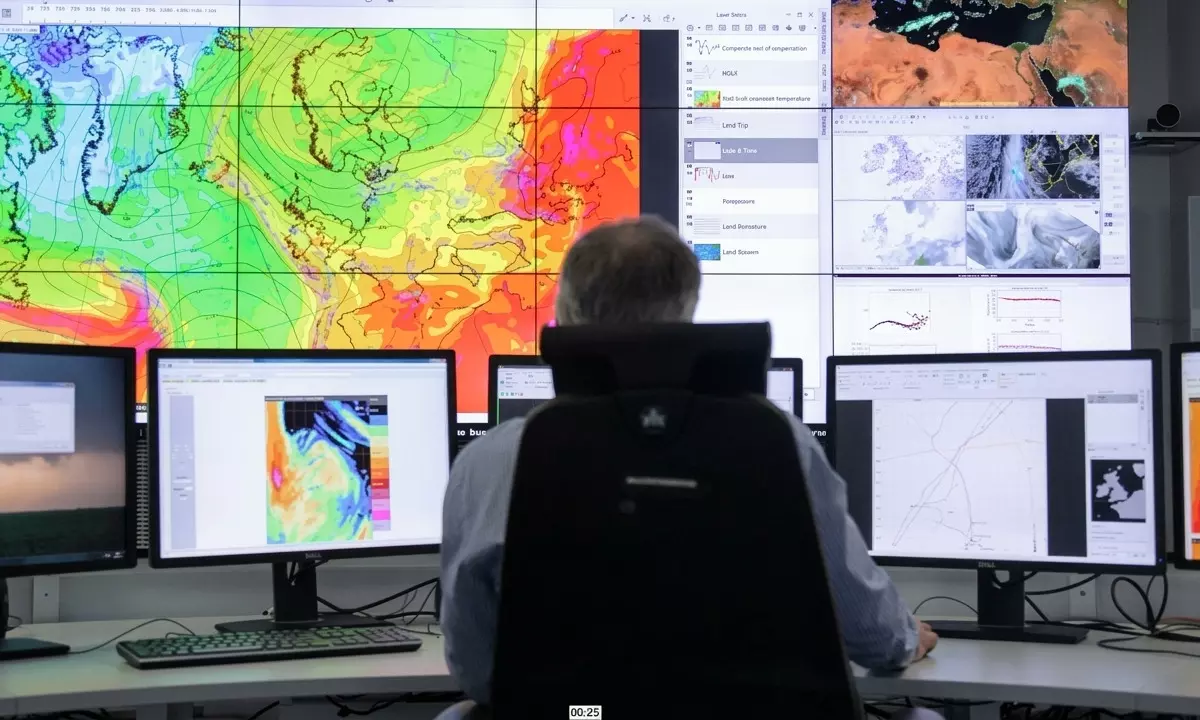


There can be Atmosphere GCMs, Ocean GCMs, and a combination of the two. While Atmosphere GCMs consist of hundreds of equations on temperature, winds, humidity, water, and clouds, these are then put together in a computer program, giving us future projections. As discussed above, the data is arranged in a three-dimensional grid spacing of the Earth, which includes the horizontal and vertical aspects of the atmosphere. The equations behind the computer model are based on fundamental laws of physics in thermodynamics and fluid dynamics for an ideal gas. While many of the horizontal atmospheric processes are easily handled by the grid, many vertical processes, which have a limited geographical spread, need to be parameterised. To elaborate, a grid is typically 100 km by 100 km, but many processes, such as cloud formation or convection, occur on a much smaller scale or too quickly. To model these, a simple guide or an algorithm is used to approximate the process at a sub-grid level; this is known as parameterisation.
Ocean GCMs model the processes in the oceans at the surface and sub-surface levels. As in Atmosphere GCMs, the horizontal aspects are much larger than the vertical aspects. Ocean GCMs have to consider a more complex topography, including continents, ocean floors, straits, and basins. Further, the ideal gas laws used in Atmosphere GCMs have to be modified, and other laws of thermodynamics and fluid dynamics have to be invoked in Ocean GCMs. Here too, parameterisation of many important processes, which happen on a small scale (such as turbulent mixing of waters on the surface, mixing with tidal waters, or eddies), has to be done.
Atmosphere and Ocean GCMs are coupled to give AOGCMs, where the exchange of heat, salinity, and momentum is integrated to provide a comprehensive model. These models help us understand how a change in surface ocean temperature affects winds and leads to hurricanes and cyclones. Similarly, they help us analyse how a change in atmospheric temperature affects ocean currents. For example, AOGCMs help us simulate phenomena such as the El Niño–Southern Oscillation, which includes the El Niño and La Niña currents and affects weather and rainfall across the world.
Earth System Models
When biogeochemical aspects, such as the carbon cycle and ice sheets, are added to AOGCMs, we get Earth System Models (ESMs). All ESMs are therefore GCMs, but not all GCMs are ESMs. With the carbon cycle included, ESMs can analyse the exchange of carbon dioxide between land, air, and oceans, which includes processes such as photosynthesis, respiration, and other ecosystem aspects such as deforestation, mangroves, plant and animal life, etc. ESMs are therefore more comprehensive and can be used to answer various ecological questions, such as the impact of climate change on mangroves or plankton.
Regional Climate Models
Since the geographical scale of GCMs and ESMs can be rather large, it is difficult to study climate change and its impact at a regional level. For this, regional climate models have often been suggested. Such regional models define boundary conditions, which are often taken from global climate models. Boundary conditions are simply the values of variables such as temperature, wind, and pressure at the boundary of the region. Regional models can be useful because they incorporate local conditions into the model, such as topography, which can provide results with higher resolution and greater detail. The drawback of regional climate models is that the boundary conditions are derived from global models and are therefore biased, and they cannot provide feedback loops from local and regional climates to the global climate.
The Coupled Model Intercomparison Project (CMIP)
Another important milestone in climate modelling was the establishment of CMIP by the World Climate Research Programme (WCRP) in 1995. The WCRP was founded in 1980 under the World Meteorological Organisation in Geneva and today underpins much of the scientific research under the United Nations Framework Convention on Climate Change (UNFCCC). CMIP was essentially a project to compare the multitude of GCMs and ESMs being developed, along with the variety of results being produced. It began as a small initiative to run standard experiments, such as model behaviour with a 1 per cent increase in carbon dioxide. The more recent CMIP5 and CMIP6 are far more sophisticated and have incorporated past climate data to provide future climate projections. CMIP6 also includes various socioeconomic conditions to suggest different pathways of global greenhouse gas emissions and their consequences.
Conclusion
We have discussed the evolution and hierarchy of various climate models above. Climate models are a valuable tool for studying past climates and providing projections for the next century. All climate models are underpinned by fundamental laws of physics and offer reasonably accurate projections. These projections also provide guidance for the social and economic policies we should adopt. All models point to the urgent need to reduce greenhouse gas emissions, mitigate their effects, and prepare to adapt to the adverse impacts of climate change that we are already witnessing.