Polls That Matter
With over 17.4 crore voters and 824 constituencies at stake, the elections are not just about political power but also about governance models, voter eligibility controversies and the evolving nature of democracy
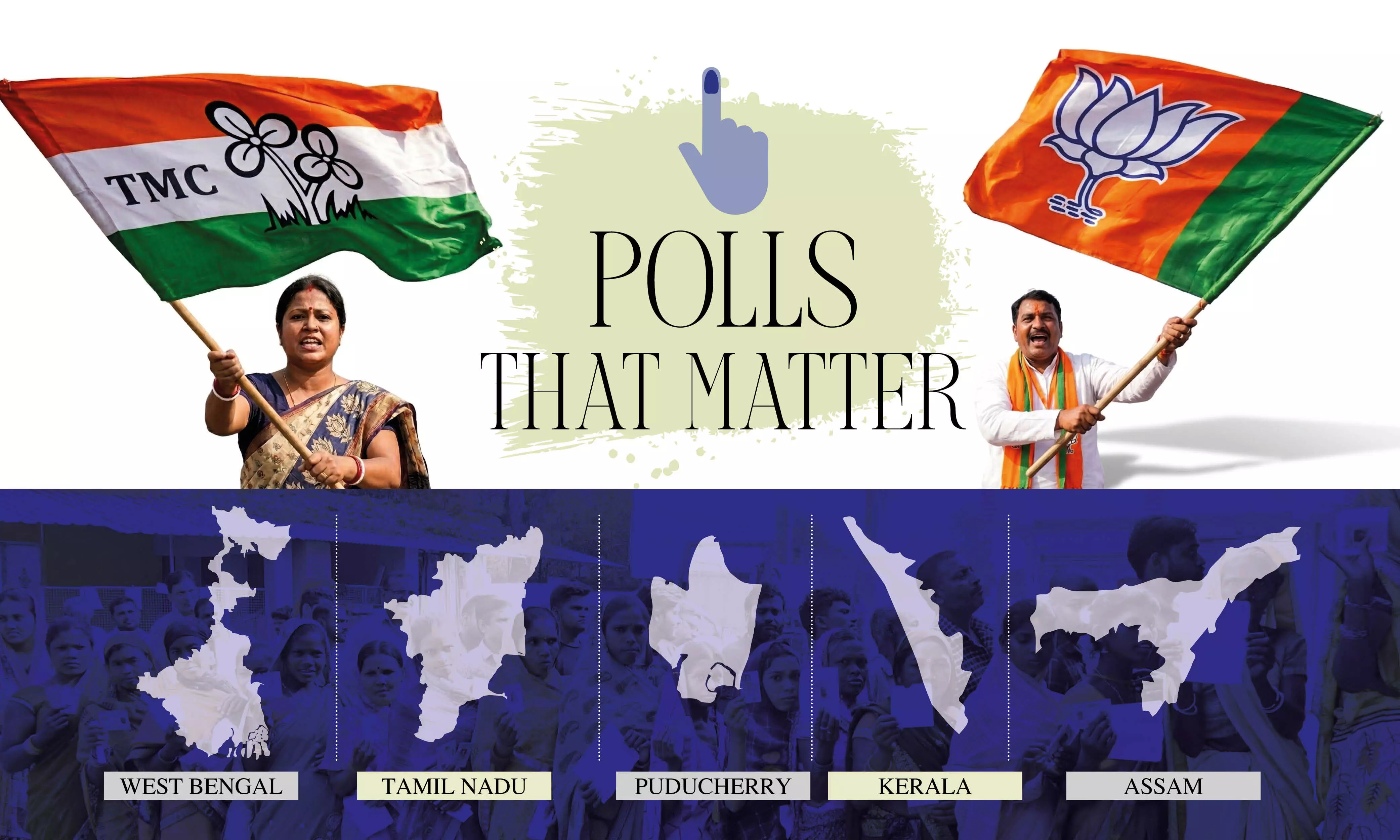


On March 15, the Election Commission of India (ECI) announced the schedule for Assembly elections in four States, Assam, Kerala, Tamil Nadu, West Bengal, and one Union Territory, Puducherry. The announcement sets in motion an electoral cycle that will determine governments across 824 constituencies. Some 17.4 crore people will vote across the five regions. Counting for all the constituencies is scheduled on May 4. Except in West Bengal, where elections will be conducted on two different dates (April 23 and 29), in all other regions, voters will cast their votes on April 9. In 2021, citing poor law and order conditions, the previous assembly election in West Bengal was held in eight phases. The Model Code of Conduct (MCC) came into force across the five regions the moment ECI made the announcement. In West Bengal, within 24 hours, the Election Commission transferred a large number of senior officials, including the chief secretary, home secretary, and director general of police.
SIR Controversy
In India, which is now considered an ‘electoral autocracy’, the upcoming elections are the second set of polls being held where the Special Intensive Revision (SIR) process has been completed, though ECI is yet to provide satisfactory explanations for the anomalies that arose during the SIR. These include a lowered gender ratio in most States except Tamil Nadu and an abnormally high number of deletions compared to the estimated adult population. The deletions are expected to affect short-term migrants and married women in particular. According to the Hindu, it could affect West Bengal election results, where the ‘Sword of Damocles’ still hangs over 60 lakh people regarding their voting eligibility due to ‘logical discrepancies’ in their applications, which are still under review by judicial officers.
In West Bengal, as per the Chief Election Commissioner Gyanesh Kumar, the total number of eligible voters stands at 6.44 crore, down from 7.04 crore in the electoral rolls published after the SIR on February 28. The drop is due to the removal of more than 64 lakh names identified as dead, duplicate, shifted, or absent during the verification process. The issue has triggered political reactions, with the Trinamool Congress, Left Front, and Congress urging the Election Commission of India to ensure that all genuine voters, including those under adjudication, are allowed to cast their votes. The BJP has not supported this demand and has instead defended the revision process.
In Tamil Nadu, the final electoral roll has 5.67 crore voters after deletion of 74 lakh entries. SIR deleted 8.57 lakh names in Kerala as per the final voters list, which has 2.69 crore voters.
SIR is not initiated in Assam. According to the final electoral rolls, Assam has approximately 2.25 crore voters. Incidentally, Assam was the first state in the country where the National Registrar of Citizens (NRC) exercise was rolled out for weeding out illegal immigrants. The NRC list, published on August 31, 2019, had found more than 31.1 million people eligible to be included in the registry while leaving out over 1.9 million people. This was conducted by the NRC co-ordinator, Prateek Hajela. On May 20, the Assam NRC authority filed an FIR against its former NRC Co-ordinator Prateek Hajela for allegedly facilitating the entry of names of ineligible persons as Indian nationals in the document. In August 2025, Assam chief minister Himanta Biswa Sarma said that, once there is an opportune time, the faulty National Register of Citizens (NRC) will be corrected.
Major contestants
Among the four states, Kerala, Tamil Nadu, and West Bengal are ruled by opposition parties, which are vocal against the Hindu nationalist party, the BJP government in Delhi. In Assam, a BJP-led government rules.
· In Assam, the ruling BJP-led National Democratic Alliance (NDA) faces the Congress across all 126 seats.
· In Kerala, the main contest is between the ruling Left Democratic Front (LDF) and the United Democratic Front (UDF) for 140 seats. The BJP-led NDA is also in contention. The BJP plans to contest around 100 seats, while allies Bharath Dharma Jana Sena (BDJS) and Twenty20- an Indian political party based in Kizhakkambalam, Kerala, formed in 2015, are expected to cover the remaining 40.
· In Tamil Nadu, the ruling Secular Progressive Alliance, led by the DMK, faces the BJP-AIADMK combine across 234 Assembly seats.
· In Puducherry, the ruling alliance of All India N.R. Congress (AINRC), the BJP, and the AIADMK faces the Congress-DMK-CPI combine across 30 constituencies.
· In West Bengal, the ruling Trinamool Congress (TMC) is seeking a fourth consecutive term across the State’s 294 Assembly seats, with the BJP intensifying a determined challenge.
Among the top 10 richest states (by GSDP in FY2025), two election-bound states, Tamil Nadu and West Bengal, rank second and fifth, with GSDP of Rs 31.19 lakh crore and Rs 18.15 lakh crore, respectively. Kerala stands out as a state with consistently high HDI values over the years, attributed to its high literacy rates, robust healthcare infrastructure and relatively high income levels. Though the state of Assam, which follows the Gujarat development model, has not yet emerged as a major economic success story, it has immense geo-strategic importance to India as a gateway to East Asia.
Significantly, the other three states, ruled by the opposition parties, follow their distinctive development models to counter the neo liberal ‘jobless growth model’ followed by the Union government.
For example, Tamil Nadu follows the Dravidian model of governance, focused on inclusive growth for people across all walks of life, through targeted social interventions to counter caste- and gender-based negative externalities. The Kerala Model of development is based on bottom-up and state-driven development, which is about systematic State investment in education and health, resulting in a set of high material quality-of-life indicators coinciding with low per-capita incomes, both distributed across nearly the entire population of Kerala. According to me, the four pillars of the Bengal model, introduced by the Chief Minister Mamata Banerjee, are: decentralised development, sub-regional emphasis- aiming to unite distinct ethnic and racial identities to strengthen the sub-regional identity of the divided Bengal, social inclusion and women empowerment.
Socio-economic conditions
Among the four states, West Bengal houses the maximum number of people (7.5 per cent of the Indian population). Population density is also maximum in West Bengal, followed by Kerala. Interestingly, all four states have population densities higher than the Indian average. In the case of Bengal, it is over three times the Indian average, though the state has barely 2.7 per cent of the nation’s geographical land.
The two southern states have higher per capita nominal GDP than the Indian average, while two states of eastern and north eastern India have lower per capita income than the national average. For Tamil Nadu, the credit–deposit ratio is strikingly high at 115 per cent compared to a very low C-D ratio for West Bengal, Assam, and Kerala. In Tamil Nadu and West Bengal, MSMEs play a very significant role. Significantly, the unemployment rate in West Bengal is the lowest (2.5), and in Kerala, the highest at 7.2.
Share of services in GSVA is very high, and Tamil Nadu's share of industry among the four states is the highest, while West Bengal has the least value among the four states.
In education and health parameters, the southern states have many impressive achievements compared to West Bengal and Assam.
Surprisingly, Kerala and Tamil Nadu have very high overall crime rates compared to West Bengal and Assam. In the case of Tamil Nadu, the total crime against women is low. So is the incidence of rape. In the other three states, figures of rapes are much higher. Rape figures are in absolute numbers, not expressed in per lakh adult women. In Assam, with a low population density compared to Kerala and West Bengal, the rape cases are alarmingly high. West Bengal has the lowest crime rate against children, followed by Tamil Nadu. In Assam and Kerala, the crime rates are higher than the national average.
Among all the models, the Dravidian model has made remarkable achievements in socio-economic sectors. Kerala model, though excelling in education and health care, has very poor crime records. Bengal has remarkably reduced the number of multidimensionally poor people, and it has also reined in crime rates. Education and health care are two areas of concern. Assam’s weakest area is its failure to provide security to women and children from rapist and criminals.