Living on Global Credit
Global debt has reached historic extremes, reshaping economic power, squeezing social spending and pushing nations toward a fragile future where borrowing threatens stability more than growth


The total global debt — consisting of the global public and private debt — was at USD 251 trillion in 2024, with public debt of USD 99.2 trillion and private debt decreasing to USD 151.8 trillion. In 2021, global debt reached a record USD 303 trillion — a steep jump from what was a record global debt in 2020 of USD 226 trillion, pushing the global debt-to-GDP ratio to 336 per cent in 2021. The said ratio was just above 235 per cent of global GDP in 2024, although private debt declined to under 143 per cent of GDP, the lowest level since 2015. In contrast, public debt rose to nearly 93 per cent of the global GDP in 2024. However, in the first three quarters of 2025, over USD 26 trillion was added to global debt stockpiles, marking a fresh high of near USD 346 trillion global debt — driven largely by government borrowing in both mature and emerging markets.
Rising Public Debt
One significant development in the global debt architecture is a steady rise in ‘public debt’-the total financial obligation a government owes to internal (domestic banks, citizens) or external (foreign governments, institutions) lenders. Global public debt has increased more than fivefold (from USD 17 trillion to USD 92 trillion) during 2000-22, outpacing global GDP, which tripled over the same time. Public debt has increased faster in developing countries compared to developed countries over the last decade. Developing countries owe almost 30 per cent of the total, of which roughly 70 per cent is attributable to China, India, and Brazil. The rise of debt in the developing world has mainly been due to growing development financing needs – exacerbated by the COVID-19 pandemic, the cost-of-living crisis, and climate change – and by limited alternative sources of financing. Consequently, the number of countries facing high levels of debt, with public debt exceeding 60 per cent of GDP, has increased sharply from only 22 countries in 2011 to 59 countries in 2022.
Recent data suggest that global public debt is approaching an astonishing USD 100 trillion. According to the International Monetary Fund (IMF), if current trends continue, by 2029 the total amount of public debt could exceed the size of the entire global economy—a level not seen since the aftermath of World War II. Wealthier nations are also borrowing heavily. The United States of America owes USD 38 trillion, roughly 125 per cent of its GDP. The UK’s public debt is equal to its output (GDP), leaving little room for responding to future shocks. In 2024, the total government debt of Japan stood at 1,212 trillion yen (approximately USD 7.9 trillion), which was 236.7 per cent of GDP- the highest among the developed nations. At the end of the third quarter of 2025, the general government gross debt to GDP ratio in the euro area (EA20) stood at 88.5 per cent, an increase compared with 88.2 per cent at the end of the second quarter of 2025. In the EU, with a total government debt of Euro 15.3 trillion (approximately USD 18.2 trillion), the ratio also increased from 81.9 per cent to 82.1 per cent.
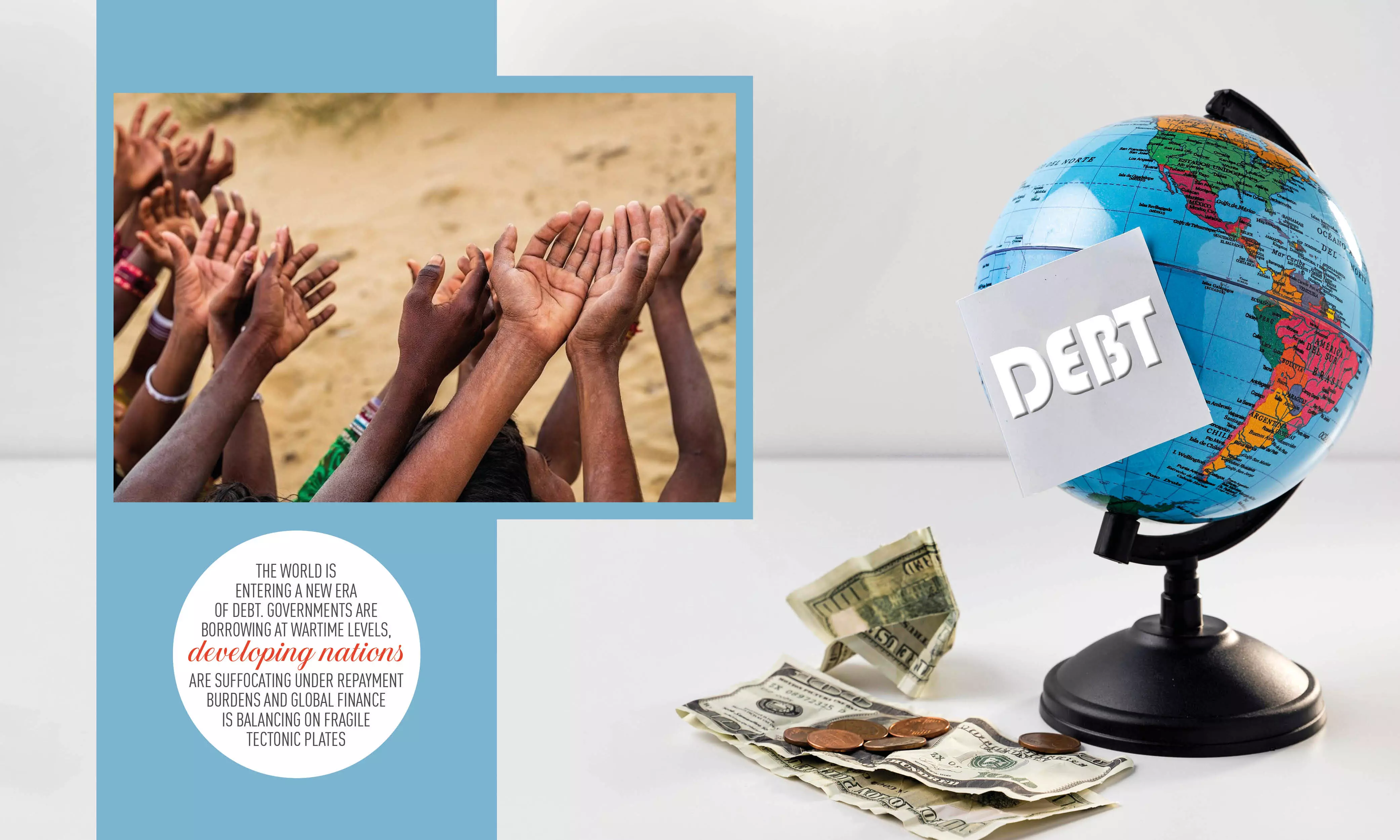
Identifying the ballooning national debt and volatile global politics as two “tectonic plates” that threaten to destabilise the financial order, JP Morgan Chase CEO Jamie Dimon issued a stark warning regarding the future of the American economy.
Regional Debt Pressures Diverge
The World Bank’s International Debt Report (IDR) 2025 reveals that in 2024, the total external debt stock of 119 Low- and Middle-Income Countries (LMICs) and Guyana reached USD 8.9 trillion compared to USD 6.27 trillion in 2014. And for a second consecutive year, LMICs’ interest payments to service their total external debt reached an all-time high, increasing 2.2 per cent to USD 415.4 billion in 2024. These payments are 2.4 times higher than they were a decade ago. This increase in interest payments has had severe consequences in high-debt countries, where, on average, more than half the population is already unable to afford a healthy diet. IDR also revealed that in 2024, LMICs paid out USD 205.1 billion more in principal and interest than they received in new loans, marking the third consecutive year of net outflows.
Table 1 reveals that the external debt stocks of the LMICs have substantially increased across all the regions during 2014-24. External debt share in the gross national income (GNI) reached nearly 50 per cent in the regions of Sub-Saharan Africa, Europe and Central Asia, which is alarmingly high. In the region of East Asia and the Pacific, this share is quite low at 15.7 per cent, indicating the economic stability of the region. Data in Table 2 corroborate the above observation.
Country-specific data in Table 2 reveals, in all four parameters: TEDS as a percentage of Exports, TEDS as a percentage of GNI, Debt service as a percentage of exports, and Debt service as a percentage of GNI, China is the best performer in managing external debt, followed by India. South Africa and Brazil are the major emerging nations of the world. Among India’s neighbours, Pakistan shows the worst condition. Its TEDS as a percentage of Exports is 315 per cent compared to 82 per cent for India. TEDS as a percentage of Exports is also very high for Sri Lanka and Bangladesh at 280 per cent and 192 per cent, respectively.
Major consequences of rising debt
Huge public debt of the developed countries — especially of the massive USA debt of over USD 38 trillion — is a serious concern for the stability of the global financial system. Last week, JPMorgan Chase’s chief, who is widely regarded as the most influential banker in the world, issued a stark warning regarding the future of the American economy, identifying the ballooning national debt and volatile global politics as two “tectonic plates” that threaten to destabilise the financial order. In addition to the unsustainable public debt, the second “tectonic plate” he identified is the shifting global economic order, where heavy US borrowing, rising interest costs, and fracturing trade relationships are reshaping how capital flows and where companies invest. He described this as the “biggest unknown,” pointing specifically to the war in Ukraine and the strategic alignment of Russia and China, nations that have signalled a desire to “dismantle” the Western system established after World War II.
The International Monetary Fund warns that by 2029, global debt will surpass 100 per cent of the world’s gross domestic product, meaning the world’s borrowing could soon exceed the size of the entire global economy. Nonetheless, the richer nations can still (at least for now) borrow at lower costs and keep spending, while many poorer nations are running out of room to take on more debt.
Data reveals that between 2010 and 2023, spending on interest payments in developing countries increased by 73 per cent, while health and education spending rose by only 58 per cent and 38 per cent, respectively. In many countries, particularly in Africa and parts of Asia, governments have spent more per capita on debt interest than on healthcare—a pattern that is as alarming as it is unsustainable. In Africa, average borrowing costs are nearly 10 times higher than those of the United States. A growing number of countries are being forced to choose between repaying creditors and investing in their people. One-third of developing countries now spend more on interest payments than they do on health, education, or climate action. In least developed countries, nearly 14 per cent of domestic revenue is consumed by interest payments—leaving governments unable to meet even basic needs. This ‘crowding-out effect’ is one of the most pernicious aspects of the global debt crisis. The diversion of public funds from social investment to debt servicing undermines the long-term development prospects and traps countries in cycles of fragility.
As seen during the 1980s Latin American debt crisis – a period often referred to as a “lost decade”, another debt crisis is looming on the horizon. This time, the world’s largest economy, the United States of America, may trigger the crisis.