India’s Stakes in a Burning Gulf
As conflict engulfs the Gulf, India faces rising risks to energy security, remittance lifelines, diaspora safety and its delicate diplomatic balancing in West Asia


On February 24, the Indian Minister of Commerce and Industry, Piyush Goyal, signed a key document with Jasem Mohammad Al Budaiwi, Secretary General of the GCC. The Gulf Cooperation Council (GCC) includes six member countries, namely Saudi Arabia, the United Arab Emirates (UAE), Qatar, Kuwait, Oman, and Bahrain.
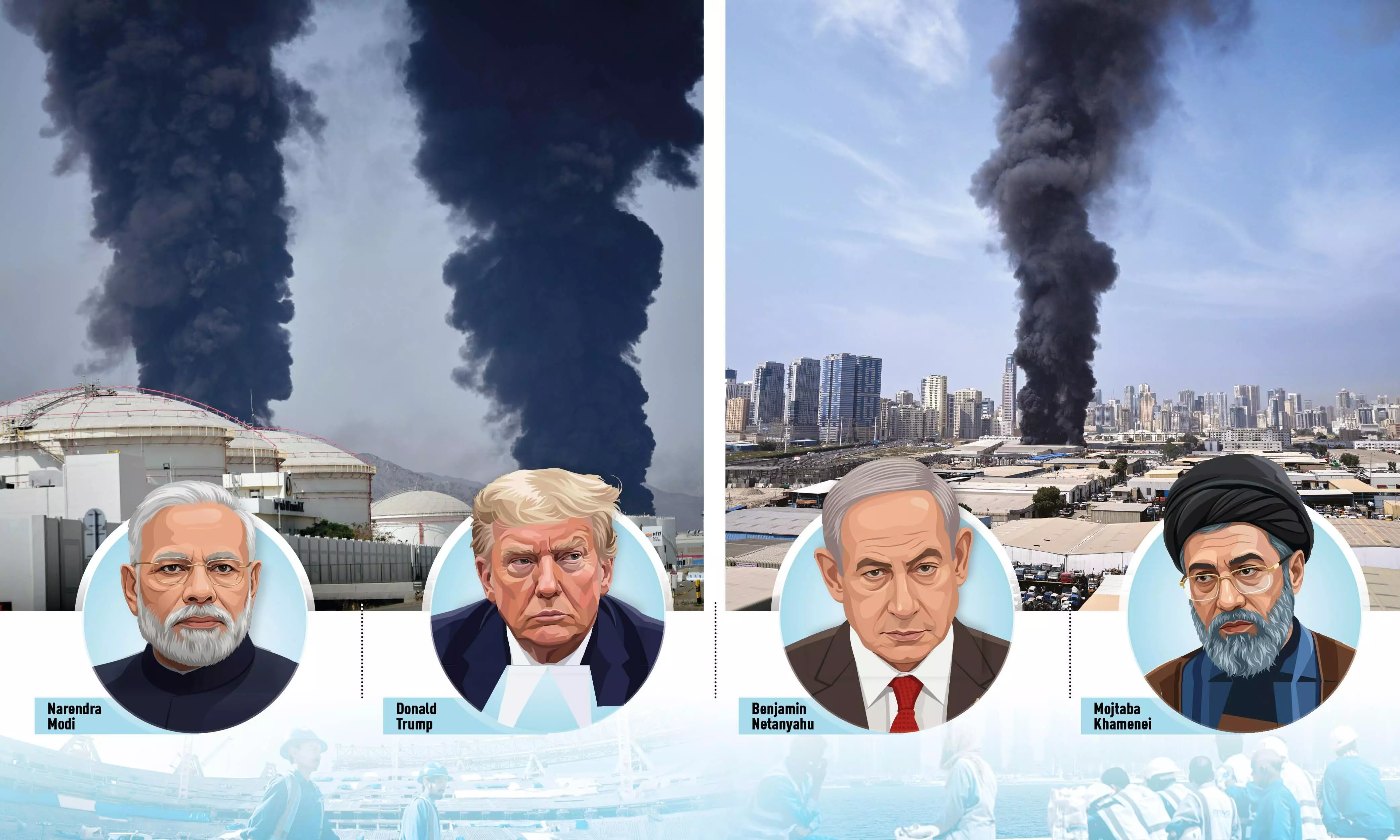
The next day, the Indian Prime Minister, Narendra Modi, left for a two-day (February 25–26) state visit to Israel, which was described as “extraordinarily productive”. Modi’s ill-timed Israel visit has put India firmly in the Israel-US camp, as US President Donald Trump, on Saturday (February 28, 2026), announced that his country had begun “major combat operations in Iran” after Israel launched strikes. The Indian Prime Minister’s strong support for Israel — refusal to condemn the Israel-US strikes on Iran and delay in condoling the assassination of Iran’s Supreme Leader, a long-time friend of India — has “diminished India’s stature in the eyes of the world”.
Over 50 per cent of the GCC’s population comprises expatriates, with Indians leading at 9.5 million and Bangladeshis at 5 million. India has individual pacts with key GCC members like the UAE and Oman to strengthen economic ties. India-UAE Comprehensive Economic Partnership Agreement (CEPA) was signed in 2022, and India-Oman Comprehensive Economic Partnership Agreement (CEPA) was concluded in 2025. Prolonged war in the Middle East has put millions of the Indian diaspora in a severe crisis.
As per January 2025 data revealed in Parliament, out of the total 17.2 million Non-Resident Indians (NRIs), as many as 9.6 million, representing 55.76 per cent of global NRIs, reside in the Middle East. The size of the Indian community in GCC countries stands at 9.54 million. Out of this, the UAE hosts more than 30 lakh Indians, Saudi Arabia over 30 lakh, and Kuwait over 1 lakh. Qatar and Oman host over 5 lakh each, while Bahrain has the smallest number in the GCC.
In that regard, despite the prolonged conflict — which has intensified since October 7, 2022 — Israel hosts 1,23,000 Indians. Before the 12-day Israel-Iran conflict in June, Iran had over ten thousand Indians, most of them being religious pilgrims and students. Iraq, which is slowly limping towards normalcy after decades of internal turmoil, has over 17,000 Indians, while resource-scarce Jordan is home to over 16,000 Indians.
India is the world’s largest recipient of remittances, with record-high inflows amounting to USD 135 billion (EUR 117 billion) in 2025. India took in nearly USD 40 billion in remittances from GCC countries alone, accounting for about 38 per cent of its total inflows. The UAE accounted for around 20 per cent of total Indian remittance inflow.
Gulf countries in crisis
After four weeks of the US-Israel joint invasion of the Islamic Republic of Iran, the war situation has turned complicated. In a strategic move, Iran has targeted Gulf countries, which act as vassal states of the USA and allow US military bases for the protection of their oil infrastructure and the ruling Arab monarchs of Saudi Arabia, the United Arab Emirates (UAE), Bahrain, Kuwait, Qatar, and Oman.
In retaliation, Iranian forces have launched attacks in the Middle East where US troops are deployed, as well as Israeli military facilities in Tel Aviv and other parts of Israel. So far, Iran has launched strikes across nine countries in the region: Bahrain, Iraq, Jordan, Kuwait, Oman, Qatar, Saudi Arabia, and the UAE. An Iranian drone also struck a runway at a United Kingdom military base in Cyprus.
Tehran sees several GCC monarchies not as neutral neighbours but as part of a wider US-led security architecture in the region. That perception is influenced by the long presence of Western military bases and by the political afterlife of the Abraham Accords, which began formal normalisation between Israel and the UAE and Bahrain in 2020. In Iran’s view, the Gulf cannot claim neutrality while remaining tied to American security power and, in some cases, to new arrangements with Israel, observes The Hindu.
Iranian missile strikes sparked fires near luxury hotels and data centres in Dubai, caused panic at Kuwait’s international airport, and put Saudi Arabia’s largest oil refinery out of commission. Qatar has shut down its liquefied natural gas (LNG) exports. Oman suffered successive Iranian drone attacks targeting its Duqm port complex. Bahrain’s oil installations have also been attacked.
Desalination plants in the GCC countries are most vulnerable at this stage, as all six Gulf Cooperation Council (GCC) nations critically rely on desalination plants for their water supply. Desalination fulfils 77.3 per cent of total water demand in Qatar, 67.5 per cent in Bahrain, 52.1 per cent in the UAE, 42.2 per cent in Kuwait, 31 per cent in Oman, and 18.1 per cent in Saudi Arabia. Desalination facilities in Kuwait and the United Arab Emirates (UAE) suffered indirect damage from missile and drone strikes early in the conflict.
For these oil-exporting GCC countries, there is an immediate concern that the Houthis in Yemen, either for their own interests or at Iran’s behest, might enter the conflict. If the group does get involved, it would likely do so by restarting attacks on ships transiting the Red Sea and the Bab al-Mandeb Strait — threatening the flow of an additional 12 per cent of international seaborne oil transits and 8 per cent of global liquefied natural gas trade. For shipping companies, these attacks would add to the already rising costs from the closure of the Strait of Hormuz, through which 20 per cent of global oil and gas tankers pass.
Contradictions within GCC: UAE — a ‘Zionist Trojan horse’
In a scathing article published a few weeks before the war by Saudi academic and former Shura Council member Dr Ahmed bin Othman Al-Tuwaijri, the Emirates is described as exploiting its alliances with Zionist Israel to challenge Saudi Arabia and other major Arab powers. Al-Tuwaijri argues that the UAE’s strategic alliance with Israel is motivated by long-standing animosity towards Saudi Arabia, jealousy over its religious, geopolitical, and economic stature, and a misguided attempt by Abu Dhabi to assert regional dominance. He characterises the Emirati-Israeli partnership as a calculated betrayal of Arab and Islamic unity, stating that Abu Dhabi has “thrown itself into the arms of Zionism,” serving as a “Zionist Trojan horse” within the Arab world, enabling Israeli influence and destabilising the region to serve Tel Aviv’s ambitions.
A week before the invasion of Iran, Mike Huckabee, the United States Ambassador to Israel — an avowed Christian Zionist and staunch defender of Israel — suggested that he would not object if Israel were to take most of the Middle East, stressing what he described as the Jewish people’s right to the land. Such a swath would encompass modern-day Lebanon, Syria, Jordan, and parts of Saudi Arabia.
It is alleged that Benjamin Netanyahu’s recognition of “Somaliland” in December 2025 — a breakaway part of Somalia — represents the culmination of a long and complex trajectory of clandestine relations, and comes as part of a broader regional project to redraw maps of influence in the Horn of Africa and the Red Sea in ways that serve the interests of Tel Aviv and its trusted allies, foremost among them Abu Dhabi. Notably, the UAE had previously sought to secure international recognition for Somaliland through the United Nations, though these efforts failed. These initiatives formed part of a wider Emirati strategy to construct an empire of influence centred on control over ports, strategic waterways — including the Red Sea and the Gulf of Aden — military bases, and key trade and energy routes, in coordination with the United States and Israel.
This explains why no country, other than Israel, has been hit harder by Iran than the United Arab Emirates. It appears Iran is looking to inflict maximum regional and global pain, testing a state that has positioned itself as an ally of Israel and the USA, the Gulf’s safest bridge between East and West, and the future of the region.
Observations
The future of millions of Indian and other South Asian citizens earning their livelihood in the Middle East region, especially in the Gulf countries, is uncertain at this stage, as millions of South Asian workers in the Middle East provide a vital economic boost by sending money home. Economists warn these flows would be at risk if a protracted conflict dents the Gulf region’s economies. Most people killed in Iran’s Gulf attacks have been from South Asia, and entire economies back home are on edge, reports Al Jazeera.
The present crisis will accelerate the shift of global energy demand from fossil to non-fossil fuels, reducing the economic importance of oil- and gas-rich Gulf countries. China’s State Grid will spend 4 trillion yuan (USD 574 billion) to upgrade the country’s power grid between 2026 and 2030, a 40 per cent increase in spending, state-run Xinhua news agency said. This massive project aims to boost west-to-east power transmission, integrating renewable energy with 15 new Ultra-High Voltage (UHV) lines to meet carbon reduction goals. With the drop in demand for petroleum, the hegemony of the petrodollar is bound to decline.
Global capital is likely to migrate to safer havens. Colombo Port City in Sri Lanka may emerge as an alternative to Dubai, Abu Dhabi, and Muscat. Colombo Port City, developed by China Harbour Engineering Company (CHEC) as a flagship Belt and Road Initiative (BRI) project, aims to facilitate connections to the South Asian market through investment opportunities, international business environments, world-class infrastructure, and high-quality sustainable living. Sri Lanka is already offering tax holidays of up to 15 years and positioning Colombo Port City as a new financial and trade hub as it seeks to attract UAE investors.
In an emerging new world order, the Zionist dream of ‘Greater Israel’ in the Arabian region of the Middle East and North Africa (MENA) does not look feasible in the near future. The dream map of the “Proposed Boundary of ‘Greater Israel’” marks an area including all of Jordan, Lebanon, Syria, and the Sinai Peninsula; the Nile delta region of Egypt along the Suez Canal and northwest of Cairo; and virtually all of Iraq, including access to the Persian Gulf. It also includes a large portion of north-western Saudi Arabia, a corridor well over 100 miles wide along the Red Sea, stretching south more than 450 miles from the Gulf of Aqaba to the Holy City of Medina. Nonetheless, the existing Zionist state of Israel is becoming increasingly isolated across the world, including in the USA.
Although Iran, a member of the BRICS+ bloc, has asked India, which holds the rotating chairmanship of BRICS this year, to support its bid to condemn the joint US and Israeli military campaign against it, New Delhi has so far resisted calls to intervene. India’s alignment with Israel and the USA during this Iran crisis has raised questions about its ethical voice on the principles of sovereignty, anti-colonialism, and global justice.