Future of Warfare
As artificial intelligence becomes central to military planning and targeting, the infrastructure that powers the digital economy — data centres, cloud systems and AI platforms — is increasingly emerging as a strategic battlefield
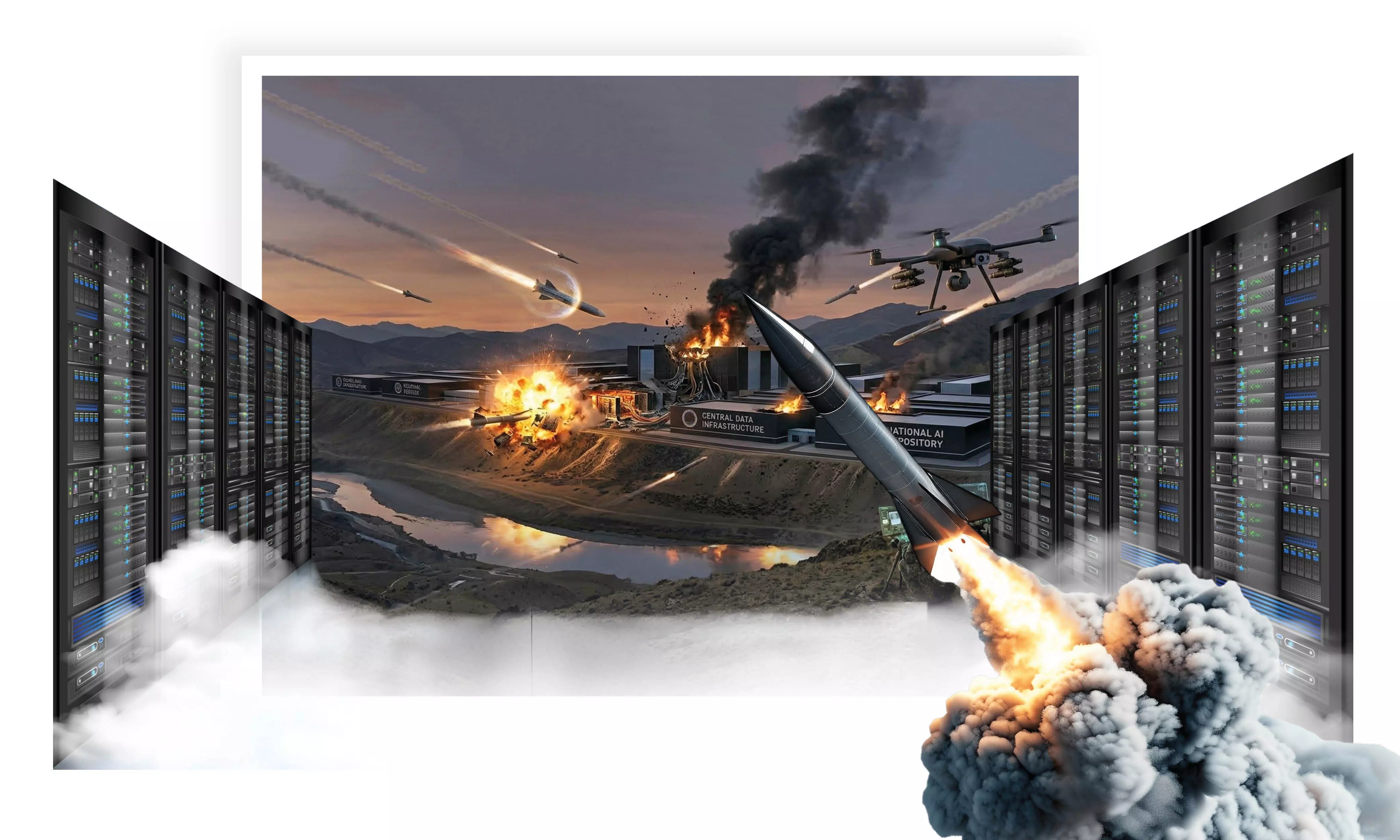


Data centres — the physical buildings that house all the infrastructure required to power banking apps, cloud services, and artificial intelligence platforms — are the new targets during the ongoing war involving Israel, the USA, and the Islamic Republic of Iran. Amazon said two of its data centres in the United Arab Emirates (UAE) were hit by drone strikes on March 1, and a third centre in Bahrain was damaged by debris from a nearby strike. Iran’s Islamic Revolutionary Guard Corps (IRGC) claimed responsibility for the attacks, telling their state media that the attacks were ‘aimed to identify the role of these centres in supporting the enemy’s military and intelligence activities’. The strikes swiftly brought the war directly into the lives of 11 million people in the UAE, nine out of 10 of whom are foreign nationals. Millions of people in Dubai and Abu Dhabi woke up the next morning unable to pay for a taxi, order food delivery, or check their bank balance on their mobile apps. Iran warned that US tech firms, including Google, Microsoft, and Palantir, could become targets as the war expands.
Rising use of AI in war — a contentious trend
AI’s unprecedented use in the Iran crisis signals profound changes in the way the world wages war. The U.S. military was able to strike a blistering 1,000 targets in the first 24 hours of its attack on Iran, thanks in part to its use of artificial intelligence. The military has used Claude, the AI tool from Anthropic, combined with Palantir’s Maven system, for real-time targeting and target prioritisation in support of combat operations in Iran and Venezuela.
According to experts, military AI refers to a huge collection of different systems and tasks. The two main categories of military AI are: automated weapons and decision support systems. Automated weapon systems have some ability to select or engage targets by themselves. Decision support systems, in contrast, are now at the heart of most modern militaries. These are software applications that provide intelligence and planning information to human personnel. Many military applications of AI, including in current and recent wars in the Middle East, are for decision support systems rather than weapons. Claude is embedded in the Maven Smart System, used widely by military, intelligence, and law enforcement organisations. The Israeli Lavender and Gospel systems used in the Gaza war and elsewhere are also decision support systems.
Anthropic's AI tool Claude is playing a key role in the U.S. military's campaign in Iran, observes the Washington Post. Anthropic’s Claude has reportedly been vital to the massive and intensifying offensive, which has already killed an estimated thousand-plus civilians in Iran. This is an era of bombing “quicker than the speed of thought”, with AI identifying and prioritising targets, recommending weaponry, and evaluating legal grounds for a strike, experts told The Guardian.
Anthropic PBC — founded in 2021 by seven former employees of OpenAI — is an American artificial intelligence (AI) company headquartered in San Francisco. As of February 2026, Anthropic has an estimated value of USD 380 billion. It operates as a public benefit corporation that researches and develops AI. In September 2023, Amazon announced a partnership with Anthropic. As part of the deal, Anthropic uses Amazon Web Services (AWS) as its primary cloud provider and makes its AI models available to Amazon Web Services customers.
In September 2025, Anthropic announced that it would stop selling its products to groups with majority shares owned by Chinese, Russian, Iranian, or North Korean entities due to national security concerns. In October 2025, Anthropic announced a cloud partnership with Google, and in November 2025, NVIDIA, Microsoft, and Anthropic proclaimed a partnership deal. NVIDIA and Microsoft were expected to invest up to USD 15 billion in Anthropic.
Recently, Anthropic has become the central actor in a high-profile fight with the US Department of Defence (DoD) over the company’s refusal to allow Claude to be used for domestic mass surveillance and autonomous weapons systems that can kill people without human input. Amid tense negotiations, the AI firm rejected a Pentagon deadline for a deal last week, in a move that led Pete Hegseth, the defence secretary, to accuse Anthropic of “arrogance and betrayal” of its home country. Meanwhile, Trump denounced Anthropic in an interview, saying he “fired them like dogs”. On Thursday, the DoD formally declared Anthropic a supply-chain risk and demanded that other businesses cut ties — the first time an American company has ever been targeted, which poses grave financial consequences for the company if fully enacted.
Significantly, Anthropic’s integration into the military began with a 2024 deal with Palantir to allow Claude to be used within its systems, which already operated in classified environments. The two companies touted the agreement as a way to drastically reduce the resources and time needed for military operations and intelligence gathering. The following year, Anthropic, along with several other major AI companies, struck a USD 200m deal with the DoD to use their AI tools for military operations.
Anthropic’s recent standoff with the DoD is seen by tech analysts as reflecting the AI firm’s inherent contradictions. It is a company founded on the premise of ‘creating a safe future for AI’, which has nevertheless struck major partnerships for classified work with the Pentagon and surveillance tech giant Palantir. Its leadership now says it is deeply worried about the existential risks of AI, though they recently dropped a founding safety pledge, citing the speed of industry competition, observes The Guardian.
A group of experts argues that increasing military use of AI is essentially making humans more important in war, not less. People have preferences, values, and commitments regarding real-world outcomes, but AI systems intrinsically do not. The incident of the Tomahawk cruise missile that struck a girls’ school adjacent to an Iranian naval base, killing about 175 students, is a case in point.
Data Centers — a new hazard
Data centers are the critical physical infrastructure powering the AI revolution. An AI data center is a facility that houses the specific IT infrastructure needed to train, deploy, and deliver AI applications and services. According to IBM, it has advanced compute, network, and storage architectures and energy and cooling capabilities to handle AI workloads. While traditional data centers contain many of the same components as an AI data center, their computing power and other IT infrastructure capabilities vary greatly.
Though the board members and senior executives of mega corporations increasingly recognise that data centers have become a core part of their operations, a single security breach can damage client trust, disrupt business operations, and even result in financial penalties or regulatory action. In addition to the digital and physical security threat, mega data centers pose a serious environmental threat to the locations where they are placed.
As the use of AI proliferates, environmental policy analysts, academic researchers, and others are raising concerns about the impacts the data centers powering the technology are having on communities, ecosystems, and the climate. Among those concerns are the immense energy and water resources the centers require and the air, light, noise, and other pollution they generate. By 2030, data centers’ global electricity use is estimated to more than double to 945 terawatt-hours, a little more than Japan’s total electricity consumption in 2024, according to a report published in April 2025 by the International Energy Agency.
The environmental footprint of AI data centers is well documented. It is observed that as energy demand increases, the companies behind AI lean on dirty sources such as gas and coal to keep things running. One proposed data center facility in New Mexico is called Project Jupiter. Developers intend to generate 2,880 megawatts at the facility using “simple-cycle gas turbines” to power two “microgrids” at the projected USD 165 billion campus. Local advocates are opposing the construction on environmental grounds. Tech giants such as Meta, Microsoft, and Google have turned to nuclear power for a steady supply. The low cost of solar and wind power remains highly competitive, but their share of the power supply for data centers remains relatively low compared with natural gas.
Powerful computers that run A.I. also get extremely hot. So, to keep them from overheating, data centers cool them with powerful air-conditioning systems that are run by water. In March 2024, Forbes reported that the water consumption associated with a single conversation with ChatGPT was comparable to that of a standard plastic water bottle. Even a mid-sized data center consumes as much water as a small town, while larger ones require up to 5 million gallons of water every day — as much as a city of 50,000 people.
Growing protest against Data Centers
As tech companies build data centers worldwide to advance artificial intelligence, vulnerable communities have been hit by blackouts and water shortages. A report by the Data Center Watch reveals that between May 2024 and March 2025, USD 18 billion worth of data center projects were blocked, and another USD 46 billion of projects were delayed over the last two years in the face of opposition from residents and activist groups. There are at least 142 activist groups across 24 states in the USA organising to block data center construction and expansion.
Nearly 60 per cent of the 1,244 largest data centers in the world were outside the United States as of the end of June 2025, according to an analysis by Synergy Research Group, which studies the industry. More are coming, with at least 575 data center projects in development globally from companies including Tencent, Meta, and Alibaba. From Mexico to Ireland, fury mounts over a global AI frenzy. In Ireland, data centers consume more than 20 per cent of the country’s electricity. In Chile, precious aquifers are in danger of depletion. In South Africa, where blackouts have long been routine, data centers are further taxing the national grid. Similar concerns have surfaced in Brazil, Britain, India, Malaysia, the Netherlands, Singapore, and Spain. The missile attack on the Amazon data centers in the UAE adds a new challenge to the AI industry.