Drops of Inequality
As billions lack safe water, a booming global industry and AI-driven demand are turning a basic human necessity into one of the world’s fastest-growing commodities
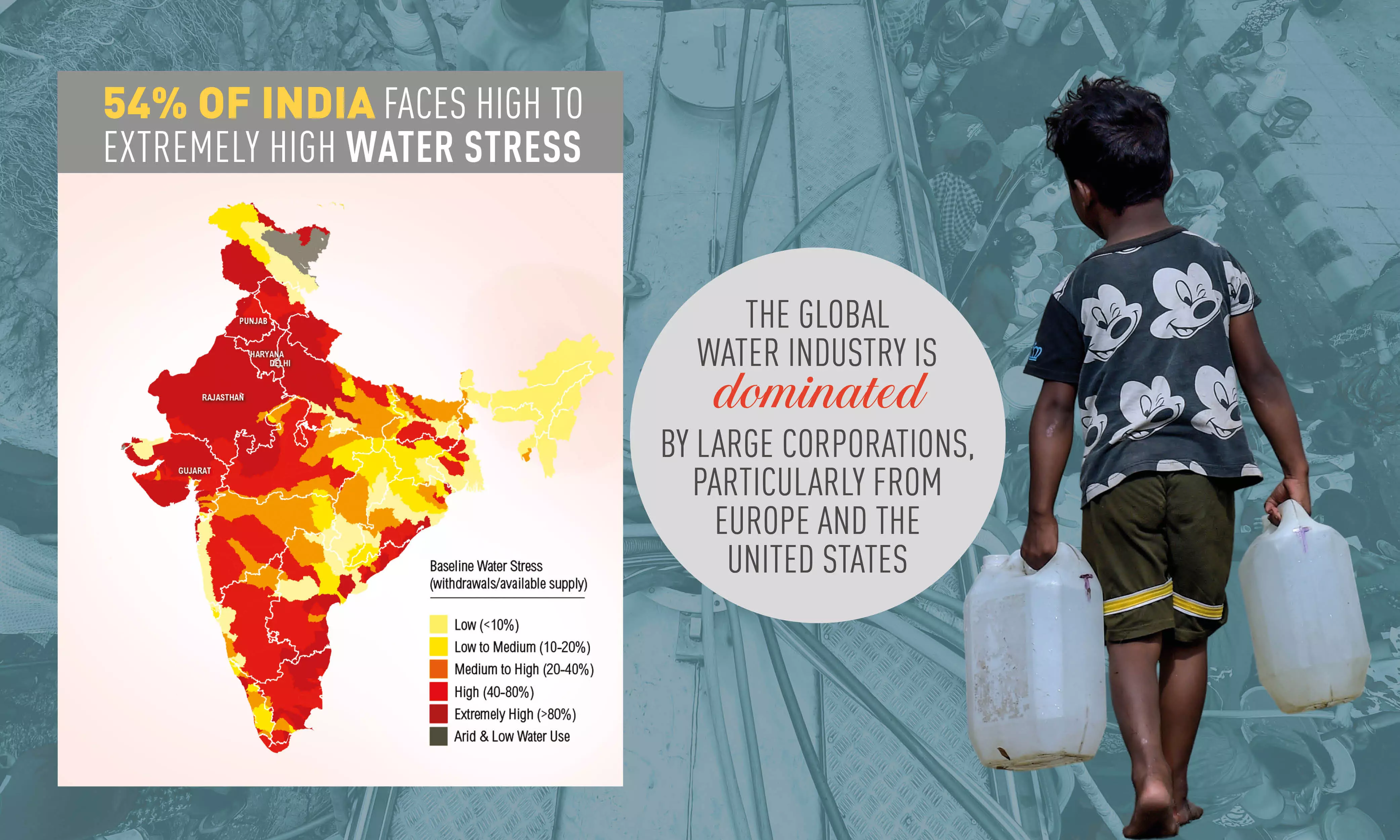


The United Nations ‘World Water Development Report 2026: Water for All People – Equal Rights and Opportunities’, highlights how unequal access to water and sanitation services impacts health, education, livelihoods and safety. Today, 2.1 billion people still lack safely managed drinking water, and women and girls spend an estimated 250 million hours every day collecting water. Unfortunately, privately owned global water utility corporations now control this vital natural resource- essential for the survival of the planet Earth.
Global water industry
Driven by increasing urbanisation, industrial use and the need for advanced water management solutions, the global water and wastewater treatment market size was valued at USD 372.39 billion in 2025 and is projected to grow from USD 400.32 billion in 2026 to USD 713.96 billion by 2034, exhibiting a CAGR of 7.50 per cent during the forecast period.
The water market is segmented by product types, its usages and geographic distribution. The segmentation by product types is: water treatment technologies, desalination plants and smart water management systems. Water treatment technologies lead the mater market by product type with the largest market share by value. Water market segmentation by application is: municipal water supply, industrial water use and agricultural water use. In this segment, the municipal water supply leads the global water market. Region-wise, the water market can be divided into the following segments.
North America dominated the water and wastewater treatment market with a market share of 38.20 per cent in 2025, driven by increasing adoption of smart water management systems, membrane filtration technologies, and a strong focus on water reuse. The U.S. market is projected to reach USD 138.93 billion by 2026.
The Asia Pacific market was valued at USD 140.12 billion in 2025, capturing 37.60 per cent of global revenue, and is estimated to reach USD 152.29 billion in 2026. China and India are witnessing substantial investments in wastewater infrastructure to address water pollution concerns. The Japan market is projected to reach USD 3.96 billion by 2026, the China market is projected to reach USD 99.8 billion by 2026, and the India market is projected to reach USD 23.3 billion by 2026. India has the 5th largest water and wastewater treatment market in the world, valued at approximately $11 billion. It is expected to grow to over $18 billion by 2026. With 18 per cent of the world’s population but only 4 per cent of the world’s water sources, India grapples with water scarcity in many regions.
Europe accounted for USD 60.78 billion in 2025, representing 16.30 per cent of the global market share, and is projected to reach USD 64.67 billion in 2026.
The UK market is projected to reach USD 11.09 billion by 2026, while the German market is projected to reach USD 11.77 billion by 2026.
The market in Latin America and the Middle East & Africa is expected to experience considerable growth due to increasing regulatory pressure and infrastructure development initiatives. The water market in the Middle East & Africa reached USD 16.51 billion in 2025, representing 4.40 per cent of total market revenue, and is projected to reach USD 17.18 billion in 2026.
In 2025, the South American market stood at USD 12.73 billion, representing 3.40 per cent of global demand, and is projected to grow to USD 13.66 billion in 2026.
Water in the “AI economy”
One of the major drivers of the water industry is the rising demand for water in the “AI economy”. Data centres are often the most visible AI water consumers. Even with efficient cooling, a single hyperscale data centre (~130 megawatts) can use 171 million litres of water annually. But what is less visible is that AI-related chip manufacturing and power generation consume even more water than data centres. Taken together, these three sectors make up an “AI economy” whose demand for water is rising rapidly.
At present, the AI economy consumes 23 cubic kilometres of water a year. By 2050, this is predicted to more than double (up 129 per cent) to more than 54 cubic kilometres (roughly 14 trillion US gallons), according to new research by Global Water Intelligence and Xylem. In other words, our world needs to find an extra 31 cubic kilometres of water a year for the AI economy to run. That’s enough to supply every human being on Earth with an extra 3,820 litres of freshwater a year.
Growing market for desalination water plants
The market for desalination water plants is growing very fast and is projected to grow at 9.5 per cent and reach the $32 billion mark by 2025. Desalination plants turn saltwater from the oceans into freshwater for human use. Saudi Arabia is the global leader in water desalination, producing roughly 22 per cent of the world’s desalinated water. The kingdom hosts the largest plants, including the Ras Al-Khair and Shuqaiq facilities. The Middle East overall leads with 60 per cent of global capacity, heavily relying on seawater reverse osmosis (SWRO) for water security. Saudi Arabia- the world’s largest producer with over 30 major plants and massive expansion projects. UAE- operates high-capacity plants like Jebel Ali and Taweelah, with nearly 90 per cent of its drinking water derived from desalination. Israel- a technological leader, with plants like Sorek Desalination Plant providing a significant portion of national demand. In Israel, six desalination stations supply around 800 million cubic meters of water, thus meeting 70 per cent to 80 per cent of the country’s potable water needs. A seventh station, located in the Western Galilee, is planned to come online in 2027 and provide an additional 100 million cubic meters.
The desalination companies like Veolia Water, Metito, Acciona Agua, American Water Works, General Electric company and Doosan Heavy continue to expand their horizons with new inventions and innovations in the desalination sector. Major desalination companies are focusing on the Middle East and Asian regions (refer to Table 1) that receive scanty rainfall and are rich sources of seawater to conduct the desalination process.
Experts see a future where industrially useful minerals such as sodium chloride salt, magnesium and calcium are extracted from the seawater alongside clean water, and no highly-salty wastewater - known as brine. As focus shifts towards green investments, several oil and gas and utilities sector investments are becoming less attractive. Even as investors pull out of the largest energy companies for renewable alternatives, investors are looking to invest in the top desalination companies, and it is fast becoming one of the upcoming green investment channels to look out for.
Dominance of European and US companies
Europe and USA-based major water utility companies dominate the global water industry (Table 2). Veolia SA and Suez SA –the two French companies were established in 1853 and 1880, respectively. Xylem Inc was established in 1911. Veolia, the oldest company, is the industry leader. A few Chinese companies, like Beijing Enterprises Water Group- a leading water utility service provider operating numerous projects and serving a large population and Beijing Capital Co Ltd.-a significant player in the Chinese municipal water market, are emerging players in this fast-growing industry.
As a result of increased urbanisation in 19th-century Europe, the traditional reliance on water from wells, water vendors or other sources was replaced by a centralised water supply system. This occurred in 1802 in Paris, 1808 in London and 1856 in Berlin. In New York, a major epidemic of yellow fever struck in 1795. The public blamed the poor quality of ‘tea water’ and filthy wells for this epidemic. Under public pressure, the city turned to the private sector to provide clean drinking water. Hence, the Manhattan Company, which later became the Chase Manhattan Bank, was formed to deliver water in the city.
During its first industrial revolution in the 16th century, London was unwilling to spend more on public works and therefore called on the private sector. By the 19th century, the water supply was concentrated in nine water companies.
In the aftermath of a major cholera outbreak in 1840, the water companies became regulated entities. They were required to supply continuous filtered piped water to residences. In 1902, with the Metropolis Water Act, the water entities were municipalised. In 1861, the share of private provision of water supply in larger towns was 60 per cent, which decreased over time, reaching 20 per cent in 1881 and only 10 per cent in 1901. During the period 1900-1974, the municipalities were in charge of the water supply, with the exception of 20 per cent of the population who were supplied by private water companies.
One of the main reasons why so many developing countries decide to involve the private sector in water and other infrastructure is the influence and persuasiveness of international donors, like the World Bank, UNDP, WTO, IMF, Bill Gates, Melinda Gates Foundation, et al, that support such policies. Since the early 1990s, the Bank has adopted a strong position in favour of privatised water. This was promoted through policy reports, support for joint initiatives (such as the Global Water Partnership and World Water Council) with water multinationals, and through loan conditionalities or policy-based lending, observes Naren Prasad, UNRISD.
Thanks to the global corporations, water has become a fast-growing economic commodity over the last two centuries.