Breaking ‘Sarpanch Pati Raj’
Despite three decades of constitutional reservation ensuring women’s entry into grassroots politics, real power often remains with husbands who operate as “proxy rulers.”
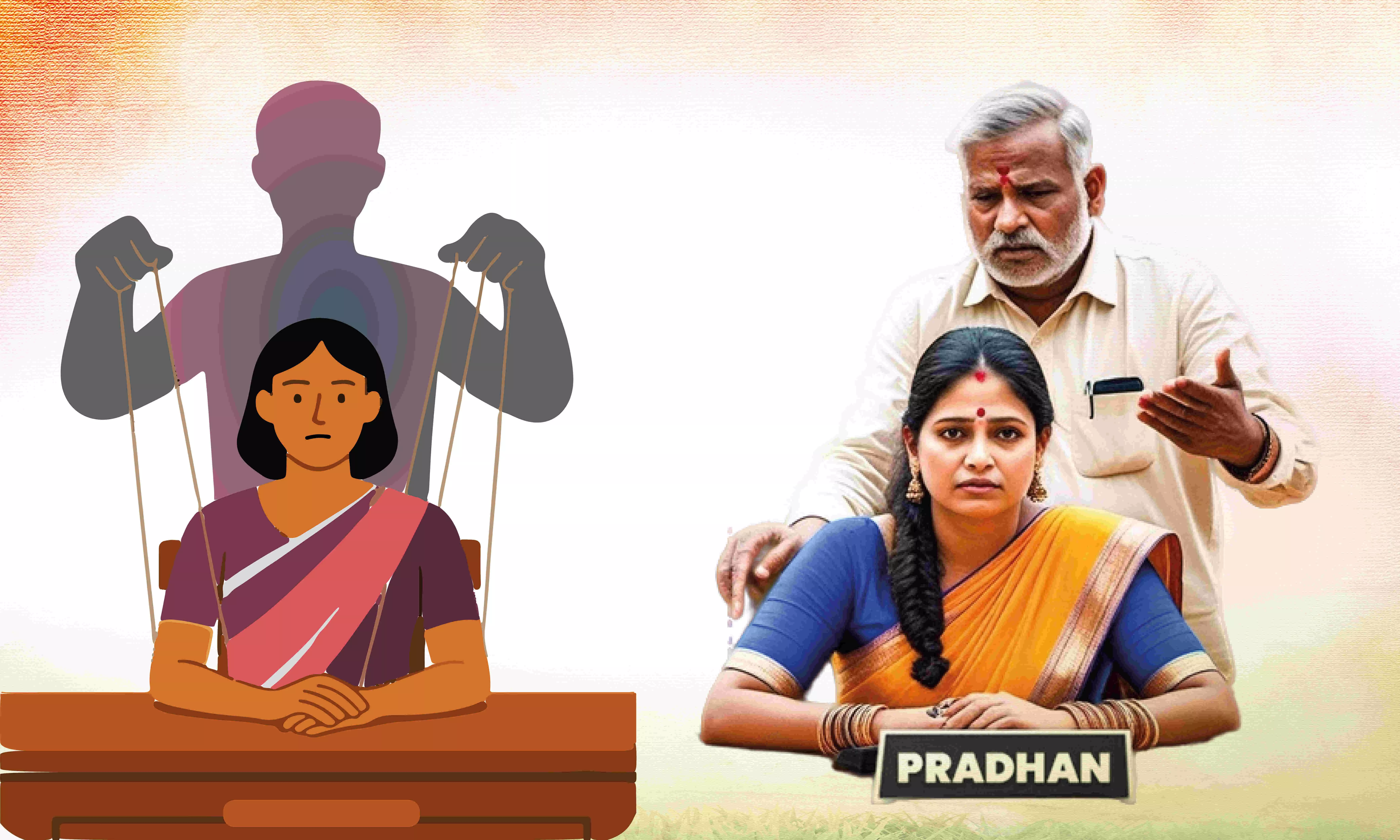


The ‘Sarpanch Pati’ phenomenon is an unconstitutional practice of husbands and other male relatives of elected women Sarpanches exercising authority on their behalf.. Disapproving of this practice of proxy representation, the National Human Rights Commission (NHRC) has issued conditional summons to 32 states, including the Union Territories. The Commission thus directed its Registry to issue Conditional Summons to the Principal Secretary, Department of Urban Local Bodies and Principal Secretary, Department of Panchayati Raj, of Arunachal Pradesh, Assam, Chhattisgarh, Goa, Gujarat, Haryana, Himachal Pradesh, Jharkhand, Karnataka, Kerala, Madhya Pradesh, Maharashtra, Manipur, Meghalaya, Mizoram, Nagaland, Punjab, Rajasthan, Sikkim, Tamil Nadu, Telangana, Tripura, Uttar Pradesh, West Bengal, Andaman and Nicobar Islands, Chandigarh, Dadra and Nagar Haveli, Daman and Diu, Delhi (National Capital Territory), Jammu and Kashmir, Ladakh, Lakshadweep and Puducherry. The above-mentioned authorities are directed to appear before the Commission on December 30, 2025, with Action Taken Reports on the steps taken by the respective governments to eliminate the unconstitutional practice of ‘Sarpanch Pati’. A few states, including Andhra Pradesh, Bihar, Odisha, and Uttarakhand, have already submitted their responses. The Commission, in its letter, mentioned the rising concerns regarding the persistent violations of constitutional mandates and human rights in the functioning of Panchayati Raj Institutions (PRIs) and Urban Local Bodies (ULBs), particularly in constituencies reserved for women.
The issue of Pradhan Pati, or Sarpanch Pati, or Mukhiya Pati, symbolises a mode of proxy politics that is prevalent across the country but is more pronounced in some particular pockets and regions. Pradhan Pati does not only mean husbands, but includes male relatives exercising real political power, leaving the officially elected women leaders to function as mere figureheads. It is socio-culturally acceptable for men to act as proxies for their wives, sisters, or daughters-in-law. Pradhan Pati practices are creating structures of irresponsible governance at the Panchayats, as it pushes and often creates parallel paths and informal structures, promotes proxy participation, fostering misuse of funds, sustaining corruption, and inducing ineffective governance, and defeating the goal of accountable and transparent governance by the local self- government institutions like the Panchayats, observes the Advisory Committee Report (2025), Ministry of Panchayati Raj, Government of India.
Genesis of the Sarpanch Pati practice
The Sarpanch Pati phenomena originated after the government made reservations for women in the rural panchayat and urban local bodies. The gender mandate was intended to increase grassroots representation of women in politics and increase the distribution of decision-making. After years of debate on women’s reservation, the historic 73rd and 74th amendments to the Constitution, in 1992, mandated that all state governments reserve one-third of seats for women in local rural bodies (i.e., within Panchayati Raj institutions) and one-third of the offices of the chairperson at all levels of the newly created Panchayati Raj institutions, as well as in urban local bodies. Additionally, one-third of these seats would be reserved for women who identify as part of the historically marginalised SC/ST population. A few states like Bihar (the first Indian state), Andhra Pradesh, Chhattisgarh, Jharkhand, Kerala, Maharashtra, Odisha, Rajasthan, Tripura, Uttarakhand, and West Bengal, have made legal provision for 50% reservation for women among members and Sarpanches. Currently, India has over 15 lakh Women Elected Representatives (WERs), constituting approximately 46.6% of the total elected representatives in Panchayati Raj Institutions (PRIs). Additionally, 21 States and 2 Union Territories (UTs) have expanded this Constitutional provision and extended reservation for women to the extent of 50%.
However, the prevalence of patriarchal norms, limited enforcement of legal safeguards, and socio-cultural barriers have hindered women’s effective participation and leadership in Rural Local Bodies (RLBs). Even after three decades of reservation, the prevalence of Sarpanch pati phenomena indicates about the resistance women faces in exercising their constitutional rights in a male dominated socio-political culture of India.
In 2015, at an event to mark the National Panchayati Raj Day, PM Modi called for an end to the practice of “husbands of women sarpanches” or “sarpanch pati” exercising undue influence on the work of their wives elected to power. Recalling a political event in which someone told him that he was an SP (sarpanch-pati), the PM said, “This business of SP is going on. The law has empowered women. When the law has given them the rights, they should also get an opportunity. Bring to an end this SP culture. They (women) should be given the chance. They should be promoted. But no corrective measure was taken by the government till the Supreme Court intervened in 2023.
Initiatives to address the issue
In July 2023, the Supreme Court of India was approached by the Mundona Rural Development Foundation, an NGO, regarding the issue of “sarpanch-patism” in the panchayat system. Reacting to the complaint, the Supreme Court observed that the government should look into the problem of men often wielding the actual power behind elected women who remain “faceless wives and daughters-in-law” in grassroots politics. The honourable judges also advised the NGO to make a representation before the Ministry of Panchayati Raj. They urged the government to take appropriate action to empower women and implement reservation objectives.
The Ministry of Panchayati Raj (MoPR), acknowledging the seriousness of these challenges, and in compliance with the Supreme Court’s advice, constituted an ‘Advisory Committee on Women Pradhans’ that was formed in October 2023 to examine and address issues related to proxy participation and empowerment of women as genuine grassroots leaders. In their first report on ‘Transforming Women's Representation and Role in Panchayati Raj Institutions: Efforts to Eliminate Proxy Participation’, released in February 2025, the Committee identified the following major challenges the women elected representatives (WERs) face in Panchayati Raj Institutions (PRIs). Committee's interactions with the State Governments and field visits involving interaction with WERs/Women Pradhans, revealed the following nine challenges: (i) Lack or Inadequate Experience of Political Leadership, (ii) Gender-Based Discrimination, (iii) Prevailing Patriarchal norms and practices, (iv) Political Pressure, (v) Socio-economic and cultural disadvantages, (vi) Pressure of balancing their public life with domestic responsibilities, (vii) The WERs in most Panchayats face lack of or limited opportunities and access to rapid and customized capacity-building training, (viii) The principle of rotational reservation of seats, whereby, WERs are allowed only a tenure of 5 years., (ix) Due to socio-cultural reasons combined with lack of education and experience, and subsidiary/subject partner roles assigned in families, the WERs are hesitant in taking financial decisions independently.
The committee has recommended “exemplary penalties should be enforced for proven cases of proxy leadership, deterring male relatives’ interference”. It called for policy interventions and structural reforms, including initiatives such as gender-exclusive quotas in some panchayat subject committees, ward-level committees, appointing women’s ombudspersons, setting up a federation of women panchayat leaders, and gender resource centres to serve as hubs for leadership training, legal advice, and support networks.
One of the significant suggestions that the committee secured from its field visits was that minimum school-level education should be made mandatory for contesting elections to the post of “panchayat president”. Though the committee recorded this in its report, it’s not part of the nine-point final recommendations. The Haryana government had introduced a law setting a “minimum” education for eligibility to contest a panchayat election. For women, it was the completion of Class 8. The Supreme Court of India in December 2021 also upheld the law. The panel also recorded that one of the suggestions it received was “minimum school-level education should be made mandatory for contesting elections for Panchayat President, irrespective of gender”.
The panel has also recommended constructing a robust accountability and oversight mechanism in the form of “helplines” and “Women Watchdog Committees” for confidential complaints and “whistle-blower rewards” in verified cases. It suggested that the government declare annual awards to be given to ‘anti-pradhan pati champions’, and national awards for exceptional women leaders on Republic Day, which might inspire grassroots leadership and create role models.
Following the Advisory Committee’s suggestions, MoPR has collaborated with The Viral Fever (TVF) for the production of a series of compelling digital content that addresses critical issues affecting local rural governance. The first of these productions, “Asli Pradhan Kaun?” premiered on March 4, 2025, coinciding with the launch of the Ministry’s “Sashakt Panchayat Netri Abhiyan”. “Asli Pradhan Kaun?” addresses the issue of ‘Sarpanch Pati’ culture, where male family members unofficially represent elected women leaders. The film was screened at Vigyan Bhawan, New Delhi, before an audience of over 1,200 elected women representatives of Panchayati Raj Institutions from across the country.
Barriers to women
In an issue (2023) of Seminar Magazine, which focused on the political representation of women in India, Rachel Brulé, Simon Chauchard and Alyssa Heinze in their article titled; ‘Are husbands the problem?’ argued, drawing on their long-term study of Panchayati Raj Institutions (PRI) in several hundred villages since 2018, they did not believe that the hurdles women face in exercising their legally mandated roles in elected government could be reduced to a problem of sarpanch-patism, nor that sarpanch-patism constitutes the central limitation to the ability of female local officials to implement better policies.
According to them, gendered hierarchies and patriarchal norms are certainly pervasive in the daily interactions that constitute local politics. The 73rd amendment that mandated women’s political representation has catalysed deep resistance and magnified patriarchal control – empowering sarpanch-patis in some families. But it has also nurtured cooperation and support in other ways that actually reconfigure families, thus complicating the narrative. The hurdles Indian women face in exercising their legally mandated roles in elected government cannot be reduced to the problem of husbands assuming their responsibilities. While patriarchal gender norms within some households constrain the emergence of effective female leadership, it is the institutional design of local government that elevates barriers to women in politics or enables the reproduction of existing barriers.
Political institutions – from the structure of local elections, to the composition of committees, to the very rules of deliberation – guarantee women’s symbolic inclusion but also allow for substantive forms of structural inequality to proliferate. These inequalities affect women as they are not limited to intra-household dynamics. In that sense, the recurrent denunciation of sarpanch-patism by national elites obfuscates the multifaceted political negotiations taking place in gram panchayats to ensure that elected officials from all disadvantaged categories exercise the power they have legally acquired through elections, the authors observe.
According to them, this larger problem may be referred to as ‘proxy politics’ – that is, a perverse form of representative politics in which an elected official lacks either the will or the ability to perform her or his legally required duties, leading another individual to perform them in that person’s place. The sarpanch-pati narrative, while sometimes justified, ignores this larger frame of reference and, as such, frequently overlooks how the dynamics of political institutions (in particular, politics outside of the family) prevent elected women from gaining influence before offering suggestions for policy and public action.
Gender equality in politics is thus only possible if quotas reserving seats for women in government are reinforced by measures to build institutional support for the political agency of women. Specifically, the authors advocate that legislation is urgently required on three fronts: within the rules that structure local, democratic deliberation; within the bureaucracy that supports elected democratic officials; and within the state’s explicit efforts to support officials upon their assumption of elected office.
While legislation helps to break the concrete walls erected around women for centuries, true empowerment of women in a male-dominated society is only possible through the creation of gender neutral institutions across all facets of governance structure.