
Transformative Governance
Under District Magistrate Dr Rajender Pensiya, Sambhal demonstrates how empathy, technology, heritage and data-driven governance can deliver scalable, people-first development
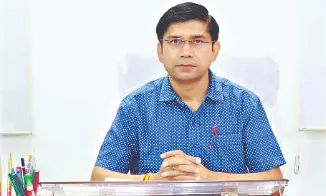


Located in northwestern Uttar Pradesh, Sambhal district is renowned for its vibrant history, cultural diversity, and rich agricultural traditions. Under the leadership of an inspiring and visionary IAS officer, Dr Rajender Pensiya, Sambhal has emerged as a model of transformative governance. Dr Pensiya was the proud recipient of the Nexus of Good Annual Award, 2025. His notable achievements as District Magistrate (DM) of Sambhal include leading sensitive places of rich heritage (68 teerth and 19 koops) and five river restoration projects, ensuring communal harmony, and implementing strong administrative reforms such as the Sambhal Samvaad App, Bharose Ki Parchi, DPMU, Ek Pushp Ek Pustak Abhiyaan, and a plastic-free environment, among others. Under his leadership, flagship initiatives were launched to address challenges in education, infrastructure, environment, heritage, technology, and civic engagement.
1. Ka, Kha, Ga, Gha Mission: Reimagining Primary Education
The schools of basic education in Sambhal had long been affected by low enrolment, poor student attendance, disengaged classrooms, and limited parental participation. Responding to these complex challenges, the “Ka, Kha, Ga, Gha” Mission was launched in July 2024 as a child-centric project aligned with NEP 2020 and NIPUN Bharat.
* Ka for teaching through Kahani (storytelling) and Kalpanasheelata (imagination).
* Kha for Khel or Khilono se Shiksha (learning through play and toys).
* Ga for Geet or Gatividhi (learning through singing and activities).
* Gha for Ghanishthata or Ghar Jaisa Vatavaran (intimacy with the child and a homely atmosphere at school).
The initiative transformed the atmosphere of schools, making them playful, sparking imagination, and making learning joyful. Crucially, it required no extra funding and relied on teacher creativity and community ownership. It covered 1,289 schools, 10 KGBVs, and 1,762 Anganwadis, directly benefiting over 1.5 lakh children. Third-party evaluations revealed a 10 per cent increase in enrolment and over 12 per cent improvement in attendance, with dropouts declining significantly. Parental involvement and school–community ties deepened, and government schools became centres of curiosity, warmth, and growth.
2. PM SHRI Schools Transformation: Infrastructure for Inspiration
The PM SHRI Transformation initiative targeted the chronic neglect of government school infrastructure, which had led to parental distrust and poor enrolment. Sixteen government schools were selected for upgrades ranging from safe campuses to accessible ramps, modular kitchens, green spaces, and digital classrooms. However, the initiative went beyond bricks and mortar. Innovative pedagogical approaches, celebration of local culture, and self-reflection exercises fostered empathy and belonging among students. Model students, such as a specially-abled child named Radha, found new confidence in these refreshed environments. Third-party monitoring confirmed an 18 per cent rise in enrolment and a 22 per cent increase in student attendance, while parents expressed restored faith in public education. Community ownership became a pillar, with Gram Panchayats, parent-teacher meetings, and teacher workshops integrating families into the educational process. All these schools are ISO 9001:2015 certified. Additionally, 16 Sambhal SHRI schools replicated the PM SHRI schools model.
3. Sambhal Samvaad App: Digital Governance for All
The Sambhal Samvaad App revolutionised public service access and citizen engagement in the district. Developed in early 2025 and launched by the Chief Minister of Uttar Pradesh, it offers updated departmental information, schemes, services, complaint redressal, and location-based utilities, placing the government in the palm of every resident’s hand. Unique features include the “Bharose Ki Parchi” for grievance appointments with the District Magistrate and real-time updates from departmental administrators. Citizens can access emergency helplines, directories, certificates, and office details instantly, resolve complaints, and report corruption directly. The app simplifies processes, enhances accountability, and advances Digital India’s goals, with over 5,000 downloads and a stellar 4.9 rating. Its design and effectiveness have set a benchmark for technology-driven, citizen-centric governance.
4. District Project Monitoring Unit (DPMU): Data-Driven Progress
Launched in November 2024, the DPMU is an ICT-enabled project monitoring hub staffed by 18 motivated professionals. It integrates 50 NITI Aayog indicators to drive holistic development in aspirational blocks, covering education, health, nutrition, agriculture, and welfare. Regular monitoring and dashboard-based reporting have led to measurable progress. Between 2024 and 2025, block rankings improved significantly, with Junawai rising from 24th to 1st position and enrolment surging by 9.7 per cent. Infrastructure upgrades, improved health outreach, welfare registrations, and enhanced learning outcomes have all been reported. A third-party evaluation by Careernaksha confirmed these achievements, commending the model for its coordination, transparency, and grassroots inclusivity. The DPMU is also ISO 9001:2015 certified.
5. One District, Five Rivers: Nature, Livelihood, and Revival
Sambhal’s river rejuvenation initiative addressed water scarcity, pollution, and rural unemployment by restoring five major rivers—Sot, Mahaba, Aril, Mahishmati, and Vardhamar—across 138 Gram Panchayats. The programme generated 224,764 person-days under MGNREGA, supporting rural families and planting nearly 38,000 saplings for ecological restoration. The introduction of 30,000 Gambusia fish helped control mosquito-borne diseases, while the removal of silt and encroachments revived water sources for irrigation and biodiversity. Comprehensive inter-departmental coordination made this project a replicable model nationwide. Impact reviews confirmed ecological balance, sustained water flow, and direct livelihood benefits, making it a scalable blueprint for rural environmental management.
6. Heritage and Pilgrimage Reclamation: Restoring Sambhal’s Glory
Sambhal’s historical identity as a pilgrimage and heritage hub had faded over the decades due to encroachment and neglect. This initiative mapped and reclaimed 68 teerth sites, 19 wells (mahakoops), and the ancient 24 Kos Parikrama, recovering 44 hectares for development. Modern techniques such as drone mapping and inter-departmental coordination were used for effective anti-encroachment campaigns. Heritage sites now host local festivals, folklore events, and crafts fairs, boosting tourism and employment. Citizen participation in site identification fostered a sense of ownership, and the revival of rivers alongside pilgrim paths reconnected Sambhal to its spiritual roots. This drive can inspire similar efforts in Mathura, Ayodhya, and Varanasi.
Sambhal’s model demonstrates that effective governance thrives at the intersection of empathy, innovation, and collaboration. From August 2024 to August 2025, enrolment increased by nearly 10 per cent, and attendance improved by nearly 12.1 per cent, supported by the Ka, Kha, Ga, Gha Mission and PM SHRI transformations. Over 1.5 lakh children benefited from joyful, inclusive, play-driven classrooms and modernised infrastructure. River rejuvenation spanned 209 km and generated 224,764 person-days of rural employment, while nearly 38,000 saplings restored environmental balance and boosted agricultural productivity. Heritage restoration reclaimed 68 teerth sites, 19 mahakoops, and revived lost water bodies, strengthening tourism and civic pride. The citizen-driven Sambhal Samvaad App processed thousands of grievances, enabled direct citizen–DM appointments, and enhanced departmental responsiveness, exemplifying participatory digital governance.
These results demonstrate that Sambhal’s integrated development model offers a replicable blueprint for districts nationwide in the true spirit of the Nexus of Good.
Views expressed are personal. The writer is an author and a former civil servant



