
Shaping a Malnutrition-Free Future
India’s nutrition challenge persists despite rising incomes, but The Foundation for Mother and Child Health empowers Anganwadi workers to deliver community-driven, data-informed child nutrition outcomes


Over the past decade, India’s per capita income has almost doubled. Families today spend more on food than ever before, and markets across urban and rural India brim with choices. Yet, the country continues to face a nutrition paradox.
Even as economic prosperity rises, dietary diversity and nutritional quality remain matters of concern. The latest National Family Health Survey (NFHS-5) shows that 35.5 per cent of Indian children under five are stunted, 19.3 per cent are wasted, and 32.1 per cent are underweight.
When children are malnourished in their early years — particularly in the first 1,000 days from conception to age two — the consequences are lifelong. Poor nutrition during this window affects brain development, immunity, and growth, leading to a higher risk of infections, lower school attendance, and reduced learning capacity. Studies, including those by the World Bank, show that children who are undernourished in these formative years are more likely to earn less as adults and struggle to break cycles of poverty. Malnutrition is not merely a health issue; it is an economic and developmental challenge that limits both individual potential and national productivity.
This paradox is not one of intent or investment. It is about information, behaviour, and access. In an era where ultra-processed foods reach the remotest villages, families — especially young mothers — are faced with more choices than clarity. They need credible guidance, delivered at the right time, in a language they understand.
And this is where India’s quiet superpower lies — in the 1.3 million Anganwadi workers who form the backbone of the Integrated Child Development Services (ICDS), one of the world’s largest community-based delivery systems.
India’s Quiet Superpower
Anganwadi workers are India’s most local governance force. Every day, between noon and 3 p.m., they provide nutrition counselling, track children’s growth, and conduct early learning activities, even as they manage data, rations, and outreach.
They are counsellors, record-keepers, and educators — often all at once. Few realise the scale or the significance of this network. No other country has such a human infrastructure for early childhood care.
Yet, this workforce remains overburdened. The solution is not to create parallel structures, but to strengthen the one that already exists — to equip Anganwadi workers with the training, tools, and trust needed to perform their roles more effectively, without adding to their workload.
A Model for Strengthening Systems
The Foundation for Mother and Child Health (FMCH) India offers an inspiring example of how this can be done.
Starting over a decade ago as a small clinic in the informal settlements of Mumbai, FMCH initially provided nutrition counselling through doctors and nutritionists. Over time, the team realised that long-term impact depended not on direct service delivery, but on building community capacity.
They began training local women to serve as community nutrition workers — identifying pregnant women, tracking child growth, and conducting regular home visits. To ensure this quality of care could be delivered consistently at scale, FMCH developed a digital decision-support tool called NuTree. The app helps frontline workers manage every stage of a child’s nutrition journey — from identifying high-risk cases to scheduling follow-ups and guiding counselling conversations.
Built with simple, icon-based interfaces and local languages, NuTree acts as a real-time assistant, reminding workers whom to visit, what to discuss, and when to refer. Together, these tools have made frontline care more structured, accurate, and data-driven, while reducing the burden on workers themselves. Over 250 workers in Mumbai used this to reach over 100,000 families. And the impact was impressive: 80 per cent of the children who were part of the program came out of malnutrition.
Encouraged by these results, FMCH made a strategic shift: to support the government system directly. Today, the organisation works in collaboration with the ICDS in Maharashtra, Karnataka, and Madhya Pradesh — developing digital tools, training modules, and data dashboards to help Anganwadi workers and supervisors perform better.
The 5Ts of Transformation
FMCH’s framework for strengthening ICDS is built around what they call the 5Ts — Training, Tools, Tracking, Trust, and Thought Leadership.
* Training: Focused, continuous learning that builds confidence rather than compliance.
* Tools: The NuTree Lite apps guide Anganwadi workers through child assessments and counselling protocols, reducing errors and cognitive load. Also, a chatbot called NuTree Bot creates safe spaces for mothers.
* Tracking: Supervisors can now visualise data trends through dashboards, with AI-generated reports underway to generate actionable insights.
* Trust: Every intervention reinforces, rather than replaces, the human touch. Many workers now proudly refer to themselves as “smart chachis”, a reflection of both competence and community respect.
* Thought Leadership: FMCH’s collaboration with district and state governments ensures public ownership and sustainability.
This approach does not create parallel systems. It enhances the capacity of an existing one — the kind of public–civil partnership that builds resilience, not dependency.
The Human Impact
Across pilot districts, Anganwadi workers trained and supported through these tools are witnessing greater efficiency and confidence. Over 60 per cent of the Anganwadi workers we train use the tools we have provided. Families respond better to personalised counselling, and data interpretation has improved among supervisors. We have seen a 100 per cent increase in diet diversity among pregnant mothers and a 28 per cent increase in meal frequency among all mothers counselled by Anganwadi workers — showing better food practices.
But perhaps the most striking change is social, not statistical. When a worker is equipped and respected, her standing in the community transforms. She is no longer seen as a data collector but as a local expert — a “smart chachi”.
From Infrastructure to Intelligence
India’s fight against malnutrition is no longer about building new programs. It is about converting infrastructure into intelligence — using data, design, and empathy to make existing systems work better.
The ICDS is already a remarkable achievement in public administration. What is needed now is to empower it with modern tools and continuous support so that every Anganwadi worker can fulfil her potential.
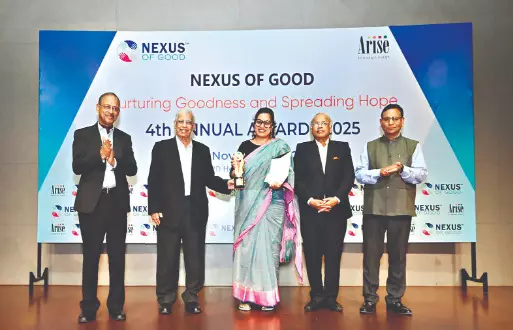
In this lies the real “Nexus of Good” — when care meets rigour, and innovation strengthens the State rather than substitutes it.
A malnutrition-free India will not be achieved by one organisation or one department alone. It will come from the collective will of those who already hold the system together — the District Administration, the Anganwadi worker, the supervisor, and the family.
Together, they are not just the last mile of governance, but the first mile of change.
Views expressed are personal. The writer is an author and a former civil servant



