
Rewriting Rural Economies
VIEWS is reshaping agriculture through women-led, climate-resilient practices—proving sustainable livelihoods can emerge from local knowledge, collective action and institutional support
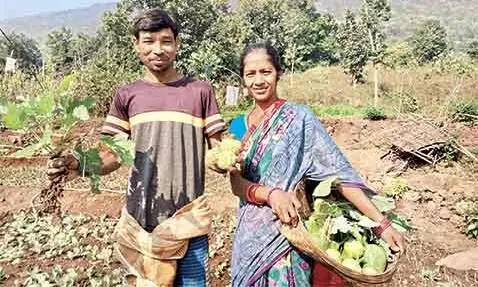


VIEWS (Voluntary Integration for Education and Welfare of Society) began as an organic farming movement in Odisha and has evolved into a leading organisation promoting climate-resilient and nutrition-secure livelihoods in Ganjam, Gajapati, and the tribal pockets of Mayurbhanj. It was the proud recipient of the Nexus of Good Annual Award, 2025.
The initiative empowers tribal and Dalit women farmers to adopt sustainable practices such as the System of Rice Intensification (SRI), organic composting, and millet-based farming systems, increasing paddy productivity and reviving millets as climate-resilient crops. To ensure fresh and nutritious food in every household, VIEWS promotes nutrition gardens in homes and schools, providing vegetables and greens year-round.
Knowledge sharing is central to the movement. Through Farmer Field Schools and Bio-Resource Centres, farmers learn organic input preparation, natural pest control, and sustainable farming techniques. A network of Community Resource Persons supports women’s collectives in planning, record-keeping, and climate adaptation at the village level.
By combining traditional knowledge with modern innovation, VIEWS empowers women farmers to lead their communities toward food security, climate resilience, and self-reliance across rural and tribal Odisha.
Impact on Odisha’s Farming Communities
Across the hills of Gajapati, the fertile plains of Ganjam, and the tribal belts of Mayurbhanj, a quiet but powerful revolution is unfolding. Farmers—especially women from marginalised and tribal communities—are taking charge of their land, reviving traditional crops, and building climate-resilient livelihoods.
At the heart of this transformation is VIEWS (Voluntary Integration for Education and Welfare of Society), a grassroots NGO founded in 2002 with a mission to empower the most vulnerable communities of Odisha through education, livelihoods, and climate action. Over the past two decades, VIEWS has evolved into one of the leading organisations in sustainable agriculture and women-led livelihood promotion in eastern India.
Building Climate-Resilient Agriculture
In the face of erratic rainfall, rising temperatures, and shrinking resources, VIEWS has worked to build an ecosystem of climate-resilient agriculture rooted in local wisdom and agroecological principles.
Through Farmer Field Schools (FFS) and Bio-Resource Centres (BRCs), VIEWS has reached thousands of small and marginal farmers with training on the System of Rice Intensification (SRI), organic composting, vermiculture, and natural pest management. These practices have reduced input costs, improved soil fertility, and increased yields, allowing poor farmers to move from subsistence to sustainable surplus.
Promoting Millets and Local Food Security
In the drought-prone villages of Ganjam and the tribal hills of Mayurbhanj, VIEWS has spearheaded a revival of traditional millet-based farming systems. Once seen as “poor man’s food,” millets like ragi, kodo, and foxtail are now recognised as “smart foods” for their resilience and nutritional value.
VIEWS supports women’s collectives to cultivate millets organically and process them through community-based millet processing units. These small-scale enterprises, managed by Self-Help Groups (SHGs), not only generate local income but also ensure that nutritious grains remain accessible to village families.
Alongside millets, VIEWS promotes nutrition gardens in households and schools to address malnutrition. More than 1,000 families have established small backyard gardens producing vegetables and greens year-round, improving dietary diversity for children and women.
Bio-Resource Centres and Farmer Field Schools
The Bio-Resource Centres (BRCs) established by VIEWS in Ganjam and Gajapati serve as demonstration hubs for eco-friendly agriculture. Farmers learn to produce organic inputs—biofertilizers, compost, and pest repellents—from locally available materials. The BRCs also host community meetings, seed exchanges, and workshops on soil testing, water management, and crop rotation.
Farmer Field Schools further strengthen farmer-to-farmer learning. These platforms bring together local farmers to test new techniques in their fields, compare results, and make collective decisions. The participatory approach not only improves adoption rates but also builds farmers’ confidence as innovators rather than mere beneficiaries.
Empowering Community Resource Persons in Agriculture
One of the most successful innovations of VIEWS has been the creation of Community Resource Persons (CRPs)—trained local farmers, mostly women, who act as village-level facilitators and peer educators.
CRPs conduct demonstrations, offer on-site advisory support, and help women’s groups in record-keeping and planning. They bridge the gap between scientific knowledge and local practice, ensuring sustainability beyond project cycles. Their leadership has become instrumental in mobilising communities for climate adaptation and local governance.
Strengthening Gram Panchayat-Level Institutions through Amo Goan-Amo Yogna
Recognising that true sustainability requires collective ownership, VIEWS has strengthened community-based organisations (CBOs) at the Gram Panchayat (GP) level. These include SHG federations, farmer producer groups, and local development committees that prepare Village Development Plans (VDPs) focusing on agriculture, water management, and climate change adaptation.
The plans are linked with MGNREGS and other government schemes to leverage public resources for soil and water conservation, farm ponds, plantation drives, and other climate-resilient measures.
By aligning grassroots efforts with local governance, VIEWS ensures that small farmers—especially women and tribal groups—have a voice in decision-making processes that shape their livelihoods.
Diversifying Livelihoods Beyond Farming
To reduce dependence on mono-cropping and unstable agricultural income, VIEWS promotes diversified livelihood opportunities.
In the coastal villages of Ganjam, where many families depend on fishing, VIEWS supports sustainable fisheries and fish-based microenterprises. More than 300 households now earn a steady income through fish processing, drying, and packaging, while adopting environmentally responsible practices to protect marine ecosystems.
In inland villages, livestock and poultry units provide supplementary income for landless and single women. Over 850 families have received support in goatery and backyard poultry, coupled with veterinary linkages and training.
Women’s groups are also engaged in mushroom cultivation, vegetable farming, and value-added food processing, turning agriculture into a year-round source of income.
Women-Led Enterprises and Farmer-Producer Company
VIEWS has long recognised women as the backbone of rural agriculture. Through 600 Self-Help Groups (SHGs), women have built collective savings, gained financial literacy, and ventured into small enterprises.
A milestone achievement is the establishment of a women-led Farmer Producer Company (FPO) in Ganjam, enabling small producers to access better markets, bulk inputs, and financial services. The FPO promotes aggregation, branding, and collective marketing of organic produce, ensuring fair prices and reducing exploitation by middlemen.
This institutional approach transforms women farmers from wage earners to entrepreneurs—empowering them to lead local economic development.
Skill Development and Youth Engagement
Rural youth are vital to sustaining agricultural innovation. VIEWS has trained 1,650 youth in market-driven skills such as agri-entrepreneurship, food processing, digital marketing, and repair of agri-machinery. Many have established microenterprises or found employment locally, reducing migration and creating role models for others.
Impact and Key Achievements
Over the years, VIEWS’ integrated livelihood programmes have yielded measurable and lasting impacts across southern and tribal Odisha:
* 600 SHGs promoted across villages;
* 18,300 farmers practising organic farming;
* 15,100 farmers adopting the System of Rice Intensification (SRI);
* 8,500 farmers adopting climate-resilient practices;
* 2,200 farmers introduced to pulse cultivation;
* 1,650 youth trained in market-driven skills;
* 160 ultra-poor women supported in enterprise creation;
* 850 families supported in livestock-based livelihoods;
* 300 households supported in fishery-based ventures;
* 330 women trained in mushroom cultivation;
* 6,500 households engaged in commercial vegetable farming;
* 1 women-led Farmer Producer Company established in Ganjam.
These numbers reflect not only the scale of outreach but also the depth of transformation—where local communities have transitioned from vulnerability to self-reliance, guided by the principles of sustainability and inclusion.
Views expressed are personal. The writer is an author and a former civil servant



