New Bay of Pigs
Severe climate tumult is widening the global justice gap, what with developing nations curtailing growth ambitions to pay for the past follies of the developed


“The promise of climate finance
remains unfulfilled. Developing
countries are being stranded
without the funding to adapt,
while the clock keeps ticking.”
— António Guterres
The images have been hitting us relentlessly. Entire Libyan neighbourhoods have been swept into the sea after dam failures, Europe’s rivers are drying up into cracked riverbeds, Canada battles its worst wildfire season, and India’s heatwaves have pushed temperatures past 50°C, causing schools to shut and power grids to buckle under growing demand. These are not isolated catastrophes, but a reality check that the climate crisis has accelerated beyond political promise and diplomatic declaration(s). Scientists have warned of tipping points for long, but the scale of devastation unfolding across continents is a wake-up call for urgency and meaningful global negotiations.
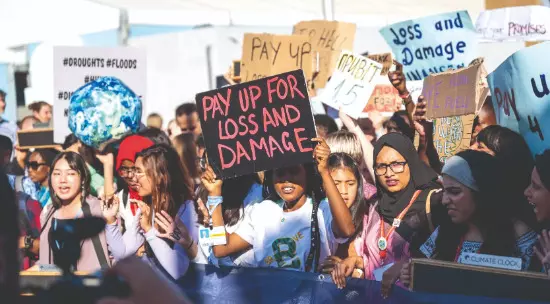
The urgency has collided head-first with a growing sense of injustice. At COP28 and COP30, negotiators from vulnerable nations challenged the global response, insisting that those who had contributed least to creating the problem were bearing the most impact. “We are paying for a crisis we did not cause,” Barbados Prime Minister Mia Mottley said, capturing the anger shared by many in the Global South.
The launch of the ‘Loss and Damage Fund’ was seen as a turning point, yet its pledges totalled only $700 million, barely enough to cover a single climate disaster. Further, given rising fossil fuel use, global emissions hit new highs in 2024 and 2025. The result: a world caught between soaring ambition and scary reality. Indeed, the world is facing climate’s Bay of Pigs—if the original event saw the US and the Cuban Democratic Revolutionary Front fail to overthrow Fidel Castro, the latest avatar is seeing the world battle a climate curve ball where rising natural adversities are stifling ambition.
Justice Versus Reality
Climate justice, once a moral appeal, has turned into a geopolitical fault-line. Developing countries say decarbonization must not undermine their growth or send millions into poverty. Resultantly, historical polluters in the West are facing pressure to deliver funds and technology commensurate with their responsibility. But political fatigue, domestic pulls and rising nationalism have slowed action.
The numbers tell the story. The promised $100 billion per year in climate finance stays elusive. Studies indicate that much of what is counted as climate finance comes in as loans and not grants, adding to the debt burden of already struggling economies. The Organisation for Economic Cooperation and Development estimates that 60 per cent of climate finance to developing countries is provided as debt. “This is not climate solidarity, it is climate debt,” a negotiator from a Pacific island nation said.
At the same time, fossil fuel consumption remains stubbornly high. Global coal use hit records in 2023, driven by Asia’s energy demand. Oil and gas investments surged, even as ‘green’ capacity expanded. This paradox, that of expanding clean energy alongside persistent fossil reliance, illustrates the reality confronting emerging economies, where energy security and affordability remain paramount.
India’s Balancing Act
No country embodies this tension more than India. As the world’s third-largest emitter in absolute terms but with per capita emissions far below the global average, India straddles the divide between climate responsibility and development necessity. Its energy demand is projected to grow faster than any other economy through 2040, driven by industrial growth, urbanization and rising incomes.
India has made bold commitments too, such as 500 GW of non-fossil energy capacity by 2030, net-zero emissions by 2070, and rapid expansions in solar and wind power. It has also become a leader in green hydrogen, electric mobility and battery manufacturing, positioning itself as a clean energy hub. Analysts praise India’s progress as energy deployment is among the fastest worldwide. Yet, challenges remain. Coal fuels 70 per cent of electricity generation and efforts to phase this down face tough political and economic hurdles. Coal-dependent industries employ millions and provide revenues to the government. “A transition in India is not simple. It is not just about replacing energy sources, it is about livelihoods, regional equity and political stability,” an energy expert said.
The 2024 heatwaves and erratic monsoon exposed the vulnerability of India’s agriculture sector, affecting crop yields and food security. Year 2025 brought its own challenges, especially during the monsoons. Urban and rural flooding highlighted infrastructure glitches, strengthening the argument that adaptation and resilience must receive equal emphasis alongside mitigation.
Financing the Transition
The greatest barrier to climate action remains finance. The International Energy Agency says emerging economies need $2 trillion annually in clean energy funding by 2030. India alone requires hundreds of billions to meet its climate goals, develop resilient infrastructure and support vulnerable communities. Development banks and the West have been berated for slow, bureaucratic processes and insufficient commitments. Private finance, in turn, has been reluctant to invest at scale due to policy uncertainties.
India has called for reforms that make climate finance accessible, predictable and affordable. Finance Minister Nirmala Sitharaman says “climate action cannot come at the expense of development, nor can it be financed through unsustainable debt”. Innovative financing mechanisms, such as blended finance, green bonds and sovereign guarantees are gaining traction but remain insufficient. Without reforms to global financial institutions and greater participation from private capital, climate goals will remain out of reach. The ‘Loss and Damage Fund’, while symbolically pleasing, faces questions on long-term capitalisation and governance. Vulnerable nations fear that the fund could become just another under-resourced mechanism, unable to meet the escalating costs of disasters.
While mitigation dominates the narrative, adaptation has become a priority, especially in India. Rising temperatures, unpredictable rainfall and extreme weather events threaten agriculture, water security and public health. Without substantial funding in adaptation, development gains could be reversed. India has unveiled initiatives to bolster climate resilience, early warning systems, better farm practices and flood management. The nation’s role in the Coalition for Disaster Resilient Infrastructure reflects its commitment to global cooperation on adaptation. However, funding remains limited. Adaptation receives only a fraction of global climate finance, at under 30 per cent, as per the United Nations.
Variegated Approach Needed
The gap between climate justice and reality thus demands a new approach. Historical polluters must deliver on finance and technology commitments, while emerging economies must pursue low-carbon development pathways. A cooperative framework that balances responsibility and capability is a must. For the world, prioritizing shared resilience over geopolitical competition is crucial. Without collective action, climate impacts will accelerate, leading to greater instability, displacement and conflict.
For India, the path forward requires mobilizing financing, strengthening capacity and prioritizing adaptation alongside mitigation. By following a transparent and equitable global climate architecture, India can help shape a development model that aligns growth with sustainability and justice.
If the world fails to bridge the gap between climate justice and climate reality, the result will be severe. But if nations act with urgency and solidarity, the crossroads could lead to a resilient and equitable future, where development and decarbonization reinforce, not undermine, each other.
He can be reached on [email protected]. Views expressed are personal. The writer is a veteran journalist and communications specialist