Learning Beyond Classrooms
Through patience and pedagogy, Dr Archana Shukla helped students move from observation to action, creating a scalable model of experiential learning rooted in public responsibility


In 2021, as schools cautiously reopened following the COVID-19 pandemic, many students remained mentally and emotionally disengaged from learning. The traditional education system, already under strain, was ill-equipped to re-engage learners in a meaningful way. Amid this uncertainty, in a government school classroom in Madhya Pradesh, a quiet yet powerful revolution began—not through textbooks or online modules, but with a single question posed during a biology lesson:
“Is there any species around you that needs to be conserved?”
This simple yet profound question sparked curiosity in a group of 11th-grade students. One student recalled how her mother used to feed a small bird called goriya, or the house sparrow (Passer domesticus), which they no longer saw. This nostalgic memory became the seed of a transformative journey—one that would blossom into a state-supported conservation project and a model for Project-Based Learning (PBL) in India.
As a government school science teacher, ornithologist, and State Resource Person for PBL, Dr Archana Shukla had long advocated for inquiry-driven education. She believed that learning should go beyond rote memorisation and foster curiosity, critical thinking, and real-world problem-solving. Instead of assigning a theoretical chapter on conservation, she encouraged her students to investigate the actual causes behind the disappearance of the sparrow. Contrary to the popular belief that mobile tower radiation was responsible for their decline, students discovered through scientific literature and field research that the true culprit was habitat loss—specifically, the disappearance of nesting spaces in modern urban architecture.
What started as a class research assignment quickly evolved into action. In 2022, a new batch of students took up the challenge of designing sparrow houses. They used cardboard, husk, mud, and recycled materials, showcasing their prototypes at a school exhibition. While some boxes were adopted by sparrows, issues such as fungal growth, water damage, and fragility soon emerged. Rather than giving up, the students adapted. They collaborated with the school carpenter to build stronger, eco-friendly houses from discarded wood. This iterative, design-thinking approach taught them the value of resilience and adaptability.
Over the next two years, each new batch of students refined the birdhouse designs based on direct observation and experimentation. They addressed challenges such as larger birds, like Brahminy Starlings and Magpie Robins, occupying the houses, resolved overheating by introducing ventilation, and prevented predator attacks by removing perch sticks. They even added drainage holes to reduce fungal buildup caused by unhatched eggs. Through evidence-based design, their birdhouses evolved—providing a hands-on education in environmental science, engineering, and empathy.
Dr Shukla often shared with her students that sparrows have lived alongside humans for nearly 5,000 years, dating back to the dawn of agriculture. Unlike other birds, nesting isn’t hardwired into their genes; sparrows rely on human-made structures to breed and survive. As urban architecture now offers few crevices or nooks, sparrows are losing their homes. Their disappearance is more than symbolic; it has ecological consequences. Sparrow chicks require high-protein food, and their parents feed on garden and kitchen pests—primarily larvae and insects. Without sparrows, people turn to harmful pesticides, which can lead to diseases such as cancer and bacterial or viral infections. Thus, conserving sparrows also safeguards human health and urban biodiversity.
By 2024, what began in a single classroom had grown into a full-fledged community movement. Students started installing sparrow houses in housing societies, temples, mosques, and public spaces—especially in the Awadhpuri area of Bhopal. Parents and local residents became actively involved. The project fostered community bonding, environmental education, and civic engagement. Students continued to modify their designs—adding slanted roofs to deter pigeons and adjusting box sizes based on bird behaviour.
To date, over 5,000 sparrow boxes have been installed through this initiative. Even more heartening is that people and institutions across India have begun replicating this work—from urban neighbourhoods in Delhi and Jodhpur to school campuses in Maharashtra and Karnataka. This ripple effect is a testament to the project’s relevance and impact.
In collaboration with the Madhya Pradesh Tiger Foundation Society, students installed 200 sparrow boxes free of charge in public areas. After a year of monitoring, over 85 per cent of these boxes were adopted by sparrows, with some being reused multiple times within a single breeding season—clear evidence of the project’s ecological success.
However, the most transformative impact was on the students themselves. One student wrote and published a research paper, and the work was also featured in the international wildlife magazine Whispering Wild—making their school one of the first government schools in Madhya Pradesh to achieve this. Another student was selected for the prestigious Sakura Science Exchange Program in Japan, citing his involvement in the sparrow project as central to his application. A third student, who later secured All India Rank 47 in the UPSC Civil Services Examination, credited the bird identification and habitat mapping PBL project with building his analytical and research skills.
The project drew attention from educational forums and forest officials alike. Students presented their work to the Principal Chief Conservator of Forests (PCCF), who appreciated their thorough research and practical innovation. The Madhya Pradesh Tiger Foundation Society awarded the project a grant of ₹1,00,000, recognising it as a model for integrating student learning with conservation impact. The work has since been showcased at the India International Science Festival, state science fairs, and international educator workshops, where I had the privilege of training teachers from ten different countries on how PBL can transform learning outcomes.
This journey has not only been about conserving sparrows, but it has also been about reimagining education itself. Through this project, students developed a range of 21st-century skills:
* Critical thinking and scientific literacy through research
* Design and innovation through iterative prototyping
* Leadership and collaboration through teamwork
* Communication skills through public exhibitions and media outreach
* Civic and environmental responsibility through hands-on engagement with local biodiversity
What started as a classroom discussion on conservation turned into a scalable, state-supported model of experiential education. Today, sparrow boxes designed by our students are in demand not only in Madhya Pradesh but also in Delhi, Noida, Gurgaon, and Jodhpur. Our students are now regarded as young urban conservationists—mentoring peers, guiding NGOs, and partnering with forest departments.
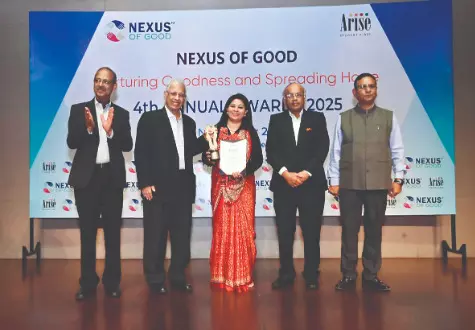
This story is not just about the house sparrow—it is about the potential of every student in every government school in India. It is a call to reimagine our classrooms as spaces of exploration, empathy, and empowerment. It is proof that when we trust students with real-world problems, they do not just solve them—they transform communities. For her seminal effort, Dr Archana Shukla was honoured with the Nexus of Good Annual Award in 2025.
Views expressed are personal. The writer is an author and a former civil servant