Digital Cattle Revolution
In Jalna and Nashik, a low-cost livestock app is quietly transforming animal health, farmer incomes and the way government tracks rural welfare
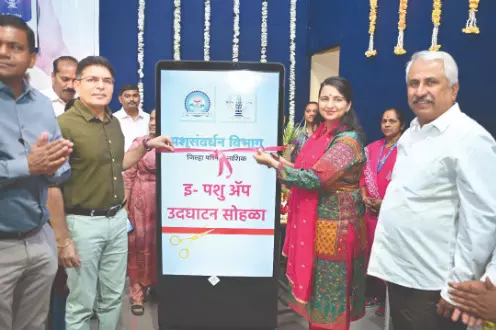


On November 16, 2025, at a glittering function at PHDCCI, Delhi, E-Pashu—an initiative by Ashima Singh—was bestowed with the Nexus of Good Annual Award 2025 by BK Chaturvedi, former Cabinet Secretary and former Member of the Planning Commission. The model that Ashima Mittal and her dedicated team have put in place is both scalable and replicable, embodying the true spirit of Nexus of Good through public-private partnership. It also demonstrates how technology can be used effectively in the process of development, even in rural settings.
This recognition sets the stage for understanding the meaningful impact E-Pashu has had on rural communities. In the heart of rural Maharashtra, livestock are not just animals—they are family members, the main source of income, and an insurance policy against uncertainty. Yet for decades, veterinary care in villages relied on handwritten registers and fading memories. Missed vaccinations, untracked breeding cycles, and delayed treatment often resulted in disease outbreaks and financial distress for farmers.
Recognising this gap, Ashima Mittal, I.A.S., Collector & District Magistrate Jalna (Former CEO ZP Nashik), spearheaded E-Pashu—a pioneering digital livestock management system designed to bring transparency, traceability, and accountability to animal healthcare.
From Paper to Platform
Before E-Pashu, livestock officers managed 15-20 villages each, carrying bulky registers to record vaccination drives and breeding data. Collating district-wide information was tedious, and by the time it reached decision-makers, the data were outdated. Farmers rarely received updates about their animals’ health schedules.
E-Pashu replaced this paper maze with a single mobile platform. Each cow, buffalo, goat, or sheep is assigned a unique digital ID capturing its breed, age, vaccination status, and owner details. Field officers record every service—vaccination, de-worming, or insemination—on the app, which functions offline and syncs automatically when connected to the internet. Farmers receive reminders for scheduled vaccinations and breeding cycles, ensuring timely action.
Massive Reach in a Short Time
Since its launch on April 1, 2025, the program has achieved unprecedented scale.
* 13,85,908 animals have been digitally registered—covering nearly the entire livestock population of the district.
* 98,832 farmers have been enrolled through veterinary OPDs and village tours.
* 12,34,531 vaccinations have been reported through the app, enabling near-universal immunisation coverage.
* 25,578 artificial inseminations have been tracked, with expected calving dates automatically generated for follow-up.
Such extensive coverage has made Nashik one of the most digitally enabled districts in animal husbandry services.
Technology meets Compassion
E-Pashu is more than a data system; it is a bridge of trust between the farmer and the government. For livestock supervisors, it simplifies daily work—no more logbooks or duplicate entries. For farmers, it means predictability and peace of mind: they know exactly when their animals need care. For administrators, it provides a live dashboard of animal health, fertility, and vaccination trends, helping identify disease hotspots early. This timely information has already averted multiple potential outbreaks. Veterinary teams now respond within hours instead of days, reducing livestock mortality and economic losses.
Impact on Farmers’ Lives
Behind the impressive numbers lie thousands of human stories.
Sunita, a small dairy farmer from Partur, once lost two calves to disease because she missed vaccination dates. Now she receives reminders in Marathi and follows the schedule precisely. Her animals are healthier, and her family’s monthly milk income has doubled.
For veterinary field staff like Shankar Patil, E-Pashu means efficiency and pride. “Earlier, we spent evenings filling registers. Now I know exactly how many animals I treated today, and my work is visible on the dashboard,” he says.
These small changes are redefining how farmers perceive public veterinary care—no longer as a distant service but as a dependable, responsive partner.
Efficiency and Replicability
The platform was developed using low-cost, open-source technology, making it highly scalable. Once initial training and devices were provided, recurring expenses remained minimal—limited to maintenance and data hosting. Offline functionality ensures that data capture continues even in areas with poor connectivity.
E-Pashu aligns perfectly with national programs such as the Rashtriya Gokul Mission, Livestock Health & Disease Control Scheme, and Digital India. Its architecture can be replicated across other districts and states without major modification.
Third-Party Validation
A 2025 evaluation by the District Veterinary Department found vaccination coverage increased from below 50 per cent to over 90 per cent. Fertility success rates improved by 25 per cent, and average milk yield per animal rose significantly due to preventive care. Field staff productivity doubled, and administrative transparency improved manifold. The review concluded that E-Pashu represents “a model for real-time, low-cost digital governance with high community trust.”
A Model for Good Governance
At its core, E-Pashu embodies the principles of Nexus of Good: simple ideas that solve complex problems and can be replicated widely. It proves that when technology is designed with empathy and inclusivity in mind, governance becomes a force for empowerment.
From 13.8 lakh animals now mapped to 98,000 farmers receiving direct digital veterinary support, the numbers tell only part of the story. The real success lies in restoring dignity and confidence to rural families who depend on livestock for survival.
E-Pashu has shown that innovation doesn’t always come from metropolitan labs—it can begin in the fields of Nashik, guided by a committed team and a belief that every animal matters and every farmer counts.
A beginning has been made in Nashik. Here is an example of action on the ground. Now it is up to the other Districts and States to learn from what has happened here and bring about a transformation made possible by technology.
Views expressed are personal. The writer is an author and a former civil servant