Bridging the Digital Divide
A solar-powered, community-driven model is rewriting India’s digital inclusion story, as Dell Technologies brings connectivity, skills and confidence to those long left on the margins
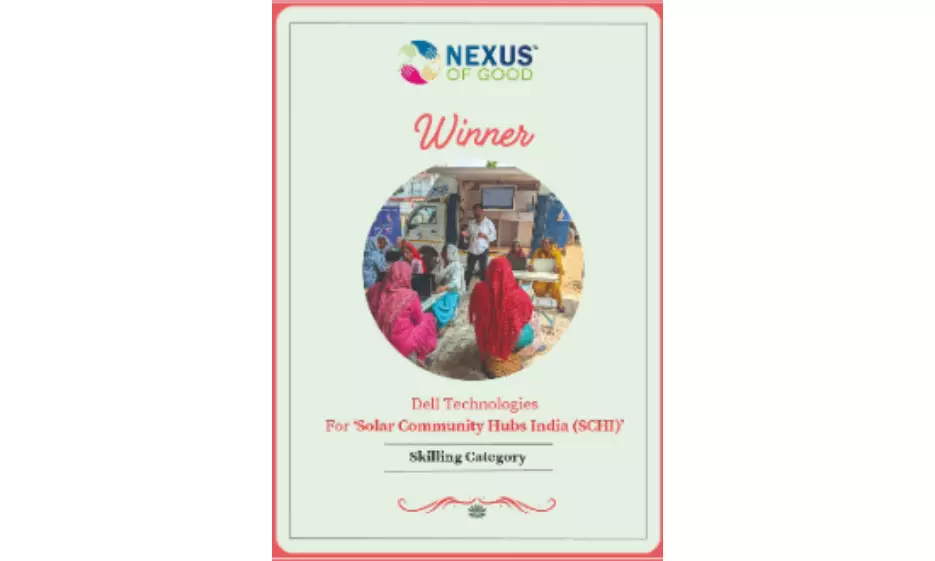


One of the proud recipients of the Nexus of Good Annual Awards, 2025, was Dell Technologies. This organisation was awarded for setting up solar community hubs, an initiative that has already created a visible impact and is being replicated in the true spirit of Nexus of Good through public-private partnership.
In today’s increasingly digital world, access to technology is not a luxury — it’s a lifeline. Yet for millions in rural and underserved parts of India, barriers like unreliable electricity, weak infrastructure, and limited digital literacy have long excluded them from the opportunities of the digital economy. Recognising this gap, Dell Technologies launched the Solar Community Hubs India (SCHI) initiative — an innovative program designed to bring technology, learning, and empowerment directly to communities that need it most.
Launched in FY23 as part of Dell’s global community impact portfolio, SCHI aligns with the company’s 2030 ESG goal of positively impacting one billion lives. In India, it is implemented in collaboration with Common Service Centres (CSC) under the Ministry of Electronics and IT, the National Skill Development Corporation (NSDC), the Army Welfare Placement Organisation (AWPO), and the Learning Links Foundation. With a special focus on Aspirational Districts, this multi-stakeholder partnership ensures scale, sustainability, and alignment with national priorities for skilling, employment, and digital inclusion.
At the heart of SCHI are mobile, solar-powered hubs — vans and kiosks equipped with laptops, internet connectivity, solar energy systems, and curated digital learning content. These hubs travel to rural and semi-urban communities, functioning as fully equipped learning and service centres. They deliver training in digital literacy, financial literacy, cybersecurity, coding, block programming, entrepreneurship, and Generative AI awareness. Through workshops, AI-enabled learning, and mentoring sessions, SCHI equips participants with practical, future-ready skills that enhance employability and self-reliance.
The program targets women, Self Help Group (SHG) members, youth, ex- and in-service defence personnel, and small business owners. By reaching these groups, SCHI addresses inequities in digital access while fostering economic empowerment, career transitions, and entrepreneurial growth. Training is contextualised through local languages, community champions, and structured modules, ensuring knowledge is applied meaningfully in daily life.
Over three years, SCHI has expanded from six pilot districts to 18 districts across 12 states and 2 Union Territories, covering Karnataka, Andhra Pradesh, Odisha, Jharkhand, Tripura, Tamil Nadu, Punjab, Haryana, Madhya Pradesh, Maharashtra, Sikkim, and Rajasthan. As of FY25, it has directly reached 2.67 million beneficiaries, making it one of India’s largest community-driven digital inclusion initiatives. Over half of these beneficiaries are women, empowered to leverage digital tools for accessing government services, starting microenterprises, and participating in the digital marketplace. Ex-servicemen and defence wards have also benefited, gaining digital literacy, cybersecurity, and entrepreneurship skills to transition into civilian careers.
The human impact of SCHI is best illustrated through individual stories. Jyoti Rajput, a Bank Sakhi from Jhansi, Uttar Pradesh, once struggled with basic smartphone operations. Through SCHI’s digital literacy sessions, she learned tools like Google Maps and WhatsApp, which proved crucial when she once got lost returning from a family event. She shared her live location with her husband and found her way home safely. Her reflection, “This knowledge gave me confidence and made me feel independent,” encapsulates the program’s core mission: empowering communities with autonomy, safety, and dignity through technology.
Similar stories abound. In Odisha, rural women entrepreneurs now use digital payment applications to manage and expand their businesses, while in Haryana, ex-servicemen retrain for IT support roles and explore entrepreneurial opportunities in digital services. SHG members gain skills in digital literacy and financial management, enabling participation in government schemes, online banking, and micro-enterprises. Across these communities, SCHI acts as a catalyst for inclusion, economic empowerment, and social resilience.
SCHI’s design emphasises sustainability and scalability. Solar-powered hubs operate in energy-deficient regions, ensuring uninterrupted learning. Their mobility allows access to remote areas, bridging infrastructure gaps. Community ownership is central — local champions and facilitators continue digital literacy initiatives, sustaining impact long after initial deployment.
Dell Technologies’ collaborative approach enhances the program’s effectiveness. Partnerships with CSC, NSDC, AWPO, and Learning Links Foundation provide governance, monitoring, mentorship, and contextual expertise. These collaborations allow tracking of participation, outcomes, and community engagement. SCHI integrates national priorities, aligning with India’s Digital India mission, Skill India vision, and Sustainable Development Goals, especially quality education, gender equality, and decent work.
Beyond digital literacy, SCHI equips learners with AI-focused skills and career readiness capabilities. Youth and veterans gain exposure to problem-solving frameworks, coding, and entrepreneurial applications of technology, preparing them to shape the technology-driven economy. For many participants, SCHI is the first step toward understanding how technology can unlock opportunities — from online education and remote work to small business growth and community leadership.
The program has achieved measurable social impact. Communities now access digital resources supporting education, employment, and financial inclusion. By empowering women, youth, and veterans, SCHI helps reduce systemic inequities, enabling sustainable livelihoods and participation in the modern economy. Each hub functions as a dynamic learning ecosystem, promoting peer learning and mentorship to translate digital adoption into tangible benefits.
As SCHI enters its next phase, it aims to deepen AI literacy, entrepreneurship training, and advanced digital skills, preparing rural communities not just to adapt to technology but to lead and innovate in an AI-driven world. Plans include expanding to additional districts, integrating career-oriented modules, and strengthening partnerships to create a lasting ecosystem of digital empowerment. By combining technology, renewable energy, and community-driven implementation, SCHI provides a scalable model for bridging the digital divide in India and globally.
For Dell Technologies, SCHI is more than a CSR initiative — it is a blueprint for tech-enabled social transformation. The program demonstrates how corporate vision, innovation, and collaboration can create long-term, sustainable social impact. Technology becomes a vehicle for inclusion, dignity, and empowerment, opening doors for millions previously excluded from the digital economy.
By bringing light — literally through solar-powered hubs and figuratively through digital learning — to underserved communities, SCHI exemplifies what is possible when corporate purpose meets community need. It highlights the profound impact that thoughtfully designed, inclusive technology initiatives can have, fostering confidence, independence, and sustainable livelihoods.
Through stories like Jyoti Rajput’s, the achievements of women entrepreneurs in Odisha, and the career transitions of ex-servicemen in Haryana, the Solar Community Hubs India program illustrates the transformative potential of technology for good. SCHI stands as a testament to the fact that with collaboration, innovation, and a clear purpose, digital inclusion can become a reality, empowering underserved communities to thrive in the 21st century.
Views expressed are personal. The writer is an author and a former civil servant