

Breaking the Wildlife Network
Operation Clawing Back exposed an organised leopard parts trafficking network, demonstrating how intelligence-led enforcement can strengthen wildlife protection and public awareness


Himachal Pradesh is known for its rich forests and treasured wildlife, ranging from the Shivalik Hills to alpine pastures. For long, the aspect of wildlife crime has largely gone under the radar, with very few reported cases and seizures of wildlife articles. It may be recalled that the legal regime for wildlife protection in our country is one of the strongest, with 3–7 years being the punitive jail term for cognizable offences under the Wildlife Protection Act, 1972.
It is in this context that the unique and unprecedented wildlife crime control operation, codenamed ‘Operation Clawing Back’, conducted by the Rohru Forest Division of the HP Forest Department, attains importance as a torch-bearing action for others to follow in enforcing the protection of the law for wildlife species in our country. This operation was meticulously planned, organised and targeted to bust an organised wildlife crime racket involving leopard claws, teeth and other body parts.
The first stage of the operation involved the detailed collection of information, collation of the information into credible intelligence, and then identifying the targets for search and seizure based on the intelligence generated. This part of the operation was planned and executed carefully, with credible intelligence inputs received on the final retail part of the leopard claw supply chain and the shops being used for stocking and selling these wildlife articles.
Based on the aforementioned intelligence, the execution of the operation was planned for February 10, 2026. The main challenge in execution was the need for several uniformed personnel, considering that six such shops were to be targeted simultaneously for search and seizure operations. In order to achieve this, 45 forest staff members from various forest ranges were assembled, divided into six teams and clearly briefed on the mission before them. Each team was provided with gloves, zip-lock bags and other tools for the collection of evidence (suspected wildlife articles).
The second challenge was the location of these shops in crowded market areas and the possibility of a law-and-order situation arising. In order to minimise this fallout and prevent the leakage of information about the raids, the operation was executed with all raids commencing at the exact same time, 10:30 AM, with all six teams reaching their target locations simultaneously with duly issued search warrants, taking control of the premises immediately and preventing any outsider intrusion thereafter. The entire process of search and seizure was recorded through videography for transparency, and efforts were made to associate independent witnesses as per the search and seizure procedure outlined in the BNSS.
In order to mitigate any law-and-order fallout, it was pertinent to ensure that the teams completed the raids effectively and efficiently within a very short period of time. To achieve this, the teams were well prepared and comprehensively briefed on evidence collection and documentation. Further, each team had around six personnel, enabling faster search operations. The entire operation lasted from 10:30 AM to 2:30 PM, with several of the raids concluding by 12:30 PM, within a relatively short time frame, preventing negative law-and-order fallouts and ensuring smooth execution.
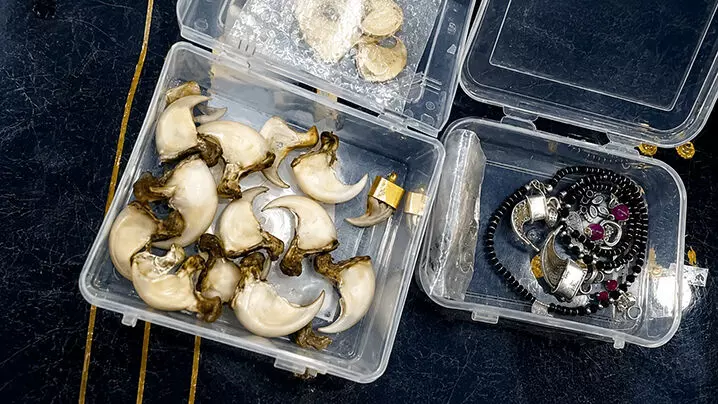
The result of the operation was noteworthy, with a total of 85 suspected leopard claws, five suspected leopard teeth and 10 unidentified bird feathers seized from six shops situated in the market area of Rohru town. The seizure of such a significant quantity of leopard parts signalled an organised wildlife crime nexus at play, the backbone of which was broken on the day of this operation. All six shop owners were soon taken into forest custody, and a remand of two days was granted by the local court. The public was briefed in detail on the evening of the operation, sending a strong message against wildlife crime. This was an unprecedented crackdown on wildlife crime in the state, which sought to draw a line in favour of conservation and sustainability, while detailed interrogation of backward supply links was carried out in an effort to strike at the root of this organised wildlife crime supply chain.
The detailed investigation, based on the statements of the shop owners, the examination of bank account statements, and the verification of CCTV footage, provided a clear picture of this organised wildlife crime nexus. The central suppliers and handlers in this chain were identified, through whom several of these wildlife articles had passed. The principal supplier in this chain, a resident of Uttarakhand, was nabbed more than two months later at one of the interstate check-posts, where vigilance had been stepped up to identify and apprehend the main suspect in the case.
The rate of forest and wildlife offence detection in the state of Himachal Pradesh has been considerably lower owing to multiple factors, including difficult terrain, remoteness and lack of staff capacity. It must be underlined that this does not necessarily mean that wildlife or forest crimes are marginal or negligible. In this context, ‘Operation Clawing Back’, which significantly exposed and dismantled a leopard claw and tooth smuggling racket extending beyond state borders, is a landmark achievement for the State Forest Department in the cause of wildlife conservation. The fact that the operation was not only able to expose the final part of the retail chain but was also able to identify and strike at the backward linkages involved is particularly noteworthy.
The operation is not merely a law enforcement action but also serves as a concerted effort to promote awareness in the hilly and remote state about the use of scheduled wildlife articles and the prohibition on trading and using such wildlife parts. Through this law enforcement action, large sections of society have come to realise the need to avoid becoming party to the illegal trade in wildlife articles and to understand the stringent provisions of the Wildlife Protection Act, 1972. It is in this context that the operation goes beyond a conventional law enforcement exercise and enters the domain of generating mass public awareness in favour of wildlife conservation, striking at the root of the demand side of the supply network for such wildlife articles.
The impact of this law enforcement action is, therefore, multifold, ranging from significantly weakening an organised leopard claw crime network to promoting public awareness about the use of wildlife articles and, most importantly, saving leopard lives in the future. Leopards are precious and invaluable natural resources that we, as humans and as Indians, have a fundamental duty to protect, preserve and conserve.
What happened in Himachal Pradesh under the able leadership of a young Forest Officer, Ravi Shankar, is a wonderful example of the Nexus of Good. Here, the law was enforced through a public-private partnership. This approach can be adopted in other parts of the country as well.
Views expressed are personal. The writer is an author and a former civil servant