Between Code and Growth
As India races toward AI leadership, it must balance ambition with inclusion, ensuring technology uplifts millions without deepening inequality or displacing livelihoods
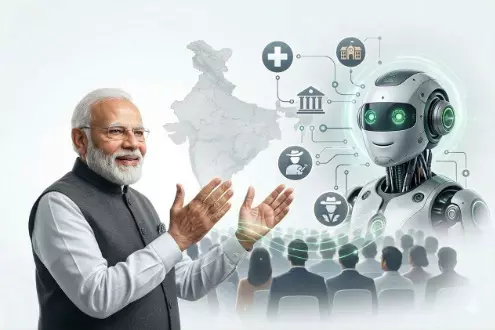


The most ancient civilisation is now facing a civilisational crisis: how to quickly turn into a global AI power! In the recent past, foreign heads of state, ministers, heads of tech giants, and who’s who of the IT and AI industry converged on the national capital to deliberate on the potential impact of AI. Most see it as a must-do-or-doom scenario. The government is facilitating infrastructure, such as nuclear power and energy, chip manufacturing, rare earths, etc., to keep India on track. The cool-thinking minds are simultaneously asking the industry to pause and think about where and on whom to focus, while keeping concerns in mind. Meanwhile, the rest of the country struggles on with the mundane task of trying to earn a living and coping.
It is agreed on all sides that the new AI tools can be one of the biggest disruptors in our society and civilisation. In the past, we have been disruptors. The concept of ‘zero’ (acknowledged by Fibonacci himself) and other numerals, the ‘decimal system’, medicine, astronomy, and soft power, as manifested in religions (Buddhism, Jainism, Hinduism), culture, and the Sanskrit language, are widely disseminated Indian contributions. At one point in time, as William Dalrymple notes in his well-researched book The Golden Road, the vast Indosphere stretched all the way from the Red Sea to the Pacific. India will learn to survive and thrive in the AI onslaught despite all the hiccups. It might be worthwhile to illustrate why this is a plausible prediction with a few examples of our famed resilience:
Our genetic mould: We withstood wave after wave of foreign onslaughts and are still a thriving, self-reliant democracy. The fact that social and territorial jurisdictions were fragmented helped the invaders, but each wave saw more assimilation of the invaders into the existing fabric than total annihilation. It has always been about resilience, with a liberal sprinkling of tolerance and geniality. Persons of Indian origin are now CEOs at Alphabet, IBM, Microsoft, Micron, Adobe, etc.
Co-existence of science and cost: We are extremely cost-conscious and prudent in our approach. We put a rover on the moon at a fraction (USD 75 million) of the cost that the USA did (USD 38 million, present cost roughly USD 295 million) decades earlier. We are slowly indigenising our navy and artillery, building cost-friendly ships, railway coaches, generic medicines, and AI stacks for public services. Pragmatic grounding in science and economy in equal measure is ingrained in our psyche.
A young nation: India at present has about 12 per cent (approximately 150 million) senior citizens, i.e., 60-plus. Predominantly, vis-à-vis other countries like Japan (48.6 per cent) or the US (38.5 per cent), we are a young nation. Although this figure has been estimated by UNFPA to rise to approximately 319 million by 2025 (20 per cent of the total population), we have a 25-year period for the young demographic mass to catch up with the latest technology. The spirit of entrepreneurship, the level of awareness and adoption of the latest technology, and the ability to learn and unlearn among Gen Z are unmatched. This generation will question, rationalise, and take informed decisions. At the same time, they are not afraid to take risks; despite some failures, the number of start-ups in India is mind-boggling. The top 79 entrepreneurs under the age of 30 have raised an impressive Rs 46,800 crore in equity funding. From robots to clean septic tanks, drones to support farming, and space mapping solutions that track satellite debris to prevent collisions, these are revolutionary small fixes to make not just India but the world a better place.
Digital literacy: The government has launched several digital literacy schemes since 2014—the NDLM (National Digital Literacy Mission), DISHA (Digital Saksharta Abhiyan), and PMGDISHA (PM Gramin DISHA)—to overcome the digital literacy divide, as only 38 per cent of households are digitally literate. Private players like Hindustan Coca-Cola Beverages, PNB Ltd, and NIIT Foundation are chipping in with requisite training. The main challenge is the availability of digital infrastructure and intermittent internet connectivity in rural areas. There has been exponential growth in digital payments and unique ID adoption. Stuart Russell, a British academic and AI safety research expert, coined the term ‘techno-optimism’ for India, citing the success of Aadhaar as an example of adoption at scale, whereas in the US and Europe, the idea of a national ID has faced pushback.
Adoption of the new AI tools and education is thus a necessity for industry, agriculture, services, and other components of the economy in India. This approach needs to be tailored to our sovereign requirements, rather than a one-size-fits-all approach, even as big tech firms will necessarily try to depict it so. Having invested billions of dollars in the development of AI tools, they have no choice but to sell their products as labour-saving technology. In a country like India, where labour is plentiful, skilled, and affordable, the deployment of AI needs careful calibration. Further, only about 17 per cent of Americans surveyed in 2025 say they are more optimistic about AI than cautious. Already, the potential risks of unscrupulous use of these tools and the absence of any global framework are being studied and shared by industry experts and institutions like the European Parliament, IEEE, UK Government, IBM, National Institutes of Health (NIH), and many others.
The NIH study flags the potential for AI errors to cause patient harm, issues of data privacy and security, and use in ways that may worsen social and health inequalities—either by incorporating existing human biases and patterns of discrimination into automated algorithms or by reinforcing inequalities in access to healthcare. One example of harm accentuated by incomplete or biased data was the development of an AI-driven pulse oximeter that overestimated blood oxygen levels in patients with darker skin, resulting in the undertreatment of hypoxia. It suggests that the health community has demonstrated its ability to shape public and political opinion about existential threats in the past. Just as the International Physicians for the Prevention of Nuclear War were awarded the Nobel Peace Prize in 1985 for assembling principled, authoritative, and evidence-based arguments about the threats of nuclear war, the study suggests the same approach should be adopted for AI in healthcare and medicine.
Armed with existing and evolving risk parameters, sovereign Indian models like Sarvam AI have indigenously developed LLM models, speech, vision, and translation systems in most of the 22 Indian languages using open-source data. The founders, Dr Pratyush Kumar and Dr Vivek Raghavan, have built the platform from scratch in an attempt to make AI accessible, scalable, and affordable for every Indian. This experiment has shown that India has achieved ‘proof of concept’; from here, the challenge is to move towards ‘proof of scale’, suitable for the third-largest economy in the world. There is also Emergent AI, founded by Madhav and Mukund Jha, which designs apps, websites, SaaS tools, customised agents, and system integrations. Within two months of its launch in the summer of 2024, Emergent had 7 million users due to production-ready coding that can be owned or modified by users. It is expected to touch 1 billion users by the end of this year.
These are the beacons that could make the dream of a modern, AI-driven India come true. In fact, the volatility and fluidity of the international job market are likely to result in a surge of ideas and talent. AI can be a game-changer if deployed in agriculture, agroforestry, marine products, and other industrial goods in incremental steps, considering the environmental costs posed by vast energy requirements. The AI invasion by big tech must be tempered by indigenous models that uplift the average Indian.
Views expressed are personal. The writer is a retired IRS officer who served as the Principal Chief Commissioner of Income Tax in Andhra Pradesh and Telangana