A Nation in Transition
BNP’s sweeping victory ends Bangladesh’s interim phase, but economic distress, US trade conditions, and strained ties with India leave the new government navigating a perilous strategic landscape


In the Holi Month of Ramadan, Bangladesh got an elected government after a gap of nearly nineteen months when the previous Prime Minister, Sheikh Hasina, had to abrogate power and leave the country on August 5, 2024, under an extremely volatile political situation due to prolonged protests led by students against her misrule. Nearly 1,400 people laid their lives, and thousands were wounded during the ‘July uprising’ that led to the regime change in Dhaka. Since then, the former Prime Minister of Bangladesh, the chairperson of the then ruling party Awami League, has been staying in India.
On August 8, three days after her ouster, Muhammad Yunus was sworn in as the head of Bangladesh’s interim government. A day before he was sworn in as the chief adviser to the interim government with prime ministerial powers, Yunus was acquitted in a labour violation case in which he had been sentenced to six months in jail. Subsequently, he has been acquitted in a graft case filed by the nation’s Anti-Corruption Commission, just days after he was sworn in to run an interim government. Significantly, on September 25, 2024, during his address to the Clinton Global Initiative on the sidelines of the 79th session of the UN General Assembly, Yunus said that the student revolution in Bangladesh was not organic, but a meticulously designed agitation which did not just come naturally. Standing next to his old friend Bill Clinton, Yunus introduced Mahfuj Abdullah (also known as Mahfuz Alam), a student leader who was accompanying him, as the mastermind behind Hasina’s ouster. Yunus introduced him to the former US President, Bill Clinton, as the “brains behind the whole revolution”. Mahfuj Abdullah has not contested the February 2026 election.
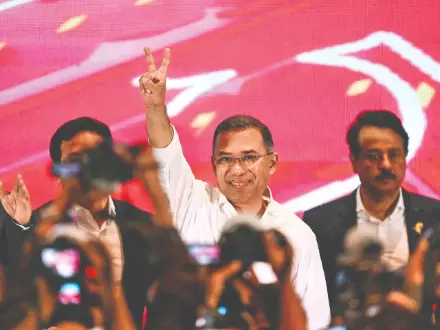
The Bangladesh Nationalist Party (BNP) has won a majority of more than two-thirds of seats in parliament in a landmark election held on February 12. Hasina’s Awami League was banned from contesting the election. Jamaat-e-Islami-led alliance of eleven parties, which includes the newly formed National Citizens’ Party (NCP) of the protesting students, came second. Voters also endorsed sweeping constitutional reform in a referendum on ‘the July National Charter’ held alongside the general election.
The “Yes” vote in Thursday’s (February 12) referendum on the constitutional issue of ‘the July National Charter’, received comparatively lower support (the “Yes” vote secured 62.74 per cent support, while the “No” vote obtained 29.32 per cent and 9.61 per cent vote cancelled) than in the previous three plebiscites (1977, 1985, 1991) held in Bangladesh. The ‘July National Charter 2025’ is a political declaration in Bangladesh based on the consensus between 30 political parties and the interim government over the constitutional, electoral, and administrative reforms in the aftermath of the July Revolution in 2024 and was signed on 17 October 2025. Over 80 reform proposals have been proposed in the charter, including constitutional, judicial, and legislative reforms.
Since August 2024, in addition to the socio-political unrest, Bangladesh has been passing through a number of economic and geo-strategic challenges. Bangladesh’s economy has plunged into its worst crisis since independence, with GDP growth plummeting to 3.9 per cent in FY2025 from 5.8 per cent in FY2023 amid investment declines. Inflation has surged past 12 per cent, up from 5.6 per cent pre-crisis, while the ready-made garments sector — once a growth engine — laid off over 1,50,000 workers. Youth unemployment exceeds 30 per cent among graduates (from 18 per cent in 2023), and an additional 3 million people face extreme poverty. According to the World Bank’s micro-simulation model, the poverty rate might have crossed 21 per cent in 2025. The number of poor people is estimated at around 36 million.
Garment exports have slowed because of U.S. tariffs and political instability following the 2024 ouster of Sheikh Hasina. U.S. President Donald Trump first imposed a 37 per cent tariff on Bangladeshi imports in April 2025, reduced it to 35 per cent in July negotiations and then to 20 per cent from August 1 before agreeing to 19 per cent on Monday (February 9), three days before the election, under a new trade deal. Bangladesh previously paid roughly 15 per cent duty to access its largest market. Under the deal, the United States will set up a system allowing a certain volume of Bangladeshi textile and apparel exports to enter duty‑free. The size of the zero‑tariff quota will be linked to how much U.S.-made textile inputs, such as cotton and man‑made fibres, Bangladesh buys. Bangladesh currently imports cotton mainly from Brazil, India, Africa, and the United States. Industry leaders observe that the deal offers some relief and potential opportunities, but its overall impact will depend on pricing, the quota formulae, and how the supply chain adjusts.
Experts have warned that Bangladesh’s reciprocal tariff agreement with the United States, signed just three days before the general election, severely limits its ability to enter trade deals with countries such as China or Russia. The deal binds Bangladesh like an octopus. For instance, the agreement states: “If Bangladesh enters into a new bilateral free trade agreement or preferential economic agreement with a non-market country that undermines this Agreement, the United States may, if consultations fail, terminate this Agreement and re-impose the applicable reciprocal tariff rate.” The US-classified non-market economies include China, Russia, Vietnam, Belarus, Tajikistan, Uzbekistan, Moldova, and Azerbaijan.
While most US tariffs remain intact, Bangladesh has agreed to eliminate or sharply reduce customs duties on most US product categories. Bangladesh has agreed to remove non-tariff barriers, licensing requirements and restrictions on US products, accept US certifications unilaterally, and comply with safety and emissions standards set by agencies such as the FDA.
Commercial purchase deals under the agreement include Bangladesh’s acquisition of 14 Boeing aircraft, with an option to buy more, a long-term off take of US liquefied natural gas valued at an estimated USD 15 billion over 15 years, procurement of at least 7,00,000 tonnes of wheat per year for five years, 2.6 million tonnes or USD 1.25 billion worth of soy and soy products over one year, and cotton worth USD 3.5 billion. The Bangladesh-USA deal goes far beyond standard tariff reductions. Instead, it creates a binding framework that integrates Bangladesh’s defence, energy, trade, and digital infrastructure into the US sphere of influence. China’s expanding presence in South Asia has compelled the USA to offer Bangladesh’s next government a sophisticated US defence system as an alternative to Chinese hardware.
Bangladesh is at the crossroads again. If the US-Bangladesh deal is ratified, which is very unlikely, by the BNP government, Bangladesh will be a dumping ground for highly subsidised US farm products. The future of its nuclear energy program, being developed with Russia’s technical and financial assistance, will face US sanctions. The infrastructure projects, undertaken with Chinese collaboration, will also face US objections.
Nonetheless, the strained relations between India and Bangladesh remain the most critical challenge for Bangladesh’s new Prime Minister, Tarique Rahman. As the Modi administration has failed to make any positive move to improve the relations, China is expected to consolidate its relations with the new government.
Views expressed are personal. The writer is a professor of Business Administration who primarily writes on political economy, global trade, and sustainable development