A Few Shining Stars
Amid today’s conflict and political intimidation, only a few Hollywood stars are choosing confrontation over caution. Worldwide, their peers are capitulating


“An artist’s duty is
to reflect the times.”
— Nina Simone
“I would like to punch him in the face. F@#$ Tru^*.”
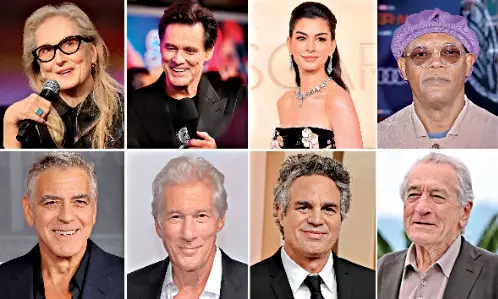
The line above didn’t come from a film script. It was the blunt reaction of Robert De Niro to the rhetoric and behaviour of US President Donald Trump during the turbulent American political cycle witnessed over the last decade. Another moment came when Meryl Streep stood before a glittering Hollywood audience and delivered a warning that reverberated far beyond the ballroom. When those with power humiliate others, Streep said, “it gives permission for other people to do the same thing”.
Jim Carrey hasn’t been skulking behind either. The master comic often uses biting satire and art to ridicule political excess, while Samuel L Jackson repeatedly condemns racism and authoritarian posturing in blunt, unfiltered terms. Richard Gere has long spoken about human rights abuses and geopolitical brinkmanship, even when doing so risks commercial backlash.
Individually, these remarks may appear like celebrity outbursts. Together, they form something striking – a pattern of public dissent from figures whose collective influence reaches millions across continents. At a time when political discourse is increasingly being shaped by intimidation, nationalism and polarisation, these actors have chosen an unusual part to play. They are not merely entertainers. For intentionally or otherwise, they have become participants in a global conversation on morality.
The Streep Moment
Hollywood has seen such moments before. From the anti-war voices of the Vietnam era to actors trashing apartheid in the 1980s, the most recognisable faces in cinema have occasionally stepped beyond the screen to challenge the political discourse. What is different today is the scale and immediacy of their influence. In the age of social media and global streaming, a single remark from a ‘star’ travels across continents in minutes, triggering debate far beyond the confines of Hollywood.
The rebellion started ten years ago, in a single moment that symbolised a cultural shift. It was the speech delivered by Meryl Streep at the 2017 Golden Globe Awards. Accepting the Cecil B DeMille Award for Lifetime Achievement, Streep used the stage not to celebrate herself but to issue a warning about cruelty in public life. Without naming Donald Trump, she described the now-infamous moment when a powerful political figure mocked a disabled journalist. “When the powerful use their position to bully others, we all lose,” Streep said. Her speech lasted just minutes, yet it rippled through global media and political circles for days. Supporters praised her moral clarity. Critics accused her of politicising entertainment.
The reactions underscored a common truth; that when globally-recognised actors speak, the world listens. For Streep (and Robert De Niro), the moment reflected a belief that art and civic responsibility cannot be allowed to remain separate. Cinema may be fiction, but the values that actors embody – empathy, justice or dignity – often shape how audiences interpret reality itself.
Films & Political Theatre
Others began to join Streep and De Niro soon, proving that their statements were not isolated moments. More Hollywood figures began to adopt an outspoken stance toward political power. De Niro has been the most direct. From film festivals to television interviews, he has warned that democracy itself can erode if citizens remain passive in the face of authoritarian rhetoric. Mark Ruffalo has also used the public platform to criticise policies he believes threaten civil liberties and human rights. His activism has ranged from environmental protection to defending democratic institutions. George Clooney, Anne Hathaway and Mark Ruffalo have used interviews and speeches to criticise policies related to immigration, racial justice and global conflicts.
There have been moments when these interventions cut through political theatre. At international film festivals, award ceremonies and TV interviews, actors have spoken about democratic decline, press freedom and the dangers of normalising intimidation. These moments are often unscripted, occasionally uncomfortable and sometimes controversial. Yet, it is this lack of choreography that lends them credibility.
Given geopolitical tensions – from confrontations in Iran to debates over military escapades – Hollywood voices have warned against reckless escalation and normalisation of war. The impact of such voices should not be exaggerated. Actors do not draft laws or command armies, but their voice travels across platforms, reaching audiences that policy debates fail to engage. In the modern ecosystem, influence is power.
What makes celebrity voices stand out is not what is said. It is the silence surrounding the words. Across the global entertainment industry, many big names have chosen caution over confrontation. In a hyper-polarised world, speaking out carries obvious risks: alienating audiences, provoking political retaliation, even jeopardising lucrative endorsements. For many, neutrality feels safer. This is visible across continents. The film industry thrives on mass appeal, and controversy can threaten carefully-cultivated brand images. Thus, even admired performers often limit themselves to generic statements about peace or humanitarian values.
Some Choose Silence
India provides an example of well-dressed silence. Bollywood stars command extraordinary, almost God-like influence across South Asia and the globe. Their on-screen personas routinely challenge injustice, corruption and tyranny with thunderous bravado. Yet off-screen, their voices are often subdued when real-world controversies erupt, be it democratic backsliding, social tensions or civil liberties. This is not to suggest that Indian actors lack conscience or courage. Some, such as Prakash Raj and Naseeruddin Shah, have spoken out, often at considerable personal cost. But the larger culture of caution within the industry cannot be ignored. The contrast with Hollywood’s outspoken minority, thus, becomes striking. Not as a competition between industries, but as a reminder that cultural power can carry civic implications.
The question of whether actors should engage in politics has long divided opinion. Many argue that celebrities possess neither the expertise nor the legitimacy to comment on policy matters. And thus, actors should focus on their craft rather than lecture audiences about governance. Supporters counter that artists play a critical role in shaping public conscience. From playwrights to novelists and from musicians to filmmakers, cultural figures have challenged injustice long before political institutions acknowledged it.
Cinema, perhaps more than any other art form, occupies a powerful position in this tradition. Films construct narratives of heroism, sacrifice and moral choice. When the actors who embody these ideals speak about real-world issues, audiences inevitably connect the two. The result is a unique form of cultural influence, one capable of reframing political debates in human terms.
Of Statistics & War
Clearly, a statistic can describe a war. And a speech can remind people why it matters. There is also the unsung role to consider – Hollywood’s outspoken actors are not democracy’s saviours, nor do they claim to be; their interventions may be imperfect, theatrical or even controversial. Yet, they perform a critical civic function simply by refusing to remain silent.
In an era where public discourse rewards conformity and punishes dissent, that refusal itself becomes meaningful. It signals that influence need not always be exercised in service of power or profit. It can be used to question both as well. The world is facing overlapping crises today – geopolitical confrontation, democratic backsliding, widening inequality and the growing normalisation of cruelty in public life. None of these problems will be solved by celebrity speeches. But neither will they be solved by silence.
The lesson from Hollywood’s most outspoken voices is thus not about cinema. It is about citizenship. In moments of moral uncertainty, the most powerful act may simply be the willingness to speak clearly, publicly and without fear, especially when others choose to look away.
Soliloquy: Having spoken of some outspoken Hollywood stars and our nut-less Bollywood tigers, let’s look at ground reality. In the last few days alone, Gaza has been flattened to rubble and 70,000 people killed, including 20,000 children. There’s action too in the corridors that ordered and watched over this massacre: Top US Counter Terrorism Officer Joe Kent has resigned. In a statement, he said: “Iran was not a threat. The US went into the war under pressure from Israel.”
The writer can be reached on [email protected]. Views expressed are personal.
The writer is a veteran journalist and communications specialist