Mythology, Reclaimed
‘Love, Life and Drama’ by danseuse and writer Sohini Roychowdhury is a contemporary engagement with mythology, feminism and lived experience
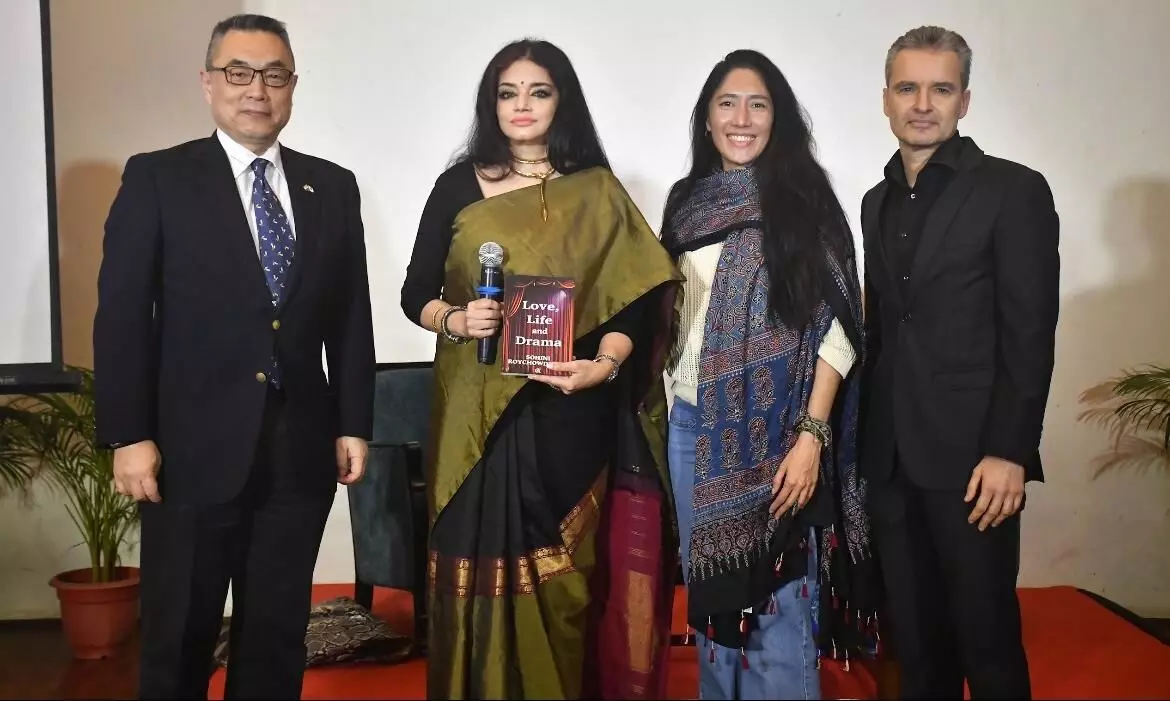


‘Love, Life and Drama’ by danseuse and writer Sohini Roychowdhury is a contemporary engagement with mythology, feminism and lived experience. Drawing on dance, philosophy and storytelling, the book revisits familiar mythological figures not as immutable icons but as emotionally complex and conflicted beings, unsettling long-held notions of virtue, devotion and desire.
The book, published by ‘Comm Dot Media Publishing’, was launched at the Saturday Club, Kolkata, in conversation with Shampa Mukherji and Marc Boudin, Director of Alliance Française Kolkata, as the chief guest. Author Linda Bortoletto, Katsunori Ashida and the Acting Consul General of Japan in Kolkata also graced the occasion as special guests. The event became a wider discussion on cross-cultural narratives, gender and the continuing relevance of mythology in a changing social landscape.
At its core, ‘Love, Life and Drama’ treats mythology as a living narrative tradition rather than a fixed inheritance. Roychowdhury argues that myths have historically functioned as social instruction manuals, shaping ideas of duty, endurance and morality, particularly for women. Her approach resists reverence without inquiry, offering instead a critical feminist lens that invites readers, especially younger ones, to question the emotional codes embedded in these stories.
Much of the book focuses on female figures from myth and classical aesthetics - Ahalya, Draupadi, Kali and the Ashtanayika, the eight archetypal heroines of Sanskrit poetry. Traditionally, these women have been admired for emotional depth while being defined almost entirely through their relationship to the male protagonist. Roychowdhury examines how this framing aestheticised female suffering and positioned emotional labour as a feminine ideal.
Her contemporary interpretation of Ashtanayika marks one of the book’s most significant interventions. The classical categories - waiting, separation, anger and reconciliation - are re-read as expressions of agency rather than obligation. Waiting becomes choice, anger is understood as awareness and refusal is recognised as self-preservation. This reframing resonates strongly with Gen Z readers, who increasingly reject narratives that romanticise sacrifice and silence in the name of love.
The book also unravels the long-romanticised saga of the Devdasis, moving beyond their ornamental representation as sacred dancers. Roychowdhury traces how religious sanction and social hypocrisy combined to control women’s bodies while denying them autonomy. By placing the Devdasi within a continuum of myth, performance and patriarchy, the book reveals how reverence often masks systemic exploitation. This uncomfortable history continues to inform conversations around art, gender and power.
Roychowdhury is unsparing in her critique of how mythology has disciplined women while appearing to elevate them. Ahalya’s redemption, she points out, is conditional upon punishment and erasure. Draupadi’s rage is validated only when it serves a larger moral order, not when it asserts personal dignity. Even Kali’s ferocity is carefully circumscribed, celebrated as a divine exception rather than accepted as a human possibility. Across narratives, women’s power is permitted only when it can be ritualised.
What distinguishes ‘Love, Life and Drama’ is its accessibility. Roychowdhury avoids academic jargon, grounding her arguments in lived experience and insights from performance. Dance emerges as both archive and resistance - a space where gendered expectations have been enacted and contested. This approach makes the book particularly engaging for younger readers, drawing them toward mythology not through nostalgia but through relevance.
Importantly, Roychowdhury writes from within the traditions she critiques. Her familiarity with classical forms lends authority to her analysis and prevents the book from becoming dismissive of the past. Instead, ‘Love, Life and Drama’ argues reinterpretation rather than rejection, insisting that mythology must evolve to remain meaningful.
In a time when mythology is frequently simplified or politicised, ‘Love, Life and Drama’ offers a measured, thoughtful intervention. By foregrounding questions of agency, voice and representation, Sohini Roychowdhury reclaims myth as a space for inquiry rather than obedience, making a compelling case for why these ancient narratives continue to matter to contemporary readers.