
Tapestry Of Dream And Memory
Easterine Kire’s The Sky Husband weaves dream, memory, and history into luminous stories where love transcends time, language, and the boundaries of the visible world


God speaks to us through our dreams, says the wise woman Hami. Her neighbour Mimi has learned this truth, and it passed down in turn to her daughter Aniya. When Aniya - lovely, young, wealthy - begins to have a recurring dream about the man she is going to marry, it is Hami in whom she confides. And Hami - elder, experienced, elemental - ensures that the knowledge encoded in the dream can find realisation in their reality.
The titular story of Easterine Kire’s The Sky Husband is as expansive and poetic as the other seven short stories in this volume by an author whose craft is finely attuned at this height of her acclaimed career. Chan, the protagonist of “Chan and the Blue Forest”, does not dream — because he is lulled into long carefree sleeps in the arms of a beautiful forest spirit who has enchanted him away from his family. The ‘magical realism’ of this tale is narrated by an authorial stand-in, Noni, who recounts it from an interaction with a Manipuri student at JNU’s School of Social Sciences, where she has delivered a talk about “writing from the heart, writing what you love, believe in and care for, and not writing to fulfil people’s expectations.” But although Noni believes in this message, and although she goes on to meet Chan herself (she is struck by how extraordinary he looks when his face catches the light), his truth does seem unbelievable. “Who would believe me if I tried to share this story? I couldn’t think of anyone in my group of acquaintances and friends who would believe such things were still happening. My publisher would give a listen and remark, ‘Oh, that’s very good fantasy stuff. Why don’t you write a novella about that?’”
In “The Tracker”, Ashi doesn’t have time to dream either. In the present day, when the story begins, she is an underappreciated wife in her sixties. In 1960, where the story travels, she was a new recruit of the Naga Army who became an invaluable asset for her keen sense of smell which could identify various animal scents and therefore ease out hunting. Theirs was an itinerant army which never stayed in the same place two nights in a row and never had any time to rest.
“Cherry Blossoms in April” also depicts the political history of the Nagas. In 1944 Kohima, which the Japanese occupy upon promises of liberation from the British, love blooms between a captain and a local. To Sanuo, Akio is her sky husband. The chasm of language is erased through expression. “How many moments and hours and days did they have together? They were absorbed in each other, transcending speech, using only hand movements to tell each other their secrets and make each other happy. These are never the memories that remain and comfort. They are too fragile. Perhaps we were never meant to love on earth. The finest love stories always end in death or parting. Perhaps we overreach ourselves when we love.”
If “Sometimes Life” presents the soft romantic dream of two lovers named Bani and Liam reuniting after a fateful misunderstanding which caused a thirty-year-long silence, its partner in “Bani’s Story II” is “a living nightmare” for its protagonists. There is a fateful error again — but one which results in a life taken too soon, and the devastation left behind for all those who survived. “Dodili Va’anilo” is about suffering too: dreams erased because rest itself is impossible: “A persistent darkness fuelled the silent battle between light and gloom, truth and reality. An inky blackness unrelieved by starlight. Shula had never known such despondence before… And as she lay there, self-accusation entered in. She deserved to be deserted. The depths of despair that gripped her were indescribable.” But the title is an indication of love’s triumph after all. The beloved is a loving shepherd among the lilies, and can be relied upon for light.
“How All Love Stories Should End” is a final confirmation of cathartic destiny. The author returns as narrator for Uncle Ben and Aunty Nima (perhaps Rev. Dr I. Ben Wati and Nirmala Mahanty), who lived sixty years together before dying sixteen days apart. Romeo and Juliet were given a contrived ending by Shakespeare: “... even the cleverest playwright surely could not have written an ending as beautiful and harmonious as that of Uncle Ben and Aunty Nima… Their spirits, briefly apart for some days, are now reunited beyond all fear of parting. Could any love story come up with a better ending than this one designed by the master storymaker?”
This is a book by a master storyteller. A rich tapestry of spiritual traditions extends as the bedrock and firmament of knowledge. Insights on character have been honed over a lifetime of observation. Gentle and profound, but fundamentally resistant to simplistic categorisation, Kire’s writing sometimes feels like a vivid dream diary recorded for posterity. She is not writing fantasy, and is averse to terms like ‘magical realism’ because they fail to adequately convey the luminous literary imagination she inherited from her elders, which she has in turn left for us as alternate ways of seeing.
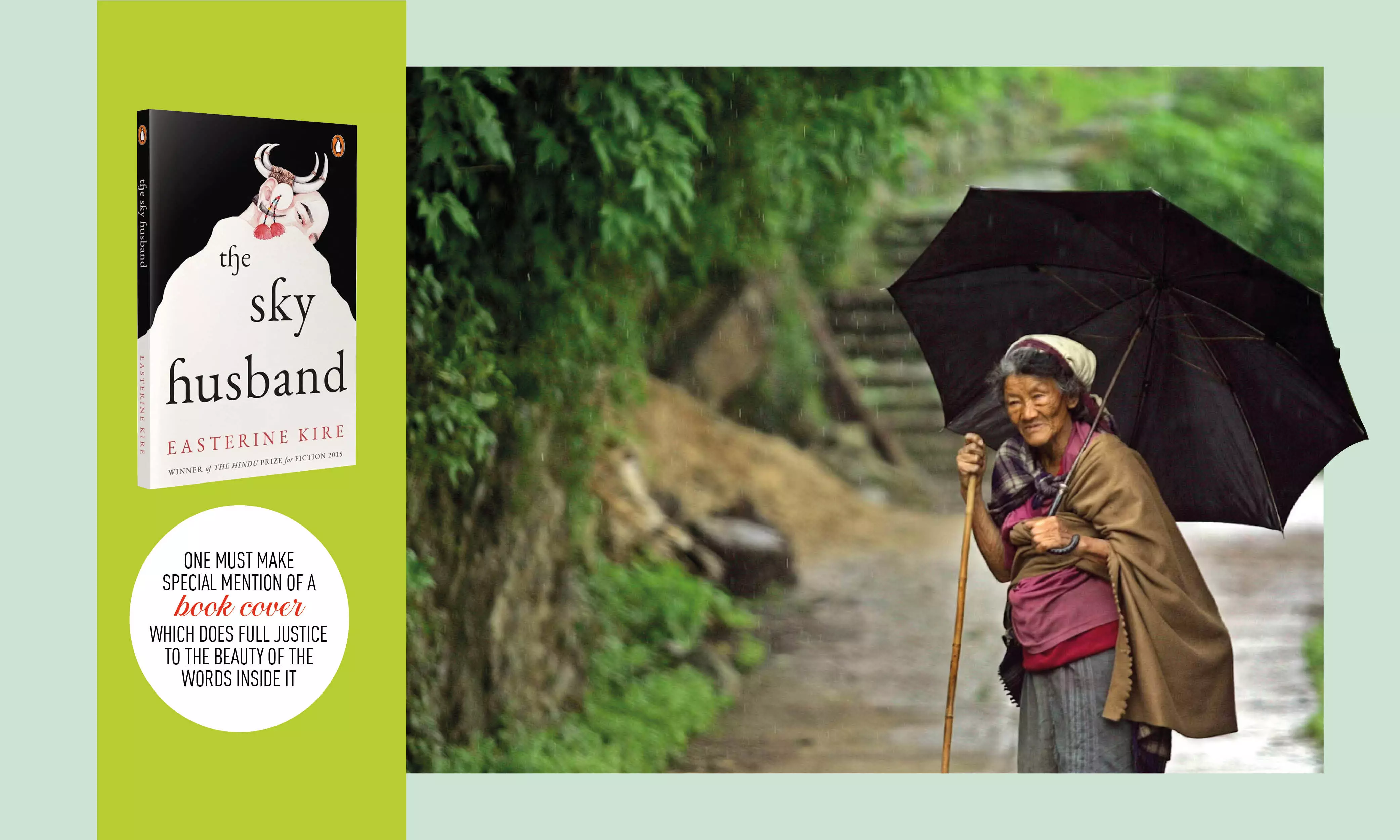
One must make special mention of a book cover which does full justice to the beauty of the words inside it: the cover illustration by Ogin Nayam is stunning, and Aakriti Khurana’s design locates it in an elegant continuation of waves across the back. It is evocative and mystical and stays with the reader.
God speaks to us through what we receive in chance encounters with art, music, trees, animals, strangers, friends, family — books. There is much we cannot and will never understand, but fleeting moments of clarity can serve as visions to overarching patterns which transcend time. The titular protagonist in Lakshmipriya Devi’s recent BAFTA-winning film is a Manipuri boy who remembers to pray to God when he needs a favour and then proceeds in a sweet imitation of what he has seen his mother do. Our Gods will continue to vary, as will the ways in which we understand their messages. God will continue to speak to us, as Kire demonstrates, through the magic and mundanity of life itself.



