Memory, Discipline and Growing Up
'Charlie’s Boys' is a deeply nostalgic memoir that traces boyhood, discipline and growing up at St Columba’s as India itself moved through profound social and political change
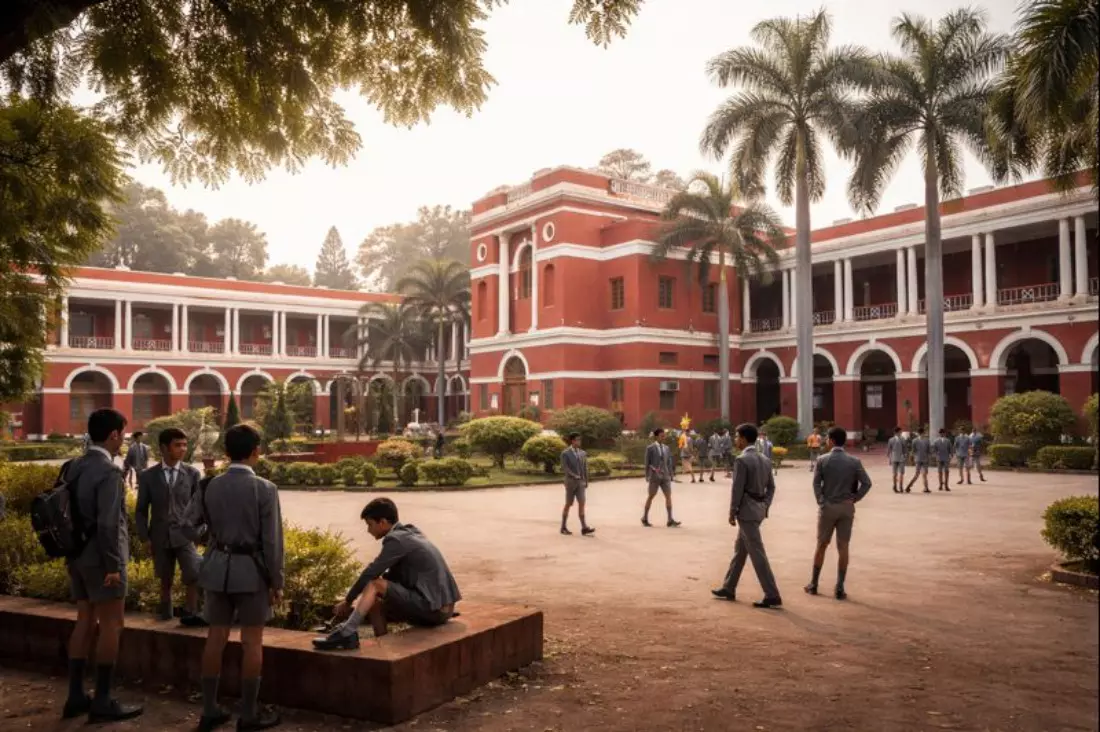


Much before Modern, DPS, Sanskriti, Sriram, Vasant Valley and IB schools marked their presence in the national capital, there was the one and only St Columba’s, which opened its portals on January 7, 1941, when the Empire was in decline but still a dominating presence. Located in the heart of Lutyens’ Delhi, it catered to the sons of the political, defence, civil services and professional elite of the city.
It was to this institution that our protagonist, Ajay Jain, was admitted 34 years later, on January 6, 1975, in KG-D, under the tutelage of Mrs Ruby Aimond, who continued to remain the teacher for this section for all the 13 years he was in school, and long thereafter. He recalls his class teachers: Mrs M Robinson in Class 1-D, Mrs Monica Singh in Class 2-D, Mrs Nazareth in Class 3-D and Mrs J Wintle in 4-A. This was a fifteen-month academic year, as the school shifted from the January–December academic year to April–March. Mrs U Das taught him in V-D. This also marked his entry to middle school, with the privilege of using a fountain pen instead of a pencil!
The headmaster of the middle school was Br Eric D’Souza—a brilliant academician and a man of many parts. He was a thespian, quizmaster and a sportsman who could dribble a football, swing a cricket ball and wield a hockey stick with equal felicity. Endowed with a photographic memory, he was “an alchemist whose students turned 24K gold”. For some inexplicable reason, Br D’Souza gave him the moniker “Jumbo”. Mr C Innis was his scout teacher and Br Fernandes taught him in Classes IX and X; they were then the big boys of the middle school.
More than a page is devoted to the very popular Manju Kak, “the most beautiful history” teacher, who made the subject so real and alive that Ajay wanted to be a modern-day Otto von Bismarck, the architect of modern Germany. He was delighted to be asked to deliver an appreciation of her strengths on Teachers’ Day, even as he fumbled with the pronunciation of “idiosyncrasy”. Siddharth Mukherjee, who went on to write The Emperor of All Maladies, produced a magazine called Eureka, but Ajay admits he was too lazy then to contribute to it.
The memoir is a record of his 13 years at school, which marked his transition from boyhood to adolescence. It has been recorded as diary entries, and the reader gets a glimpse of what it was like for a middle-class boy in an era when power supply was erratic, Ambassador cars marked status, most families could not afford a black-and-white TV set, and the popular brands were Canon, Weston, Bigston, Beltek, Televista, Crown, Texla and Uptron. He writes about the ban on Coca-Cola, the orange bar at 50 paise, airline luggage tags, the brutal murder of Sanjay and Geeta Chopra, the day of the class photo, learning photography from Rahul Gandhi and sharing his cheese sandwiches. Other entries relate to Juhi Chawla winning the beauty pageant, the assassination of Mrs Indira Gandhi, and the closure of school as Delhi reeled under the riots that followed.
India in Transition: 1985
Let me quote him from his entry dated January 1, 1985: “Our generation was at the forefront of the great transition… the year gone by was one of the most tragic in India’s history. But the new year was one of hope, one of anticipation. There was optimism in the air. The country had a new Prime Minister, the youngest ever, Rajiv Gandhi—an alumnus of St Columba’s… winds of change had been blowing across the world, and it was a matter of time before India too would be swept in a gale…”
He continues, “Unfortunately, there was a recklessness to the growth story. We would be the first generation in India to bring unimaginable prosperity and also to wreak immeasurable havoc. Our formative years were of material deficits, yet our heads always felt light and free. Our children have only known surfeit, yet they suffer from a mental health epidemic.”
Shah Rukh Khan’s Sword of Honour
This was the year Shah Rukh Khan won the Sword of Honour, but then joined Hansraj College as he was miffed with St Stephen’s for not giving due regard to the honour extended to him by the school. Ajay brims with pride when he talks of his academic accomplishments in Classes IX and X. But he also tells us that “bird watching” was not about ornithological feathers, but about ogling at girls from CJM, Mater Dei and Loreto. The girls from St Thomas’, who occupied the first row in inter-school competitions in their short skirts with “legs suggestively apart”, had all the boys gaping at them.
Defection to DPS, and back!
Senior school—or Class XI—saw a change from Section D to C, for it offered the PC2M combo (Physics, Chemistry, Computers and Maths). But then three of them—our protagonist, Rohit Valia and Anish—defected to DPS R.K. Puram, as it was regarded as a sure-shot pathway to IIT. They came back after five days, as if nothing had happened, but after some reluctance, Principal Br Pinto reinstated them following a solid firing. The entire section was once suspended for the paper and orange missiles they threw at each other and the teacher in class. An attempt at sex education and anonymous correspondence with the CJM girls of Class XI did not quite succeed.
By 1986, the honeymoon with Rajiv Gandhi was over—especially on account of the position he took on the Shah Bano case, the mishandling in Ayodhya, and the scandal surrounding Bofors. On April 1, Brother Pinto left, and then the countdown began, as Class XII was the terminal year in the school. The last entry is from May 1988, when he scored a 99 in Maths, but as the ISCE board believed that no one can be perfect, one mark was deducted.
Who was Charlie?
Finally, who the hell was Charlie? In this day and age of “political correctness”, it is difficult to recall a time when “spare the rod, spoil the child” was the accepted norm—certainly for an all-boys school. Charlie was the baton, which came in two established forms (the thin and the thick cane) and seven supplementary formats—the ruler, the leg of a chair, thorn-laden branches, the hand, the foot, the feather duster stripped bare, and the blackboard duster. This was raw corporal punishment meted out to enforce discipline, but these were times when one dared not complain at home, for fear of yet another whacking. All of Charlie’s Boys bore it well, convinced it was all for a good cause. No wonder, then, that this is the title of this wonderful “boyhood memoir”.
I close with these lines taken from the introductory chapter:
What is Memory?
“What happens when you stir a memory? It is like placing a spool of film in a projector and flicking it on. Evoking nostalgia like nothing else can. I watched scenes play out in front of my eyes. Endlessly. And tangibly. Not in three dimensions, but in four—add emotion to it. But the past is not something you can leave behind…”
Certainly not, if you are a Columban alumnus.