Beyond Dynasties, Beyond Old Politics
Sushil Manav’s Beyond Dynasties examines how the BJP reshaped Haryana’s politics, challenging decades of caste-driven dynastic dominance
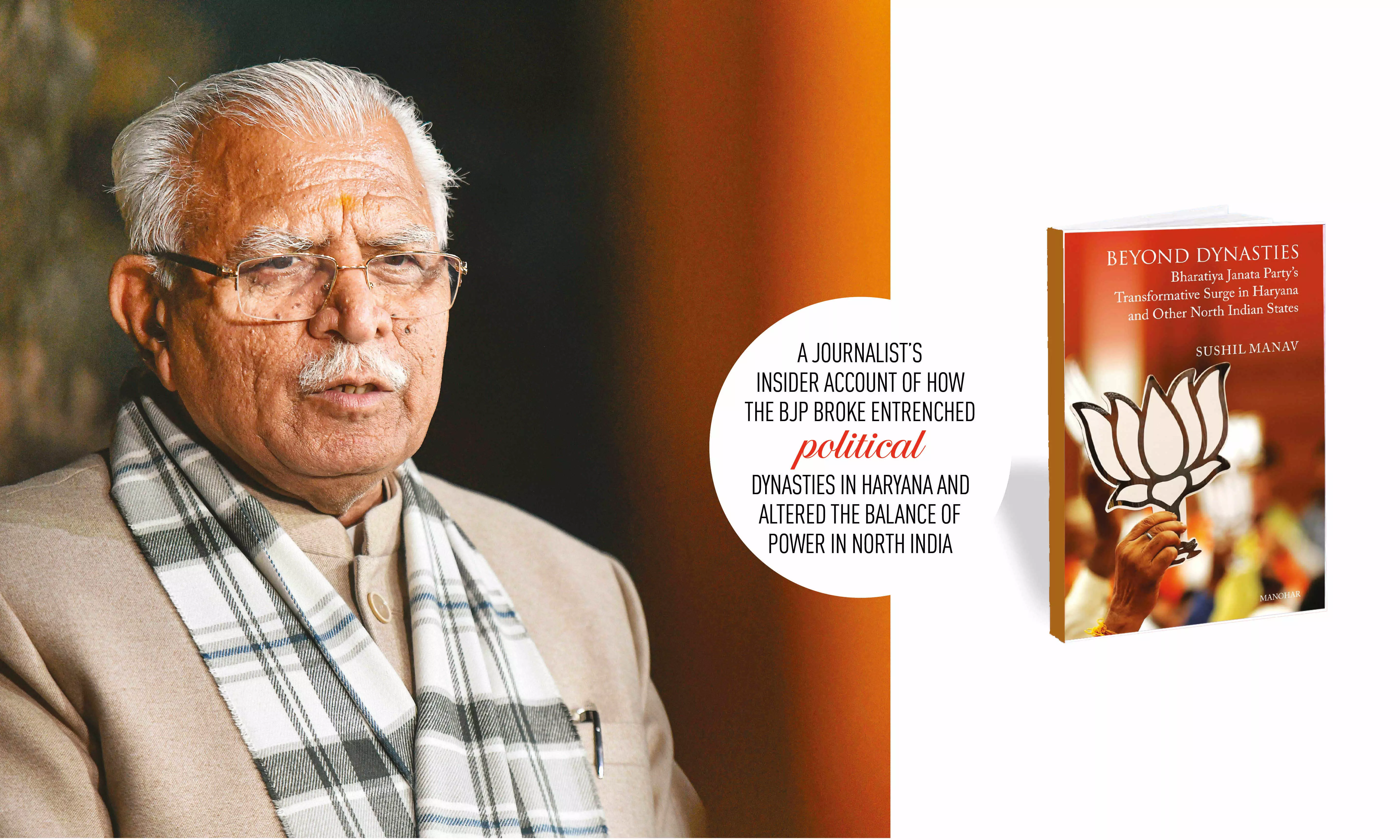


For 42 years, no government in Haryana won back-to-back elections on its own. Not Congress, not INLD, not any of the coalitions that held office by threading together defectors and desperate alliances. Then a party led in the state by a man with no land, no Jat surname, and no family political legacy did it twice. If you want to understand how that happened, and what it means for Indian politics, Sushil Manav's “Beyond Dynasties: BJP's Transformative Surge in Haryana and Other North Indian States” is the only book that comes close to explaining it.
There is something almost audacious about a working journalist writing a book about the very party he has spent decades covering, and making no apologies for it. Manav, who has reported Haryana politics for The Tribune, Millennium Post, and more recently The Print, has done precisely that. The result is a book that reads less like an academic treatise and more like a long, honest conversation with someone who has sat through countless press conferences in Chandigarh, chased MLAs down corridors in the Haryana Vidhan Sabha, and knows the names of the sarpanches in Sirsa the way most Delhi commentators know little beyond Lutyens.
That is both the book's greatest strength and, at moments, its vulnerability.
The central argument Manav makes is not subtle. The BJP's rise across Haryana, Uttar Pradesh, Punjab, Delhi, and Uttarakhand represents a historic rupture from dynastic politics, the Chautalas, the Hoodas, the Badal clan, the Mulayams. From 1972 until 2014, no single party in Haryana won a consecutive absolute majority. The BJP did it twice, in 2014 and again in 2024. In 2019, the party fell short of majority with 40 seats in 90 member assembly, and managed to run government for 5 years by cobbling together government with Dushyant Chautala’s JJP that won 10 seats. For Manav, this is not mere electoral arithmetic. It is a civilisational reset of sorts, a dismantling of the feudal political architecture that kept voters captive to Jat strongmen and caste equations for half a century.
He builds this case patiently, beginning with Haryana's political history from its formation in 1966 through the dizzying carousel of governments, floor-crossings, and coalition arithmetic that defined the state until Narendra Modi walked onto the national stage. Readers who have forgotten that Bhajan Lal toppled Devi Lal's government in 1979 by taking his MLAs to Congress, or that the 2005 elections handed Bhupinder Singh Hooda a historic 67-seat mandate while BJP was reduced to just 2 seats, will find the early chapters a useful and readable primer. Manav has clearly lived this history rather than merely researched it.
The portrait of Manohar Lal Khattar is the emotional and intellectual centrepiece of the book. Manav presents him as the anti-politician politician, no family name to trade on, no caste community to consolidate by birth, no land-holdings in the state's fertile belt. For Haryana, a state where the Jat community has historically treated the chief ministership as near-hereditary entitlement, the elevation of a Punjabi Khatri as CM was not just a political decision but a provocation. What makes Manav's account compelling is that he does not lionise Khattar uncritically. The handling of the 2016 Jat reservation agitation, the farmers' protests of 2020-21, and Khattar's eventual quiet exit in March 2024, all of it is covered with the fair-minded recognition that governance has costs, and the BJP in Haryana paid some of them.
Where Manav is on particularly solid ground is in writing about the BJP's social engineering, the deliberate effort to build a non-Jat majority coalition by bringing OBCs, Dalits, and non-dominant castes into a new political alliance. The Parivar Pehchan Patra, the welfare delivery mechanisms, the transparent job recruitment through HSSC and HPSC that ended the era of backdoor appointments, Manav treats these not as press releases but as lived realities, citing a Dalit woman in Sirsa who told him that the PPP's free ration scheme was the difference between eating and going hungry.
That ground-level texture is this book's finest quality. When Nayab Singh Saini, an OBC leader, replaced Khattar before the 2024 elections and the party defied anti-incumbency to win 48 seats, Manav is there to explain why, not just in terms of strategy documents from party headquarters but in terms of what voters in Rohtak and Fatehabad were actually saying.
The book's weaknesses emerge in its more expansive chapters on UP, Punjab, and Uttarakhand. Manav is candid in the preface that his Punjab coverage spanned only two years and his primary immersion has been Haryana. It shows. The UP and Uttarakhand chapters read more like competent journalism than first-hand testimony. The Punjab chapter, while acknowledging the BJP's limitations in a Sikh-majority state where the farmers' protests created a near-permanent wall of hostility, does not quite carry the depth of analysis the Haryana chapters do.
There are also questions the book raises without fully answering. The BJP's consolidation of power in north India has been built on a particular kind of majoritarianism, the consolidation of non-Yadav OBCs and upper castes in UP, the sidelining of Jats in Haryana, the Hindutva mobilisation in Uttarakhand. Manav acknowledges that Dalit and Muslim communities have felt the costs of this new political order, and that Adityanath's UP has had its share of controversies. But the book's underlying framework remains broadly celebratory of the transformation, and readers who want a harder interrogation of what has been displaced may wish for more.
The Lokniti-CSDS survey chapters are a useful addition, offering quantitative grounding for the political shifts Manav describes from the field. They sit a little awkwardly in a book that is otherwise warm and personal in register, but they serve their purpose.
Despite these caveats, “Beyond Dynasties” is a book that matters, and not only because it is one of the few book-length accounts of the BJP's rise in Haryana written by a journalist who covered it from the inside out. It matters because Manav is honest about his own limitations, honest about the contradictions of the period, and honest about the fact that for millions of ordinary voters in these states, the end of dynastic politics is not an abstraction but a felt experience.
North India's political story after 2014 has generated enormous commentary and almost no sustained reportage from those who were actually there. Manav was there. That counts for a great deal.