Two-Wheel Nation
India may dream of glitzy cars, but a majority of people still work, live and survive on two wheels, zig-zagging through traffic as they plan their future
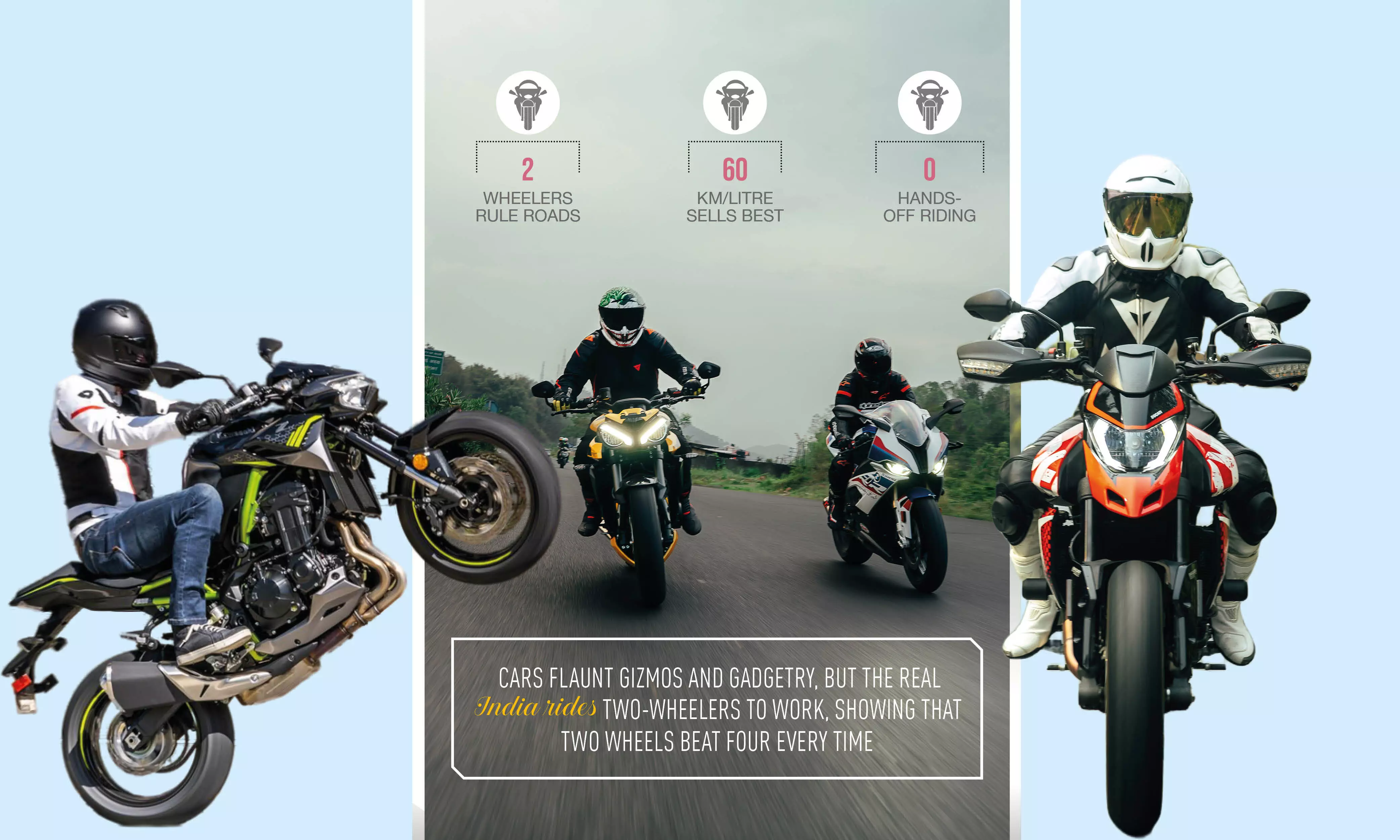


Relive the daily morning madness. At 6.30 am, before India’s cities fully stretch awake, the nation is already on the move. Not in SUVs with panoramic sunroofs or sleek sedans boasting adaptive cruise control, but on scooters and motorcycles stacked with schoolchildren, tiffin boxes, office bags, gas cylinders and the agonizing urgency of everyday life. This is the India that rarely appears in glossy launch presentations, the India that balances itself expertly on two wheels.
A Honda Activa hums past without ceremony or ado. A Hero Splendor ticks off kms like a monk high on nirvana. A TVS Jupiter squeezes through traffic gaps that would give SUVs a heart attack. None of them make headlines, but they make mornings possible. Despite the brouhaha around car launches, connected dashboards and EV roadmaps, India remains — by habit, necessity and instinct — a two-wheeler nation. Over two-thirds of personal vehicles sold are motorcycles and scooters. They are not lifestyle statements, but tools for surviving life. They do not offer escape, they promise arrival.
That this reality sits outside our national imagination is odd. Cars dominate advertising budgets, policy discussions and aspiration boards. Two-wheelers? They simply get on with the job, threading through traffic with a sense of purpose that cars can only admire from a distance.
Quiet Backbone
Two-wheelers have always been India’s equaliser. They flatten geography, shrink distances and create opportunity where infrastructure falls short. A scooter does not ask for wide roads, dedicated parking or forgiving EMIs. It asks only for balance, alertness and a certain philosophical acceptance of chaos.
For years, the market rewarded the basics. Fuel efficiency trumped all else. Reliability mattered more than design. Service reach outweighed innovation. The Hero Splendor became a national institution not because it was exciting, but because it refused to die. The Bajaj Pulsar, when it arrived, added just enough attitude to make performance aspirational, yet it did so without sacrificing practicality.
The ecosystem evolved quietly, but incrementally. Better brakes. Stronger frames. Durable engines. Rarely headline material, these were nonetheless deeply consequential. In a country where millions ride daily on our death-trap roads, even small improvements compounded into national impact.
Even when electrification knocked on the two-wheeler door, there was no drama. Only arithmetic.
Electric Turn
India’s EV two-wheeler revolution is woefully misunderstood because it simply refuses to behave like a revolution. It doesn’t shout disruption or promise to redefine mobility. It only solves problems. For urban commuters, electric scooters like Ola S1, Ather 450X, TVS iQube and Bajaj Chetak make cold, financial sense. Lower running costs. Fewer moving parts. No clutch fatigue. No fuel queues or costs. Plug in at night, ride in the morning. This is not environmental idealism; it is household economics.
Early attempts were rocky. Battery fires, software bugs, exaggerated range claims and build-quality issues justified all the scepticism. But the market learnt, it evolved. Manufacturers recalibrated. Safety standards tightened. Battery management systems improved. Charging networks — still slow and imperfect, but expanding — began to appear where demand demanded that they do.
Crucially, adoption did not stall. It remained steady, driven by delivery riders on electric scooters zig-zagging through cities, office commuters calculating monthly savings and students discovering that ‘range anxiety’ matters less when your daily commute is 18 or 20 kms, or 22 or 24. Contrast this with cars, where electrification remains wrapped in hesitation. There are resale worries, charging etiquette and the eternal ‘Is now the right time?’ Two-wheelers didn’t wait for the ideal world. They adapted.
There is a lesson in their humility.
Sunday Dreams
Yet, to reduce India’s two-wheeler story to utility alone would be unfair. Running parallel to the commuter universe is a smaller, older and persistent dream — superbikes and premium motorcycles.
This is an India that wakes early on Sundays, rolls out an Enfield Interceptor or Bear 650, a KTM 390 Adventure or a Kawasaki Ninja 650, and escapes before city traffic takes over. It is a niche, but a telling one. For decades, Indian riders lusted after machines they could only admire in magazines or YouTube clips: Hayabusas, Fireblades and BMW GS’ carving alpine passes far removed from Indian potholes.
Import restrictions and eye-watering prices ensured that superbikes remained aspirational trophies rather than daily tools. But the dream endured.
The premium motorcycle market has matured now. Ducati Multistradas, Triumph Tigers, BMW R 1250 GS and superbikes from Kawasaki and Suzuki sell small, but sell with intent. Buyers are informed, demanding and aware of global standards. They understand traction control, ride modes, quickshifters and electronic suspension not as gimmicks, but as enablers of safer, more enjoyable riding. Here, tech feels purposeful, not excessive. Yet, this remains garnish, not staple. These bikes colour India’s riding culture, but they do not carry the nation to work on Monday mornings.
Unequal Attention
Here lies the irony. While two-wheelers carry a bulk of India’s mobility burden – commuters, delivery boys and informal workers – they receive a fraction of the technological and safety focus lavished on cars. Cars debate ADAS, lane-keep assist, adaptive cruise control and driver monitoring systems.
Two-wheelers debate potholes, stray animals and calculate whether that bus will swerve. Advanced rider aids arrive slowly. Infrastructure treats riders as expendable, not an essential. This imbalance is not merely technological, it is philosophical too. Policy gravitates toward the visible and aspirational. Two-wheelers, despite their numbers, remain oddly invisible in strategic conversations.
Yet, progress continues. Better tyres. ABS going mainstream. Improved chassis dynamics. Incremental engineering that saves lives without demanding applause.
Indian Lesson
There is something deeply Indian about this narrative. While global mobility debates obsess over autonomy and artificial intelligence, India’s real progress unfolds in quieter revolutions. In Activas and Splendors that keep families afloat. In electric scooters that slash monthly expenses. In weekend riders chasing sunrise on open highways.
Cars will continue to evolve. They will get smarter, safer, more digital. They should. But they will never carry India on their own. That responsibility rests squarely on two wheels. The future is clear. Policy must treat two-wheelers as central, not peripheral, to mobility planning. Infrastructure must protect riders, not intimidate them. Electrification must prioritise scale and reliability over spectacle.
India’s mobility future will not be defined by autonomous cars gliding silently through empty lanes. It will be dictated by the familiar whirr of two wheels heading to work at dawn. Some revolutions don’t announce themselves. They simply arrive. Helmet on, engine warm, ready for another day.