Tech Overdrive
India’s mobility story can’t be defined by ‘wise’ cars, but by how we wield that wisdom. We are a nation where simple ‘succeeds’ and ‘sophisticated’ struggles
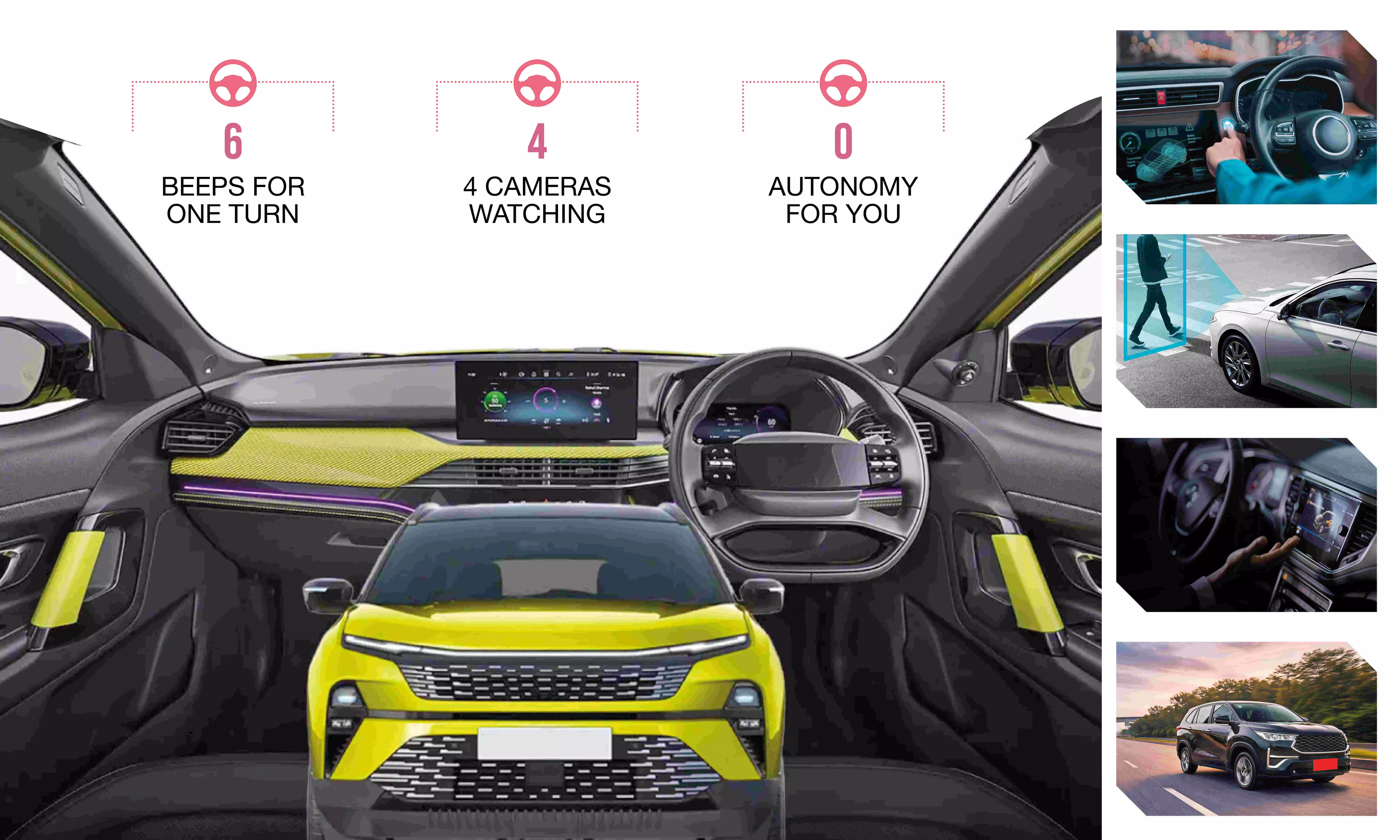


Modern cars no longer greet you with the reassuring clunk of a door shutting; they boot up. You settle into the seat and screens flicker to life, animations begin playing and deep within the dashboard, software clears its throat. By the time you reach for the seat belt to shut the warning beep off, the car is ready to assist, correct, warn, advise and — if sales brochures can be believed —save your life.
Hello auto excess, where ADAS, adaptive cruise, lane-keep assist, blind-spot monitoring, hill descent control, 360-degree cameras, connected car tech and over-the-air updates are no longer exotic gizmos but showroom staples. What was once the preserve of luxury sedans has trickled down to family SUVs and cars that cost less than a kitchen renovation.
The generosity is not accidental. Carmakers are locked in a gadget-race where features sell faster than fundamentals. Bigger touchscreens make for a sexier photograph than a stronger chassis. A long ADAS checklist is more futuristic than better braking. And in India — where buyers have evolved from fuel-efficiency obsessives to feature connoisseurs — technology has become shorthand for value.
The result is a sensory overload. Cars are not just astonishingly capable, but also oddly demanding. They beep if you drift, buzz if you approach a vehicle too quickly, flash warnings if you descend a slope too enthusiastically and admonish if your hands linger off the steering wheel for too long. Driving, it would seem, is no longer a solitary act; it is a community engagement.
Feature Inflation
Much of this tech invasion is driven by good intentions. Stricter safety norms, crash regulations and global best practices have forced carmakers to adopt electronic aids. ADAS, in particular, is sold as a guardian angel — a co-driver that watches you like a hawk for signs of fatigue, distractionyou’re your penchant for error (you are human, after all).
To be fair, these systems do work — when conditions allow. Adaptive cruise reduces fatigue on open highways. Automatic emergency braking can prevent costly mistakes. Hill descent control takes the drama out of steep slopes, especially for new drivers. Lane-keeping assistance can act as a gentle nudge rather than a digital slap.
But India and Indians complicate everything.
The Murmur of Birds
Our roads aren’t designed for predictability. Lane markings fade into philosophical suggestions. Speed limits change without explanation. Traffic flows like the murmur of birds — instinctive, aggressive and oddly coordinated. In such a haphazard ecosystem, technology often finds itself confused, issuing alerts with the anxious enthusiasm of a first-time driving instructor.
There is also a quieter truth that industry-insiders acknowledge but never advertise: many buyers use only a fraction of what they pay for. The novelty wears off very soon. Adaptive cruise is tried once and then abandoned after a sudden cut-in. Lane assist is switched off after it fights a pothole-avoidance manoeuvre. Touchscreen controls are tolerated, never than loved. What results is feature fatigue, the sense that cars are trying too hard to impress, rather than simply enabling the drive.
Human Reality
The issue is not technology itself, but the assumption that more of it automatically equals progress. Cars are becoming smarter faster than the environments they operate in are getting structured. ADAS assumes discipline. Connected tech feigns reliable networks. Software updates presume patience.
Indian driving, however, runs on intuition, negotiation and improvisation. Eye contact at intersections matters more than sensors. Anticipation beats automation. Experience still (and will always) trumps algorithms in traffic that has never read the rulebook.
This is where the conversation needs to go mature. Experts increasingly argue that the next leap in automotive evolution should not be about features, but refining them. Making interfaces intuitive. Reducing false alerts. Ensuring that hill descent control works on broken mountain roads, not just test tracks. Technology should fade into the background, not demand applause. The smartest car, after all, is not the one that interrupts you the most — it is the one that supports you quietly.
Two-Wheeled Reality
While cars debate the philosophy of assistance versus autonomy, the majority of India continues to move on two wheels. Scooters and motorcycles remain the backbone of mobility, ferrying millions through traffic with ruthless efficiency. They don’t offer adaptive cruise control or lane-keep assist. They offer something more valuable: access.
Increasingly, they are offering electricity too. EV scooters have emerged as the most consequential shift in Indian mobility; not because they are glamorous, but because they are practical. Lower running costs. Minimal maintenance and upkeep. Perfect alignment with urban commuting patterns. This is not aspirational buying, it is problem-solving.
Sure, early electric two-wheelers stumbled. Quality issues, software glitches, charging anxiety and battery concerns made headlines. But progress rarely arrives fully formed. Products are improving. Infrastructure is expanding. Buyers are adapting. And adoption continues to rise, driven not by marketing narratives but lived economics.
There is something refreshingly honest about this revolution. No one pretends an electric scooter is a technological marvel. It doesn’t lecture you about lane discipline. It doesn’t issue fatigue warnings. It simply does its job — quietly, efficiently, repeatedly. In a strange way, two-wheelers embody what cars are still struggling to learn: relevance matters more than spectacle.
Balanced Future
What does this mean for India and the rest of the real world? Perhaps that the future of mobility will not be won by the most advanced acronym. ADAS, ABS, EBD, adaptive cruise and connected tech will continue to evolve (and they should — because safety matters). But their success depends on how well they adapt to local realities, rather than imposing Utopian ideals.
Cars must become smarter, but also calmer, clearer and more respectful of human behaviour. Two-wheelers must continue their electric journey, supported by sensible policy and consistent quality, for that’s where scale meets sustainability. Progress doesn’t always arrive with a software update. It can also arrive on two silent wheels, navigating traffic with practiced ease.
India’s mobility story will not be defined by how intelligent our vehicles become, but by how wisely we deploy that intelligence. In a country where simplicity succeeds where sophistication struggles, that may be the most advanced lesson of all.