Indian Auto’s Big Six
India’s booming car market looks fiercely competitive. Yet, behind the glittering showrooms, only half-a-dozen auto firms control the gears and steering column
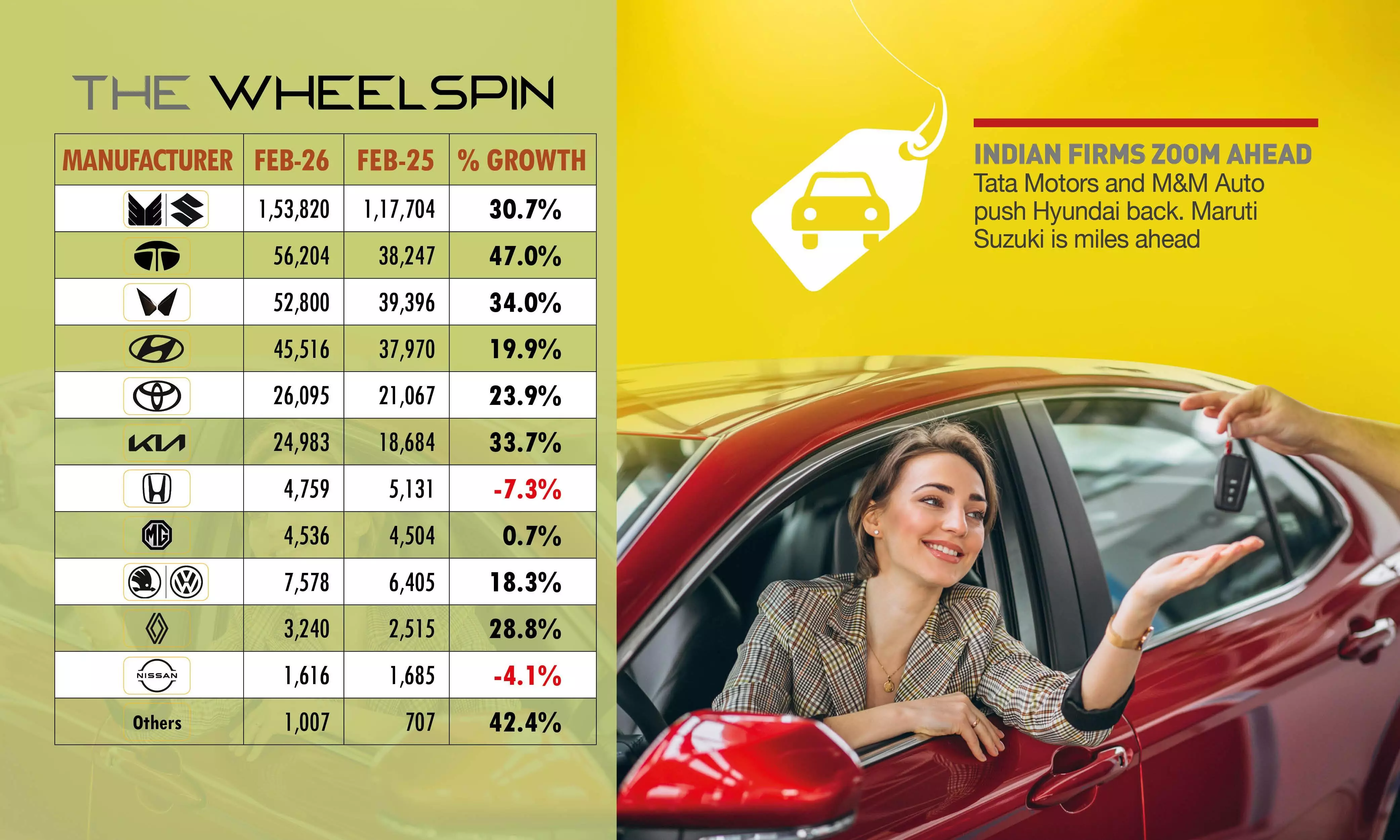


Viewed from a distance, India’s auto market looks like a crowded bazaar. Dozens of brands jostle for attention, showrooms gleam across cities and glossy billboards and advertisements promise ever more features, safety and sophistication. But move closer, scratch the surface and a different reality emerges. India’s car market is not a bustling democracy, but an oligarchy – a battlefield where a handful of generals effectively spit out the bullets, woo the rank and file, and pulverize the enemy.
The numbers tell the story. In 2025, India sold more than 44 lakh passenger vehicles, making it one of the world’s largest and fastest-growing automobile markets globally. Yet, the lion’s share of those cars came from just six companies – Maruti Suzuki, Mahindra & Mahindra, Tata Motors, Hyundai Motor India, Toyota Kirloskar Motor and Kia India. Together, these Big Six account for over 90 per cent of the passenger vehicle market. Maruti Suzuki alone commands close to 40 per cent of sales, more than many other competitors combined.
Below this dominant tier lies a long list of brands fighting for crumbs – the Indian arms of Honda Cars, MG Motor, Renault, Nissan Motor, Citroën and Jeep. Some of these are global giants with illustrious histories. But in India, they struggle to break even 2-per cent marketshare. The contrast could not be sharper – six kings sprint on the highway, while a dozen hopefuls are stuck in toll-booth traffic.
The Network Game
The overbearing reason for this imbalance is far less glamorous than horsepower: it is distribution-power. After all, India is not a single automobile market, but a mosaic of hundreds of micro-markets – from bustling metros and still-prosperous Tier-2 towns to dusty rural districts where roads are still seen only in dreams. Winning on rutty, fissured terrain demands not merely a good car; it also needs an army of dealerships, service centres and spare-parts depots.
This is where the incumbents have built their fortresses. Maruti Suzuki began knitting together its dealer and service network decades ago, long before most foreign automakers looked seriously at India. Today, its reach stretches across thousands of touchpoints, making it possible to buy or repair a car even in remote towns. That network translates directly into trust. Trust leads to sales. The same logic applies to rivals. Hyundai Motor India invested aggressively in nationwide distribution in the early 2000s. More recently, domestic champions such as Tata Motors and Mahindra & Mahindra have expanded deep into semi-urban India.
For smaller players, the gap is daunting. A limited dealership footprint means potential buyers worry about servicing, spare parts and resale value. In a price-sensitive country where the car is often the second-largest household purchase after a home, such anxieties can kill a sale before it begins.
The SUV Juggernaut
If networks built the foundations of dominance, changing consumer taste has widened the moat. India has witnessed an SUV revolution, with buyers moving away from traditional hatchbacks and sedans toward compact and mid-size SUVs. Automakers that predicted this shift are now reaping the rewards.
Mahindra & Mahindra rode the trend with models such as the Scorpio, Thar and the XUV series. Tata Motors struck gold with the Nexon and Punch. Hyundai Motor India and Kia India flooded the market with smaller but stylish SUVs like the Creta, Venue, Seltos and Sonet. Toyota Kirloskar Motor, in turn, leveraged its formidable reputation in premium SUVs with models like the Fortuner.
Lagging brands simply missed the timing. Honda Cars India remained heavily reliant on sedans such as the City for years, even as consumer tastes shifted decisively toward SUVs. Others launched promising models, but failed to update them quickly enough. Their trot just couldn’t match the gallop of the Big Six. In a hyper-competitive market, missing a trend didn’t just hurt; it erased relevance itself.
Trust and Value
Brand psychology has been another decisive factor. Indian buyers care deeply about reliability, resale value and cost of ownership. A vehicle is not merely transportation; it is a financial asset expected to hold value over time. That explains why models from Maruti Suzuki dominate the used-car market and retain exceptional resale value. Its WagonR and Swift line-up regularly top resale rankings, similar to Toyota’s Innova and Mahindra’s Scorpio.
Such perception creates a powerful feedback loop. Strong resale value attracts buyers. More buyers increase marketshare. High volumes improve the availability of service and spare parts, building even more trust. Breaking into this cycle is extraordinarily difficult. Brands that lack scale or reputation find themselves trapped outside the golden circle, no matter how good their cars may be.
Regulation and localisation have reshaped the battlefield too. In the last decade, India has introduced sweeping changes; from BS-VI emission norms and stricter safety regulations to growing expectations around electrification. Compliance demands investment in R&D, manufacturing and supply chains. Large players have the resources to absorb these costs. Tata Motors, for one, has invested aggressively in electric vehicles, emerging as the leader in India’s EV passenger segment. Domestic manufacturers such as Mahindra & Mahindra are now building entirely new electric platforms.
Heavy localisation also helps. Companies that manufacture extensively within India can price vehicles aggressively while protecting margins. Those reliant on imports or low localisation struggle to match prices in a market where even a Rs 20,000 difference can sway buyers.
The Silver Lining
For the laggards, the challenge is stark, but not impossible. India’s auto market is expanding, driven by rising incomes, urbanisation and better road infrastructure. Yet, the era of tentative commitment is over. To survive, and perhaps someday challenge the incumbents, global automakers must adopt a far deeper India strategy. That would entail building larger dealer networks, localising production extensively and launching products tailored specifically to Indian tastes, not repurposing international models. It also means recognising the cultural and emotional dimensions of the Indian car buyer. For most Indians, trust, practicality and value often outweigh sheer brand prestige.
For now, India’s auto sector resembles a highway where only a few truly control the wheel. But history shows us that any industry built on dominance can be turned on its head by technological upheaval. EVs, software-defined cars and new platforms could redraw the competitive map faster than anyone expects. The giants may rule today, but even kings need to keep an eye on the rear-view mirror.