Dashing Cheetah? Or Lame Horse?
India’s booming used-car bazaar promises dream wheels at irresistible prices – but behind the purr and polish may lurk breakdowns and very costly surprises


It is India’s Greatest Bazaar, the used-car market that resembles a Sunday flea market. Only, the toys are heavier, shinier and capable of either making your dream come true or bankrupting you if you choose unwisely. In this market, there is temptation everywhere. A near-new sedan that costs half its original price. A once-luxury SUV whose seat-leather still smells faintly of prosperity. A hatchback that promises urban freedom at the price of a smartphone upgrade. Alongside you, the buyers line up.
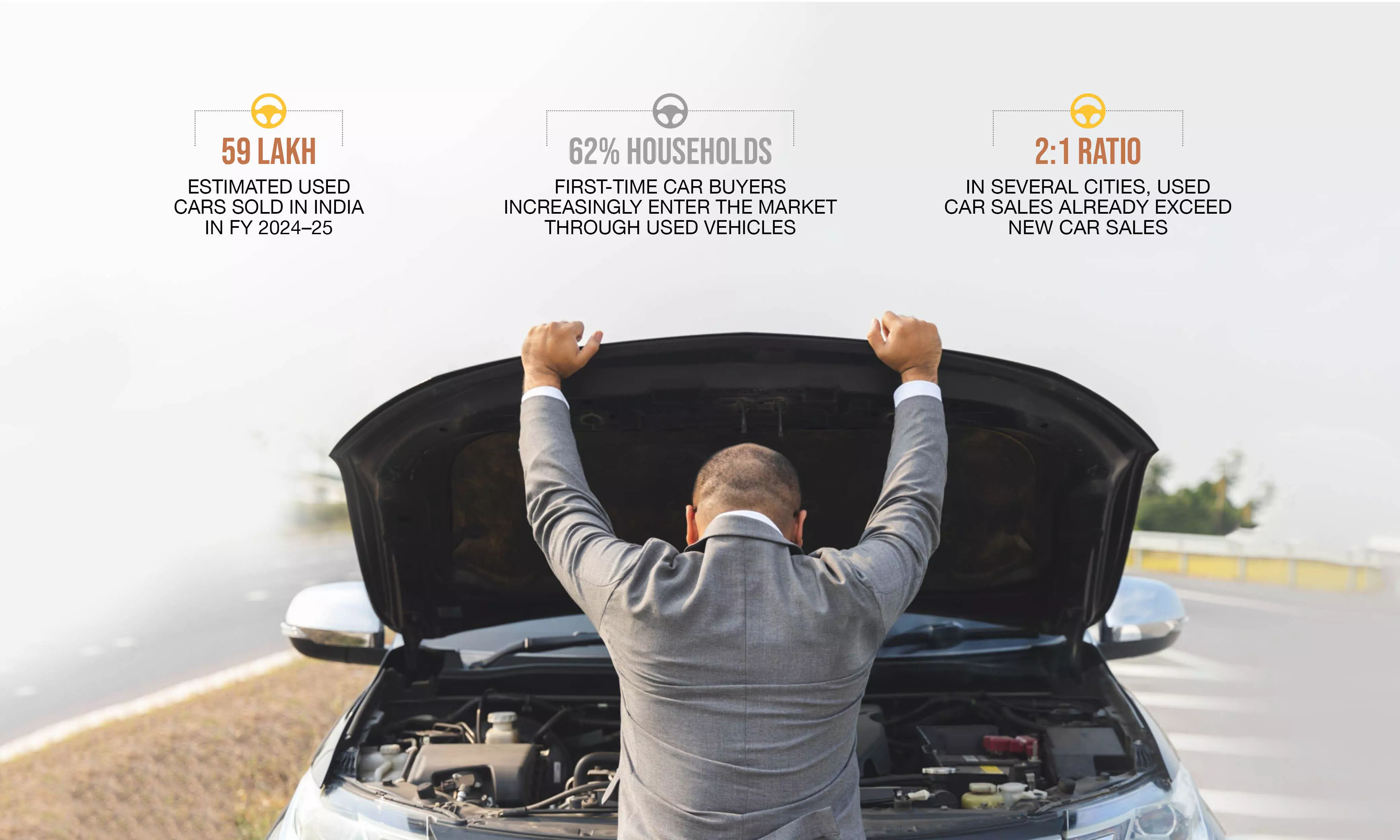
Such is India’s pre-owned car market, the fastest-growing segment of the auto economy. Around 59 lakh used cars were sold in FY 2024-25, and the number is projected to grow sharply to 95 lakh to 1 crore units annually by 2030. The second-hand market has already overtaken new car sales in volume, driven by rising vehicle prices, tighter budgets and the lure of better features at lower cost.
For many Indians, the logic is irresistible. Why buy a bare-bones new hatchback when the same money fetches a three-year-old sedan with airbags, diamond-cut alloy wheels and an infotainment screen that looks like it belongs to Captain James T. Kirk and his starship USS Enterprise? The universe treasure hunt for four gleaming wheels begins.
Could Be Hidden Gems
Truth be told, the used-car bazaar is not all about mechanical mischief, and some offerings do make for fantastic bargains. Consider the cars that never quite found buyers when new. Dealers occasionally offload slow-moving inventory into the used-car pipeline with heavy discounts. The result is a virtually new vehicle with negligible mileage, available at a price that makes accountants weep with joy.
Then there are some cherished machines; the cars owned by enthusiasts. These are rare breeds whose engines have been warmed up gently, whose service schedules are followed with religious devotion, and whose interiors are cleaned with more care than the owner’s living room. Even if such cars have clocked serious kilometres, they remain mechanically sound and visibly rapturous. Their mileage is but a number; their maintenance is the true biography.
In our growing organised pre-owned ecosystem of dealer networks, certified platforms and inspection systems, such gems are becoming visible. Reports suggest that 70 per cent of buyers prefer organised sellers because of perceived transparency and certification. The platforms promise inspection reports, warranties and buy-back guarantees. For cautious buyers, they are a welcome layer of protection in what used to be a purely trust-based marketplace. But even polished bazaars have dark corners.
Them Darker Corners
For every pampered car, there exist a 100 that have lived rather more colourful lives. And the used-car ecosystem includes a thriving underground world of improvisation and ingenuity – desi jugaad. Some vehicles that appear immaculate on the outside are, when internally dissected, mechanical jigsaw puzzles. Engines or parts are replaced with questionable substitutes. Gearboxes are assembled from parts sourced like spare screws at a hardware store. Accident-damaged cars are straightened, repainted and presented as pristine specimens of the auto world.
There are dealers who treat cars less like machines and more like gold mines. A functioning component removed here, another swapped there; each part sold separately before the skeletal remains are pimped up for sale. The unsuspecting buyer discovers the truth only after the honeymoon ends. And his romp on the road is short-lived. The car that gleamed seductively under the lights begins to cough and sputter. The suspension groans like an ageing actor. The electrical system develops moods that would embarrass a once-hot diva. This is that dreadful moment when bargain makes way for liability.
Buyers Better Beware
Triple B. This is why buying a used car demands more than enthusiasm. It requires suspicion, patience and a good mechanic. A proper inspection is essential, preferably by someone who knows that an engine bay can reveal secrets in seconds. A test drive is not a luxury; it is a diagnosis. To listen to the engine. Feel the steering. Watch the exhaust. Study the service history like a stubborn cop would alibis.
Even documentation deserves scrutiny. Ownership records, insurance claims and accident histories can reveal stories that glossy paint jobs will never fess up to. The reason may be duplicitous, but it is simple: the used-car market is expanding faster than regulation and transparency.
Crisil estimates the sector will grow 8-10 per cent annually, faster than new car sales volumes, even as its value approaches Rs 4 lakh crore. Sardonically, that is just about the size of the new-car market too. When an industry grows this quickly, quality has no option but to become suspect.
The Road Ahead
Let’s face facts. The boom in the used-car market is not merely a commercial phenomenon; it is also a social quagmire. For lakhs of middle-class households, a used car is the first step into private four-wheeled mobility. It is the family’s first highway trip, the first school drop-off sans a crowded bus, the first taste of automotive independence. Viewed through this aspirational lens, the second-hand car is not a mere machine. It is an economic ladder.
Given the sheer desire and lust for wheels in India, the next phase of the used-car market will perforce depend on trust. Organised players, certified inspection systems, digital marketplaces and transparent pricing mechanisms must somehow replace the opaque bargaining culture that still dominates many corners of the trade.
Technology can help. Vehicle-history databases, AI-driven inspection tools and digital documentation are already beginning to reduce uncertainty in transactions. And, ahem, regulators can help too. By tightening standards around accident disclosures, odometer tampering and dealer accountability. If tech and watchdogs help, the used-car ecosystem could become one of the most dynamic mobility markets in the world. An efficient circular economy where vehicles live multiple productive lives.
Until then, though, every buyer entering the used car bazaar faces an eternal question – is the machine standing before him or her a dashing buck, ready to gallop without complaint? Or is it merely a lame horse, waiting patiently for its next unsuspecting rider, who will soon discover its hobble?