Clutch-less India
India’s manual-gearbox culture is quietly disappearing, not through innovation and glitzy design but due to traffic fatigue, ease of use and consumer surrender
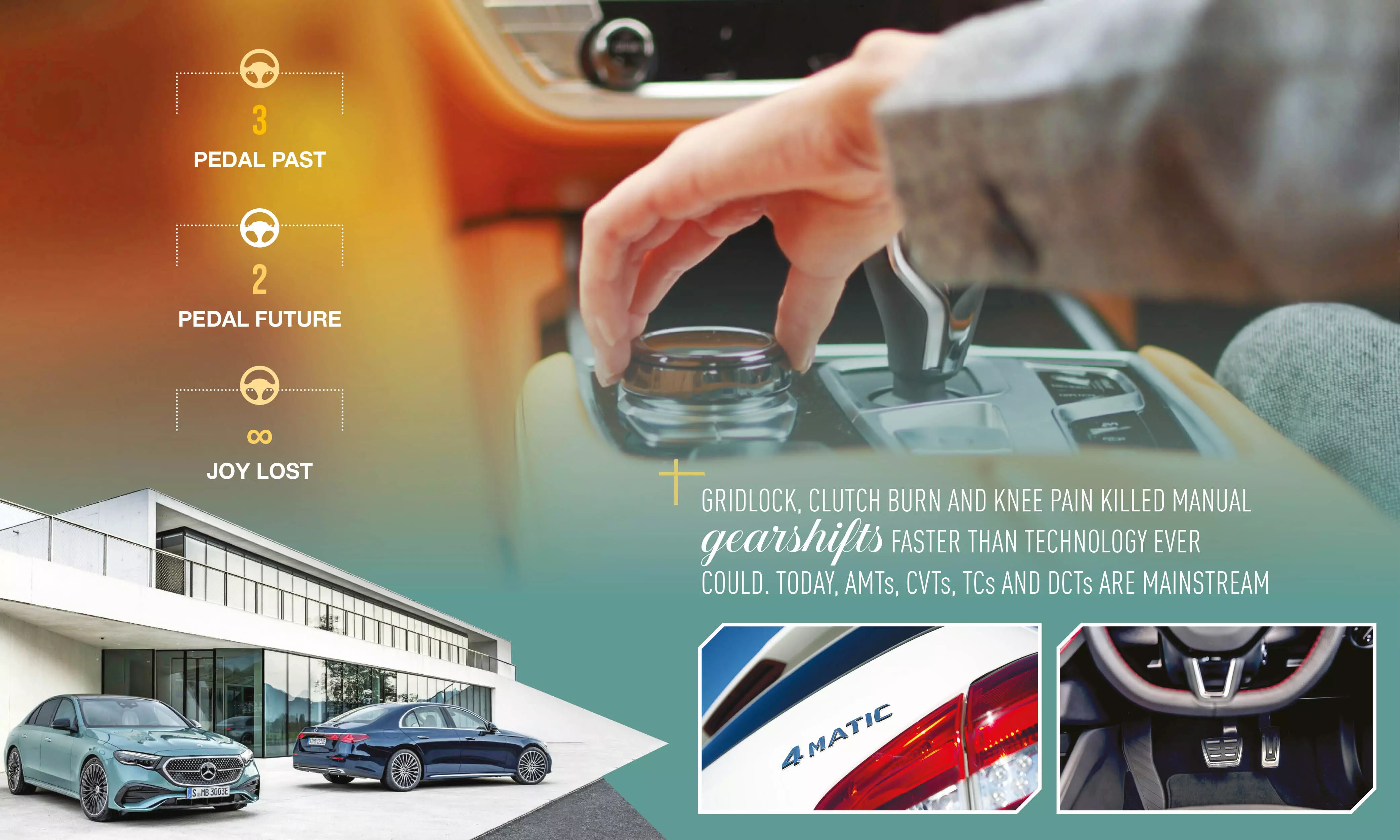


The ‘Left Foot’ is dead. So is our traditional driving logic. The one that said “left foot on the clutch, right hand flirting across gears, eyes darting to mirrors, potholes and pedestrians with India-level multitasking”. There was a time when manual gears were not just common, they were a culture, a way of life, they were how the 80s and 90s taught India to drive. That life, that drive is gone.
An Indian wasn’t a ‘trained driver’ unless he or she learned to balance clutch and throttle on an incline, stall in heavy traffic, restart with dignity and repeat the process a hundred times before breakfast. The manual gearbox was the great equaliser. Whether you drove a humble hatchback or a souped-up sedan, shifting gears made you feel involved, connected, in charge, auto intimacy at its peak. Imperfect, demanding and occasionally punishing, yes, but gratifying nonetheless.
Manuals are Slowly Dying
Across showrooms, manuals are disappearing. Automatics dominate not just premium cars but entry-level hatchbacks and compact sedans as well. Cars that once sold overwhelmingly with stick shifts now see auto variants outsell manuals by a wide margin. Once sacred, the clutch pedal is now an inconvenience. Or worse, an anachronism; a relic gone the way of India’s touted tehzeeb.
India is ready to let go. In fact, it has let go. If there is a single, unassailable villain in the manual gearbox’s decline, it is traffic. Traffic in India is not just dense; it is relentless, unpredictable and exhausting. Stop-start crawls stretch for kilometres. Stop signals last long enough to age a knee joint. Flyovers dump drivers into chaos sans warning. In this scenario, the manual is not engaging. It is beginning to be considered cruel.
Killing India’s Knee Joints
Clutch fatigue is real. Anyone who has spent an hour inching forward in Bengaluru, Mumbai or Gurugram knows the pain. The joy of gear control evaporates when first and second gear become your entire automotive vocabulary. Automatics offer mercy. No clutch. No stalling. No leg cramps. Just creep, brake, repeat.
Buyers noticed this first. Manufacturers have noticed it too. Thus, what began as a convenience has become the default choice. Automatics are no longer lazy, they are worshipped as sensible. In a market increasingly shaped by daily traffic snarls rather than weekend jaunts, sense sells.
Tech Tipping Point
Automatics of old were crude, inefficient, expensive. Early torque converters were fuel-hungry. AMTs were jerky and unloved. By contrast, manuals were cheaper, more efficient and more reliable. That advantage has eroded.
Modern automatic transmissions such as CVTs, refined torque converters and increasingly-competent dual-clutch systems are smoother, quicker and as fuel-efficient as manuals. Paddle-shifters simulate control. Sport mode sharpens response. Hill-hold assist eliminates rollback anxiety. Even AMTs, once mocked, have improved enough to win mass-market acceptance. The result is a generational shift.
Younger buyers, raised on smartphones and touchscreens, do not romanticise mechanical effort. To them, convenience is not compromise; it is progress. The manual’s emotional appeal struggles against this tech wizardry. One by one, automakers are thinning manual line-ups. Performance models have already killed the clutch. A few manuals have been kept alive to satisfy a shrinking enthusiast niche… It is a nice box to tick, not a future to invest in.
Enthusiasts Cry Foul
Driving purists will tell you this is a tragedy. For manuals force attentiveness. They reward skill. They make even slow cars fun. A well-driven manual can feel more alive than a torquier or faster automatic. The act of choosing the right gear, timing a shift perfectly, feeling the engine respond; these are pleasures that no software can ever replicate.
The truth is that India’s roads have lost the argument. Much like our cities, they no longer reward finesse, only endurance. When driving becomes a chore and not an escape, the manual’s virtues turn academic. Enthusiasts may mourn the loss of engagement, but the broader market is voting with aching knees and overworked calves.
Ironically, the shift is happening just as India builds better highways and expressways, places where manuals shine. But sadly, moments of open-road bliss are outnumbered by daily gridlock. And daily realities shape buying behaviour far more than occasional joy.
Economics of Exit
Cold business logic is at play too. Maintaining two transmission types for the same car model increases costs in engineering, certification, inventory and training. As automatic purchases climb, manuals become even harder to justify. This is not unique to India; manuals are falling out of favour in Europe and North America too.
But in India, the exit feels faster and more heartless because the manual was never just an option; it was the norm. It is being replaced in a market that is being standardised around ease. Automatics are aspirational in budget segments and expected in premium ones. Buyers choosing manuals often have to explain themselves; that alone tells the true story.
Progress or Surrender?
What is this moment really about? Progress, laziness or surrender? The answer is all three. It is progress because technology has matured enough to genuinely reduce effort without sacrificing efficiency. It is laziness only if one romanticises discomfort as virtue. It is surrender because Indian infrastructure has beaten the joy out of manual driving for the masses.
What we are seeing is not death of skill, but a reprioritisation of energies. India is choosing where to expend effort and gridlocks just do not deserve it. Sure, something is being lost. Manuals taught us anticipation, patience and joy; they connected drivers to cars in a way that automatics never will. Their slow death marks not just a technical shift, but one in culture too.
Death is Still Far Off
The manual will not vanish overnight. It will survive in enthusiasts, niche performance models and those rural markets where simplicity and repairability still matter. But its days as a default choice are over. The challenge for carmakers is to ensure that the automatic’s future does not become a numb one. Engagement must be reimagined; through better steering, smarter transmissions and cars that invite human intimacy and lust even without a clutch pedal.
For policymakers, the message is simple. Build roads that make driving enjoyable again, not merely tolerable. A country that forces its citizens to choose convenience over connection should pause and ask why. India is not abandoning manual gearboxes because it forgot how to drive. It is doing so because Indian driving itself has changed. The clutch is fading not with a bang, but with a sigh… one released in bumper-to-bumper gridlocks, left foot finally at rest.