World leader react cautiously to US, Israeli strikes and Khamenei’s death
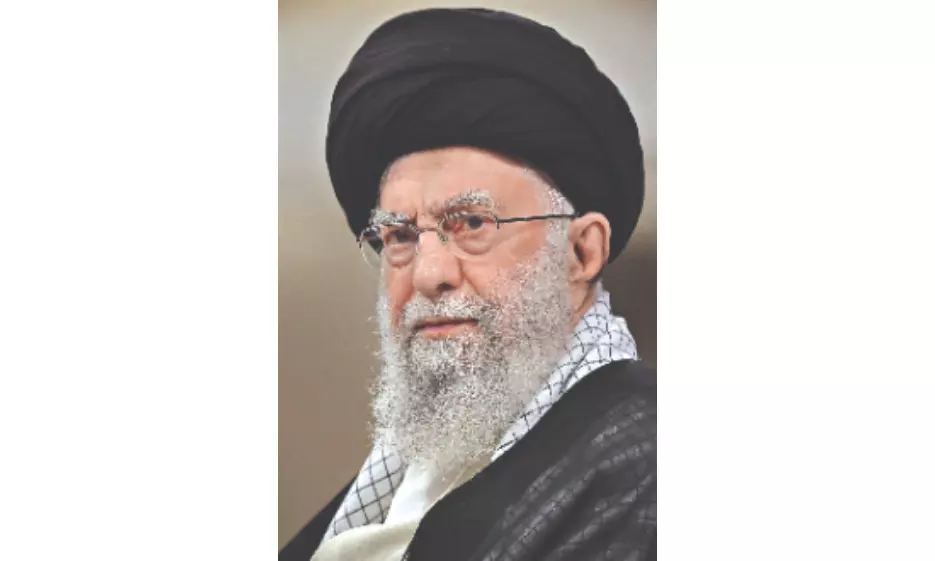


Brussels: How long will it last? Will it grow? What will the conflict and the reported death of Iran’s Supreme Leader Ayatollah Ali Khamenei mean to us, and to global security overall? Those questions echoed across the Middle East and the planet Saturday as world leaders reacted warily to U.S. and Israeli strikes on Iran.
U.S. President Donald Trump said on social media that Khamenei was dead, calling it “the single greatest chance for the Iranian people to take back their Country.” Iranian state media said early Sunday the 86-year-old leader had died without elaborating on a cause.
Israeli officials previously told The Associated Press on condition of anonymity that Khamenei was dead. And Israeli Prime Minister Benjamin
Netanyahu, in a televised address, said there were “growing signs” that Khamenei had been killed when Israel struck his compound early Saturday.
The apparent demise of the second leader of the Islamic Republic, who had no designated successor, would likely throw its future into uncertainty and exacerbate already growing concerns of a broader conflict.
The U.N. Security Council scheduled an emergency meeting.
Perhaps cautious about upsetting already strained relations with Trump, many nations abstained from commenting directly or pointedly on the joint strikes but condemned Tehran’s retaliation.
Similarly to Europeans, governments across the Middle East condemned Iran’s strikes on Arab neighbours while staying silent on the U.S. and Israeli military action.
Other countries were more explicit: Australia and Canada expressed open support for the U.S. strikes, while Russia and China responded with direct criticism.
The U.S. and Isreael launched a major attack against Iran on Saturday, and Trump called on the Iranian public to “seize control of your destiny” by rising up against the Islamic theocracy that has ruled the nation since 1979.
Iran retaliated by firing missiles and drones toward Israel and U.S. military bases in the Middle East.
In a statement, British Prime Minister Keir Starmer, French President Emmanuel Macron and German Chancellor Friedrich Merz called on the U.S. and Iran to resume talks and said they favored a negotiated settlement.
They said their countries didn’t take part in the strikes on Iran but are in close contact with the U.S., Israel and partners in the region.
The three countries have led efforts to reach a negotiated solution over Iran’s nuclear program.
Later, at an emergency security meeting, Macron said France was “neither warned nor involved” in the strikes. He called for intensified efforts for a negotiated solution, saying “no one can think that the questions of Iran’s nuclear program, ballistic activity, regional destabilization will be settled by strikes alone.”
The 22-nation Arab League called the Iranian attacks “a blatant violation of the sovereignty of countries that advocate for peace and strive for stability.”
That coalition of nations has historically condemned both Israel and Iran for actions it says risk destabilizing the region.
Morocco, Jordan, Syria and the United Arab Emirates denounced Iranian strikes targeting U.S. military bases in the region including in Kuwait, Bahrain, Qatar and the Emirates.
Under former President Bashar Assad, Syria was among Iran’s closest regional allies and a staunch critic of Israel,
yet a statement from its foreign ministry singularly
condemned Iran, reflecting the new government’s efforts to rebuild ties with regional economic heavyweights and the United States.
Saudi Arabia said it “condemns and denounces in the strongest terms the treacherous Iranian aggression and the blatant violation of sovereignty.” Oman, which
has been mediating the talks between Iran and the U.S., said in a statement that the U.S. action “constitutes a violation of the rules of international law and the principle of settling disputes through peaceful means, rather than through hostility and the shedding of blood.”
Careful wording is (mostly) the order of the day
New Zealand refrained from full-throated support but acknowledged Saturday that the U.S. and Israeli attacks were keeping the Iranian regime from remaining an ongoing threat.