India-Pakistan match: Will there be a handshake?
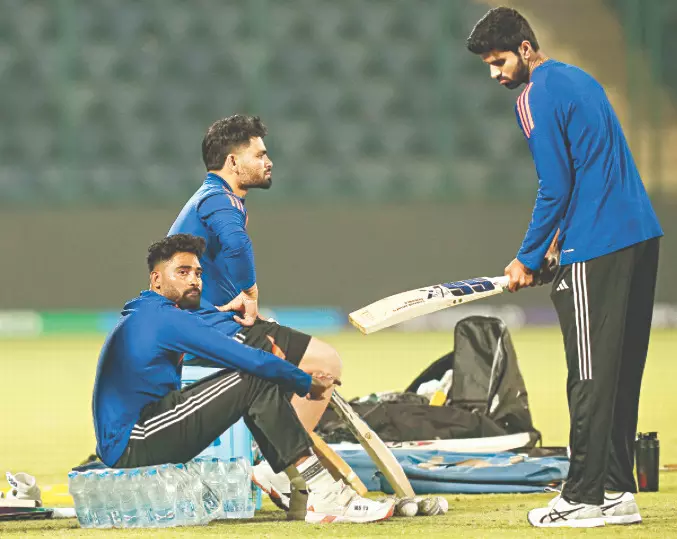


New Delhi: So now that Pakistan has finally agreed to play India on February 15, the only unresolved constitutional crisis in world cricket remains: Will there be a handshake? Or has that demand also been sacrificed at the altar of the “larger good of the game,” a phrase that has proven to be as elastic as Pakistan’s stance through this entire episode?
Perhaps the decision will be announced 30 minutes before the toss, after a high-level consultation involving the PCB, its Prime Minister’s Office, the ICC, former captains on prime-time TV, and at least one astrologer thrown in for speculation.
Because if there is one lesson this saga has taught us, it is this: Nothing about this was ever about whether Pakistan would play the match. That outcome was inevitable. What was optional — and enthusiastically explored — was the chaos along the way.
Let’s be clear. The India–Pakistan game was never in danger. What was meticulously engineered was a performance. A performance involving boycott threats, force majeure interpretations pulled from Google, emergency ICC meetings, diplomatic solidarity pitches, and a heroic attempt to look indispensable to a tournament that sells itself largely on the existence of this one match.
And through it all, the most inconvenient participant in Pakistan’s drama —India — refused to audition. The BCCI and the Indian government did the unthinkable: They said absolutely nothing. No outrage. No counter-threats. No televised chest-thumping. Just radio silence. Which left Pakistan shouting into the void, occasionally pausing to check if anyone was still watching.
The eventual U-turn has been elegantly repackaged as a noble stand for
Bangladesh, Pakistan’s suddenly rediscovered sibling in cricketing arms.
The logic is inspired. Bangladesh’s World Cup exit — rooted in retribution over the Mustafizur controversy — was promptly elevated into a moral crusade.
And thus, Pakistan positioned itself as the elder statesman of South Asian cricket justice, bravely threatening to boycott one match, but not the tournament, not the revenues, and certainly not the television exposure.
In a post-9/11, deeply polarized global order, this show of camaraderie also doubled up as geopolitical mood-setting.
The idea of an Islamic cricketing bloc flanking India from both ends was floated with subtlety roughly equivalent to a sledgehammer. Dhaka’s new political reality arrived just in time to serve as a convenient co-star in Pakistan’s relevance revival tour.
And relevance was the real prize here. With little to celebrate on the field, Pakistan Cricket discovered that manufactured crises travel faster than cover drives. Enter PCB chief Mohsin Naqvi and Prime Minister Shehbaz Sharif, compelling the ICC to fly into Lahore for talks on a problem that required neither diplomacy nor mediation — just acceptance. The optics, however, were priceless.
The ICC officials in Lahore. Pakistan as the power broker. Headlines screaming uncertainty. World Cup revenues held hostage by indecision. A banana republic of Cricket briefly convinced it was holding the nuclear codes to destroying the game.
Then came the demands. Oh, the demands. A bilateral series with India—an issue entirely outside the ICC’s remit. Rejected. A handshake mandate — legally unenforceable, emotionally charged, and conveniently vague. Debated endlessly. Threats of sanctions were met with moral posturing. “Force majeure” was invoked with the confidence of someone hoping no one would ask for footnotes.
At no point did Pakistan threaten to pull out of the tournament altogether. That would have required conviction. This was a carefully curated boycott—just enough to cause panic, not enough to cause self-harm.
Meanwhile, neighbouring boards were politely encouraged to play mediator. Sri Lanka and Bangladesh sent messages. The ICC played the indulgent parent. Pakistan, the eternally recalcitrant child of world cricket and geopolitics, was offered an ice cream, a pat on the head, and a reminder that the tantrum had gone on long enough.
And so, here we are. Pakistan will play India. The match will go ahead. The broadcasters will breathe again. The ICC will quietly move on. And Pakistan will declare moral victory, having achieved precisely what was always going to happen.
The only remaining suspense, fittingly, is cosmetic. A handshake. A gesture. A moment for the cameras. Because in this saga, symbolism mattered far more than substance.
February 15 will bring cricket. The weeks before it brought theatre. And Pakistan, once again, proved that while it may not always control the game, it will never stop trying to control the narrative.
Whether the handshake happens or not, the real hand Pakistan wanted was always the one
holding the spotlight.