
Beyond Samson’s 97: How India’s collective spark lit up Eden
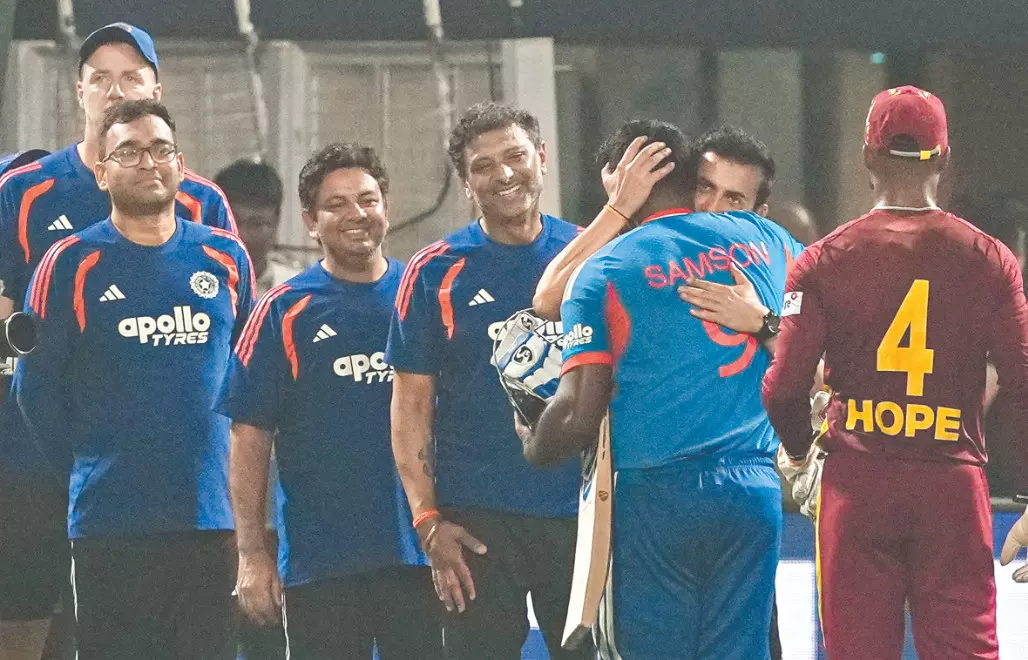


Kolkata: At Eden Gardens — where chases gather momentum as swiftly as the outfield — India’s march into the semi-finals of the ICC Men’s T20 World Cup 2026 was defined not only by Sanju Samson’s silken 97, but also by the quieter, decisive moments that made it possible.
For head coach Gautam Gambhir, the turning point arrived in a brief passage of play when Shivam Dube struck two boundaries to ease the mounting pressure of a stiff chase.
“For me, Shivam’s two boundaries are as important as Sanju’s 97,” Gambhir said. “If he hadn’t hit those two boundaries, you probably wouldn’t even be talking about that 97.”
That philosophy of collective contribution framed India’s performance. Samson’s innings, elegant as it was, never felt like an act of reckless acceleration.
“I actually thought he never accelerated the innings,” Gambhir observed. “It was just very, very normal cricketing shots. I never saw any muscling of the ball.”
In a high-pressure pursuit of 196, Samson’s mastery lay in his control of tempo — shifting gears subtly without ever appearing hurried. His composure ensured India remained within touching distance of the target at every stage.
Gambhir’s faith in Samson through a lean patch earlier in the tournament was emphatically vindicated. “We always knew the talent Sanju had… three T20 hundreds — not many people have that. We knew whenever we needed him in a World Cup game, he would deliver,” he said.
The foundation for the chase, however, had been laid earlier with the ball. West Indies’ most consistent batter in the tournament, Shai Hope, was kept quiet during the powerplay — a phase Gambhir identified as critical.
“When you play a game of this magnitude, you’ve got to start really well with the new ball,” he said, highlighting the early overs bowled by Arshdeep Singh and Hardik Pandya.
The decision to deploy Axar Patel twice in the powerplay, on a surface not typically conducive to spin, proved equally pivotal. “Once we had the powerplay in our hand, we were always in control of the game,” Gambhir added.
Control through the middle overs came via a more tactical innovation — the flexible use of Jasprit Bumrah as a roaming enforcer rather than confining him to a fixed phase. “We knew West Indies have a lot of firepower in the middle… so we needed someone like Bumrah there,” Gambhir explained.
On a night when Samson’s artistry headlined the scorecard, it was India’s layered execution — tactical, collective, and composed — that ultimately sealed their semi-final berth.



