Whose War Is It?
The US-Israel strikes on Iran raise serious legal, political and strategic questions, threatening international law and destabilising an already fragile Middle East
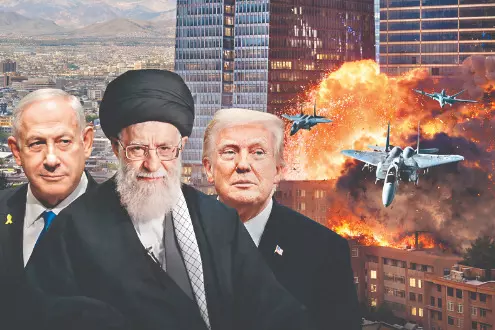


US-Israel combined strikes on Iran on February 28, which led to the death of the Supreme Leader of Iran, Ayatollah Ali Khamenei, and several others, including the country’s Defence Minister and IRGC commanders, have neither the approval of the US Congress nor the United Nations. Several US lawmakers have questioned the legality of President Trump’s war on Iran. It severely sets back the progress made in international humanitarian law since the end of World War II and puts forth an argument for resorting to the jungle law that ‘might is right’.
There is also a question of whose war it is—many analysts believe it was primarily Israeli PM Benjamin Netanyahu who, during the six trips that he had made to Washington in Trump’s second term since January 2025, managed to convince the American President to carry out what is mainly an Israeli agenda in Iran, which is regime change. There is nothing secret about it. Netanyahu has been saying that it was his dream for 40 years to change the Iranian regime. Many of the Gulf States believe that Israel wants to be a regional hegemon by obliterating any challenge—previously from Hamas in Gaza, Hizbollah in Lebanon and, now, Iran.
As for President Trump, the objective of the current war keeps altering every day, like the day’s temperature. If one day it is regime change, the next day it is eliminating the nuclear threat from Iran, and then further on it is that the US had to strike Iran to pre-empt it from launching attacks on the US. Under sanctions for decades, with the armed prowess of its proxies, Hamas and Hezbollah severely degraded, Tehran was hardly in a position to pose any significant threat to the US except for the oral harangues during Friday sermons. Specifically on the nuclear threat posed by Iran, Mr Rafael Mariano Grossi, DG, IAEA (International Atomic Energy Agency), who has oversight powers on the Iranian nuclear programme, said as recently as March 8 that there was no evidence that Iran was currently making a nuclear bomb. Seen in this backdrop, the arguments of the US to justify Iran strikes at the current juncture lack convincing logic.
There is no doubt that Israel has developed huge capabilities both in intelligence and military technology ever since its inception in 1948 to keep at bay the perceived threats from Palestinian groups and neighbouring Arab countries. It has mastered these capabilities by targeting Palestinian groups both in the West Bank and Gaza for years. But the question is whether it has achieved the much sought-after objective of “peace” for its citizens, or peace in the neighbourhood.
Regarding Iran, Israel knows very well that Tehran does not have the capabilities to threaten Tel Aviv’s existence. This gives credence to the argument that Israeli Prime Minister Benjamin Netanyahu is using the current situation to strengthen his own position domestically. In the current conflict, Israel is firing from US shoulders. It has provided all the intelligence, and President Trump and other leaders of his administration were persuaded to take up this so-called once-in-a-lifetime opportunity for regime change in Iran and go down in history. No American President since Jimmy Carter, after the 1979 revolution in Iran, could achieve this feat. PM Netanyahu succeeded by stoking the vanity of President Trump. Their claim that Iran is on the verge of going nuclear has to be taken with a grain of salt. Remember, similar claims were made about Saddam Hussein as well before the invasion of Iraq in 2003.
Trump says Iran is a terrorist country. If at all, it is not Iran but Pakistan that fits the description to a T and should have been the target of the US-Israel action if they were really interested in fighting terrorism.
Even for those reformists in Iran who have been resisting the hardliner regime for decades, and who have spent years behind bars for speaking up, these events are not welcome. One reformist leader said they were both happy and sad—happy because the hardliners who humiliated the reformists for years are themselves being humiliated now, and sad to see the massive destruction of their country and the price that ordinary Iranians have had to pay.
As for the rest of the world, the ripples of the war have been felt in many ways, but the most significant impact has been in terms of the rise in crude oil prices. Many countries have resorted to curtailing consumption, hiking prices of oil products, and returning to work-from-home arrangements to battle shortages. They are also trying to ensure the safety of their citizens in Gulf countries and making efforts to evacuate them to safer places.
From all these perspectives, it is very difficult to reach any logical conclusion as to whose interests are being served in the current conflict. It has to end immediately to contain any further destabilising effects in the region as well as the rest of the world.
Views expressed are personal. The writer is a retired IIS officer of the 1991 batch, who had served in the Middle East for seven years
.