Whispers No More
From Rupi Kaur’s censored image to a historic Supreme Court ruling, India moves from whispering shame to constitutional dignity for menstruation
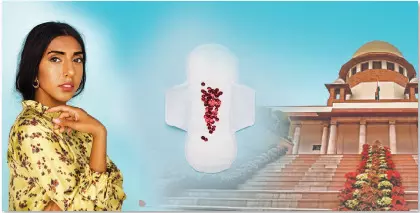


The year was 2015. Rupi Kaur, the insanely famous Canadian Insta-poet and illustrator, was still working on a visual rhetoric project at the University of Waterloo. While exploring the social stigma around menstruation, she posted a photograph of a woman lying in bed with blood on her sheets and sweatpants. She captioned it, ‘I bleed each month to make humankind a possibility. My womb is home to the divine, a source of life for our species, whether I choose to create or not’. A harmless post celebrating womanhood drove the netizens across the globe crazy. The hornet’s nest was so stirred that Instagram decided to remove it within a few hours, citing a violation of community standards. Rupi was not the one to be bogged down. She posted it the second time only to meet the same fate. She did it the third time, reinforced with reason and repartee. Instagram, gauging the ripples in global media, mailed Rupi an apology and decided to continue with the post. Rupi won. She won it for the millions.
The symbolic victory in 2015 seemed so momentous and meaningful in 2026 when the Supreme Court observed the right to menstrual health as part of the right to life under Article 21 of the Constitution. The apex court also issued directives to ensure every school provides biodegradable sanitary napkins free of cost and provisions for functional and hygienic gender-segregated toilets. The judgement, detailed and decisive, echoes Melissa Berton’s Oscar-winning speech, ‘A period should end a sentence, not a girl’s education’. The American educator and producer, whose documentary ‘Period. End of Sentence.’ won the Academy Award, literally set the tone and tenor for a historic day in India’s social landscape.
For decades, periods arrived every month wrapped in uncanny silence. Menstruation entered adolescence not with explanations, but with whispers, not with care, but with caution. Doors were shut, voices were lowered, and routines were altered. A biological reality was pushed into the shadows of shame. For a society which celebrates motherhood and predominantly worships feminine power, this seemed implausible. It was never sufficiently interpreted as the right to dignity or as the right of every woman to live without apology. Menstrual hygiene is a non-negotiable constitutional entitlement. It had to be spelt out in no uncertain terms when reportedly 23 million girls drop out annually for ‘period poverty’. The court rightly noted, ‘For menstruating girl children, the inaccessibility of MHM (Menstrual Hygiene Management) measures subjects them to stigma, stereotyping, and humiliation’. Forcing a student to absent herself due to inadequate MHM facilities violates her bodily autonomy and privacy, the Bench added. The decision, in itself, is a triumph of dignity and equality.
We are living in strange times. Wars are bragged about on social media. Weapons of mass destruction are flexed by world leaders. But conversation around menstruation is still hush-hush. There is insensitivity all around, there is indignity all over. Trump, arguably the most powerful man of the most advanced nation in the world, is the leader we do not need. The insidious ‘there was blood coming out of her eyes, blood coming out of her wherever’ barb he threw at a news anchor for being ‘difficult’ in a Republican debate is inhuman, even with generous euphemism. The immediate experience of exclusion in households is deterring women from worshipping during periods. Rotten pickles, curdling milk, dying plants, drying rivers - name a calamity and menstrual blood is blamed for it. Multiple prohibitions were imposed on ‘bleeding’ women - from sleeping in cowsheds to absenting from schools. The pads were wrapped in black plastic as if they were contraband. The act of birth and evolution, which predates everything else, is still enshrouded in myths and misconceptions. It is time we confront it upfront. Otherwise, what is the point in landing on the Moon and finding life on Mars when there is darkness under the lamp?
The ruling also places heavy responsibility on the NCERT and the SCERTs to integrate gender-responsive curricula. Education about puberty and menstruation will no longer be an ‘optional’ chapter, which can be conveniently and deliberately left unread. The academic shift is essential to knock out the ‘culture of silence’, which leaves most adolescent girls unaware of menstruation until their first period. The narrative has evolved over the years, but it is painfully slow. The amplification can be more penetrative if the advertising industry amps up its game. Advertisements have changed positioning - from cautious promotions to challenging long-standing taboos. What began as a muted euphemism has evolved into bold campaigns reshaping conversations.
In the early years, sanitary product commercials were coded and sanitised. The ‘blue splash’ was an almost apologetic global symbolism for sanitary pad advertisements. The lived realities of cramps and emotional oscillations were never touched upon. The advertisements basically air-brushed reality. Storyboards changed when authenticity was honoured. Whisper’s campaign ‘Touch the Pickle’ confronted the superstition head-on. The generational myth was torn asunder. It was a statement against inherited prejudice. Stayfree’s ‘It’s Just a Period’ crusade was similarly audacious. Menstruation was demystified in everyday contexts. This posturing, even if commercial, is significant as it invited and initiated dialogue across households. Moreover, it is gender-neutral and generation-neutral. Digital media is also accelerating the transformation. The younger population, who are receptive to progressive messaging, are themselves reaching out. However, the journey is far from over. The core essence of the Supreme Court judgement should be positively adopted by the think tank to go through the urban middle-class catchment to the rural and economically disadvantaged.
India has joined a select group of nations - including Scotland, New Zealand and others - who recognise access to menstrual essentials as a right. The domino effect of the judgment will be beyond the school gates. It read, ‘We wish to communicate to every girl child, who might have become a victim of absenteeism because her body was perceived as a burden, that the fault is not hers. These words must travel beyond the courtroom, law review reports, and reach the everyday conscience of society at large. Let us not disappoint ourselves. Let us shoulder the weight of each concluding word. After all, menstrual blood is the only one born of creation, not destruction.
Views expressed are personal. The writer is a communication professional and former journalist