Towards Energy Independence
As oil prices surge amid Middle East tensions, India faces rising inflation, supply risks and an urgent need to rethink energy security
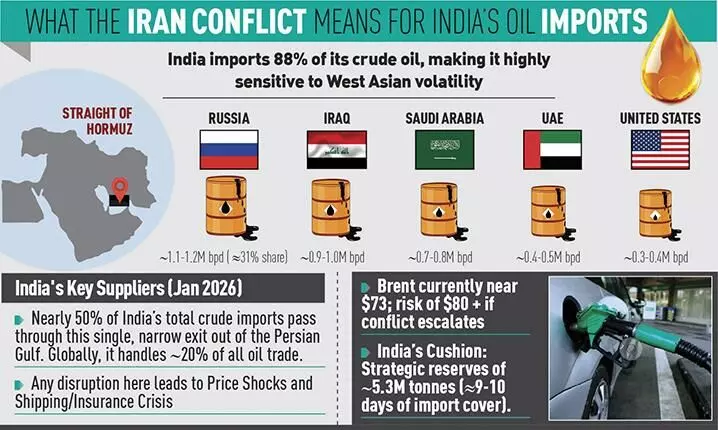


The Iran-US-Israel war in the Middle East has plunged the world into a global oil crisis. The Brent crude price has risen from pre-conflict levels (around USD 60-70 per barrel in early 2026) to over USD 90-100 per barrel recently, and in a worst-case scenario, the same is projected to reach USD 120-150 if the blockade of the Strait of Hormuz by Iran continues. The scenario is reminiscent of past oil crises of the 1970s and 1980s that exposed the vulnerability of import-dependent nations to geopolitical conflicts. The disastrous impact on the economies of these developing countries needs no exaggeration, as oil, in fact, fuels their economies. While questions as to who initiated the wars or who would end them involve endless debates, the utmost priority for these nations is to address the crisis at home immediately and review their preparedness for the future as well. Energy security is not necessarily energy independence, for the latter refers to a wider ecosystem of self-reliance that most developing nations currently lack.
For example, India, as one of the world’s largest oil importers, is in a precarious position. Out of 85-90 per cent of its energy needs, about half is imported from Iraq, Saudi Arabia, the UAE, and Kuwait, whose shipments are now unable to pass through the Strait of Hormuz. The situation is one of shortages, higher domestic prices, and strain on manufacturing units, as LPG and LNG supplies depend on 60 per cent of natural gas imports from these countries. A little relief is that recently, a few shipments to India were allowed by Iran. Though in the short term, measures like imports from Russia, shifting 70 per cent of crude to alternative routes, and drawing on strategic reserves may temporarily ease the pressure, the undesirable effects, as days pass, could include a weakening rupee, inflationary pressures, stress on manufacturing sectors, and a fall in domestic demand. The negative impact on production and employment is imminent. The first casualty could be the gig economy, worth USD 556.7 billion (2024) and employing approximately 12 million workers. Numerous digital platforms like Swiggy, Zomato, Blinkit, Dunzo, Uber, Ola, and Urban Company may have to curtail the scale of operations and downsize manpower. The second could be the agriculture sector, since the energy crisis may jeopardise operations necessary before the onset of the monsoon.
In the immediate run, what matters most is handling the panic in the markets that affects common households and businesses alike. Closure of small hotels, food stalls, long queues at fuel pumps and LPG booking centres, not to mention the shopping frenzy for induction stoves in the market, all indicate that the crisis may persist for some time. Ensuring an uninterrupted supply, with constant vigilance against hoarding or black marketing, is the foremost priority for governments. It is timely that, early in March, the government invoked the Essential Commodities (EC) Act, 1955, to ensure the stable supply and fair distribution of energy products, specifically LPG and natural gas. District administrations need to play a pivotal role in ensuring the smooth functioning of the PDS and the distribution of fuels and energy products in local markets through rationing, especially in rural areas.
The crisis may pass in time, but import-dependent countries like India need to learn from this sudden and unforeseen situation and find ways to safeguard their future energy security. “Energy saved is energy produced,” they say. Energy wastage in India is substantial but has always remained a matter of little concern. In power, technical losses due to old transformers, long low-voltage lines, poor maintenance, and commercial losses due to non-payment and unmetered agricultural connections were reported at 15.04 per cent in FY 2024-25, with monetary losses estimated between Rs 1.5-1.7 lakh crore per year. This is compounded by “phantom loads” (chargers, standby appliances, etc.) and inefficient old refrigerators and air conditioners that consume 5-10 per cent extra electricity. With regard to fuel—petrol, diesel, and LPG—excess consumption due to inefficiency is a drain on valuable resources. In the transport sector, studies show that old-engine vehicles, traffic congestion, and idling in cities are responsible for 20-30 per cent fuel waste. Similarly, in the agriculture sector, which is a major diesel consumer, inefficient and old pump sets consume 15-20 per cent more fuel than modern 5-star or IE3/IE4 models—a necessary evil, as the majority of farmers are engaged in subsistence farming.
Reducing wastage is the fastest way to contain demand. Every unit of power or litre of fuel saved will directly lower India’s exposure to import disruptions. In the power sector, focus on the Revamped Distribution Sector Scheme (RDSS), High-Voltage Distribution System (HVDS), and infrastructure upgrades in rural and agricultural feeders is essential, in addition to ongoing Bureau of Energy Efficiency (BEE) programmes. In the transport sector, fast-tracking EVs and hybrids (through the FAME scheme with state incentives) is necessary to eliminate fuel wastage. Stricter Corporate Average Fuel Efficiency (CAFE) norms and promotion of CNG, public electric buses, and rail are equally important. In agriculture, the KUSUM scheme needs to be aggressively expanded to replace old diesel and electric pumps with BEE 5-star and solar pumps, alongside drip and micro-irrigation to reduce over-pumping.
Dependence on fossil fuels is an economic imperative for developing countries, including India, which makes their energy narratives vulnerable. Nonetheless, as emphasised in various COP summits, renewable and non-fossil resources need to be created on an epic scale as standby arrangements, though not as permanent alternatives to fossil fuels. India has strongly pushed for renewable energy in G20 forums, highlighting its commitment to achieving 500 GW of non-fossil fuel capacity by 2030. Though coal remains indispensable for baseload power generation, the push for solar, wind, and electrification provides a buffer against future disruptions.
The good news for India is that in FY 2025-26, renewables accounted for 75 per cent of all new capacity additions—a record 49.6 GW, with solar alone contributing 38 GW. As per official data, India’s non-fossil energy capacity has crossed 50 per cent of the power mix, while renewables contribute about 25 per cent to generation. India ranks fourth globally in total installed renewable energy capacity (after China, the USA, and Brazil), according to IRENA and MNRE data. Ernst & Young’s RECAI index ranks India among the top four globally in solar and wind attractiveness, signalling strong FDI potential. India has also championed global solar alliances and urged G20 nations to triple renewable energy capacity by 2030.
The current crisis is, in fact, an opportunity to accelerate the transition process. However, challenges remain—grid integration and transmission, battery storage and pumped hydro, and land acquisition in some states. Moreover, attitudinal changes are necessary to expand demand for non-fossil fuels and to control energy losses. Renewables and non-fossil fuels play a crucial role in climate action and, in the long run, help create an ecosystem of energy independence—a higher goal than energy security.
Views expressed are personal. The writer is a former Additional Chief Secretary of Chhattisgarh