
Threads That Hold a Civilisation
Manipur’s GI-tagged textiles embody cosmology, matrilineal knowledge, and sustainability, yet face generational decline and imitation markets that threaten both livelihoods and cultural memory
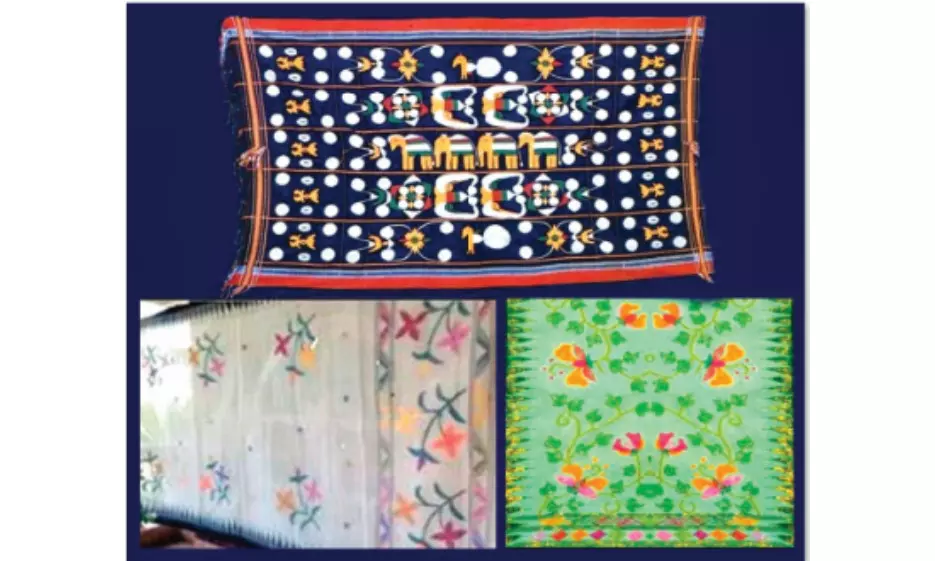


In the heart of Manipur, the loom does not merely produce cloth; it breathes with the pulse of a civilisation. Its rhythm forms a sacred cadence, weaving an ancient cosmology into tangible fabric. This enduring art stands as one of the state’s deepest cultural and economic testaments, rooted not in mere craftsmanship but in the sacred. For the Meitei community, weaving is not a mechanical act but a divine enactment, a ritual in thread that mirrors the creation of the universe itself. Meitei belief holds that the supreme goddess Leimarel Sidabi, along with her incarnations, first bestowed this knowledge, enabling humanity to echo cosmic order through warp and weft. This sacred inheritance is inscribed in the Leinunglon Puya, one of the revered ancient manuscripts of the Meitei, written in the Meitei Mayek script. The text solemnly records the divine origin of weaving and the mythological discovery of cotton from which fabrics were born. Here, cloth is not a commodity but cosmology.
Anchoring this living heritage are three textiles granted Geographical Indication (GI) status in 2014: Shaphee Lanphee (GI No. 371), Wangkhei Phee (GI No. 372), and Moirang Phee (GI No. 373). These are not merely protected products but embodiments of a living epistemology, carrying within their threads histories of power, devotion, and social memory. Each GI-tagged textile forms a distinct pillar of Manipur’s woven legacy. Shaphee Lanphee, the “fabric of war and animals,” is a ritual shawl encoding celestial and bestial symbols, once bestowed by sovereigns as a reward for valour. Moirang Phee carries the epic of Khamba-Thoibi, rooted in the historic village of Moirang, where India’s tricolour was first hoisted in 1944; its serrated pheejin border evokes the teeth of the supreme deity Ibudhou Pakhangba, signifying divine protection and lineage. Wangkhei Phee, a muslin of near-spectral fineness, was woven as raiment for royalty, embodying an aesthetic philosophy where mastery is expressed through ethereal lightness. Together, these fabrics constitute a woven library, a visual lexicon shaped by ecological intimacy, cosmology, and collective memory. These textiles represent a pre-modern intellectual property system and a tangible claim to a cultural territory defined not by borders but by generations of artistic intellect. Their recognition marked a turning point, bringing the nation’s intangible heritage into formal recognition in the global market.
The roots of this legacy lie in Manipur’s distinctive historical epistemology, where weaving knowledge was matrilineal and haptic - a sacred trust passed from mother to daughter through touch, repetition, and practised memory. This legacy transformed homes into creative spaces, with the loom emerging as a symbol of women’s independence, livelihood, and social dignity. Today, however, this living heritage confronts the pressures of the 21st century. A troubling generational shift reflects a widening disconnect between traditional vocations and contemporary aspirations. Studies such as Selvam et al. (2025) identify a critical “knowledge gap,” with less than 11 per cent of the weaving workforce under the age of thirty. Urban migration and alternative livelihoods challenge the decentralised, home-based apprenticeship model that once sustained the craft. Simultaneously, the sanctity and economic value of Manipur’s textiles are threatened by mass-produced imitations from other states. Markets are flooded with digital prints, mechanical facsimiles and soulless copies that sever sacred symbols, reducing living narratives to disposable souvenirs. This dilution poses a dual threat: it undermines the livelihoods of authentic weavers and erodes the cultural connection for consumers.
The bridge between ancient knowledge and future growth must therefore be built by learning from the decentralised resilience of the past while embracing the connective tools of the present. GI-tagged fabrics must move beyond legal protection to emerge as powerful “Brands of Origin,” sustained by compelling narratives of authenticity. An integrated digital traceability system could allow buyers to scan a QR code and trace a fabric’s journey to the weaver, her village, the source of cotton, and even the folk memory or royal decree that inspired the weave. Such technology can revive the community-based covenant of traditional trade, strengthening human-centred cultural exchange. In doing so, these textiles gain irreplaceable value, offering not merely a product but a living story and a direct connection with its maker.
Equally significant is the alignment of Manipur’s handloom legacy with the principles of slow fashion. Long before sustainability became a global imperative, the craft embodied it. The use of plant-based dyes, hand-spun yarn, and the zero-electricity loom offers a natural blueprint for carbon-neutral production. The craft does not need to adapt to sustainability; it is sustainability incarnate. This narrative must be articulated with strategic clarity. Such textiles should be positioned as visionary luxury, attracting global consumers who value sustainable artistry and strengthening both economic value and cultural pride.
For this growth to endure, the knowledge system itself must become aspirational for younger generations through formal education. Integrating the mathematics of designs, the science of natural dyes, and the literature of motifs into academic curricula can transform perceptions of the loom. It must be understood not as an archaic chore but as a sophisticated field of innovation. Structured programmes and degrees in Traditional Textile Science can create dignified career pathways, drawing young minds toward this dynamic fusion of heritage and technical mastery.
The unbroken thread of Manipur’s textile heritage, exemplified by the three GI-tagged fabrics recognised since 2014 and others awaiting inclusion, already contains the blueprint for its future. By honouring the matrilineal epistemology of the loom, its ecological wisdom, narrative power, and sustainable core while embracing modern branding, digital tools, and pedagogical innovation, such heritage traditions can inspire a broader cultural renaissance across regions. This synthesis ensures that living heritage does not merely survive but thrives in the marketplace, the classroom, and the collective imagination. The loom thus stands not as a monument but as a portal, connecting ancestral wisdom to future prosperity and ensuring that every fabric tells a story both eternal and urgently new.
Views expressed are personal. The author is a Senior Research Fellow at Bharat Ki Soch



