The Post-Hasina Equation
With Dhaka’s political shift, India faces renewed risks to border security, connectivity projects, and regional influence while navigating demands for Hasina’s extradition and justice
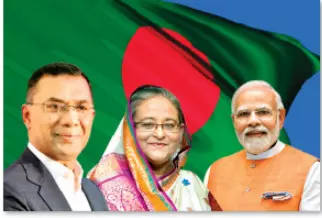


The “Sheikh Hasina factor” represents the central pivot around which India-Bangladesh relations evolved from a “Golden Chapter” of unprecedented cooperation into the current era of diplomatic uncertainty following her ouster in August 2024. India is now cautiously navigating a more complex relationship with Bangladesh.
Under Hasina’s 15-year tenure, India enjoyed a period of cooperation and strategic certainty. Hasina dismantled anti-India insurgent camps (like ULFA) in Bangladesh, which had historically plagued India’s Northeast. She facilitated major infrastructure projects, including the Akhaura-Agartala rail link and the use of Chattogram and Mongla ports for Indian cargo. Bilateral trade peaked at approximately $13 billion. The landmark 2015 Land Boundary Agreement (LBA) resolved decades-old border enclave disputes.
The current “dilemma” (Post-August 2024) relates to Hasina’s flight to India and continued shelter there, which has become a significant “irritant” in bilateral ties. The interim government and the victorious Bangladesh Nationalist Party (BNP) have faced domestic pressure to seek her extradition to face trial for “crimes against humanity”. Many Bangladeshis perceive India’s long-term support for Hasina as “unconditional backing” of an authoritarian regime, fueling resurgent anti-India rhetoric. India’s decision to provide her refuge is viewed by some in the new leadership as a “hostile act,” especially when she makes political statements from Indian soil.
The shift from a pro-Hasina administration to the current political landscape has introduced several risks and strategic repercussions for India. There are concerns that the “Chicken’s Neck” (Siliguri Corridor) could become vulnerable again if the new regime reduces vigilance on insurgent groups. There are also concerns regarding strategic realignment. India fears Bangladesh may drift toward China or Pakistan for defense and infrastructure needs to balance Indian influence. Ongoing transit and energy projects, such as the India-Bangladesh Friendship Pipeline, face operational delays due to political instability. Bangladesh’s demand for Hasina’s return to face justice remains the primary hurdle in normalising state-to-state relations.
Historically, the Awami League has been India’s most dependable partner, aiding in counter-terrorism and resolving long-standing land and maritime border disputes. Many Indian observers believe the Awami League remains an essential political force that cannot be permanently sidelined. Dhaka has flagged concerns over Awami League members allegedly operating offices and plotting from Indian cities, claims which India has dismissed as “misplaced”. While India maintains it does not support the Awami League’s political activities from Indian soil, it officially expressed concerns over the Awami League being barred from recent elections, suggesting that stability may not return without their inclusion. The Ministry of External Affairs (MEA) described the ban as a “concerning development,” stating that as a democracy, India is naturally worried by the “curtailment of democratic freedoms and shrinking political space” in Bangladesh.
Sheikh Hasina’s presence in India could continue to be an irritant. The BNP government will keep raising it whenever it wants to pressure India. Senior BNP leader Salahuddin Ahmed recently confirmed the party’s commitment to pursuing her extradition under the 2013 treaty with India, stating, “We always press for her extradition according to the law”. While Hasina’s return is the most politically sensitive issue, it is being balanced against critical economic and security needs. PM Rahman has struck a measured tone, stating that “national interest” and “mutual respect” will guide foreign policy. Hopefully, he will not let the extradition issue derail bilateral cooperation. Recognising the changed political reality, India has begun “deftly” reaching out to the Bangladesh Nationalist Party (BNP) to ensure its interests are protected regardless of which party is in power.
The BNP’s position has been articulated by its Secretary General Mirza Fakhrul Islam Alamgir, who has said that Bangladesh’s relationship with India will not be “held captive” over the issue of ousted prime minister Sheikh Hasina. Fakhrul stressed that the BNP will pursue projects that serve Bangladesh’s interests and will not be deterred from deepening development partnerships with India. “We believe that Hasina has really committed serious human rights violations. There is a popular demand to punish her, and we believe that India should hand her over to us. But not handing over Sheikh Hasina to Bangladesh will not be a deterrent to building broader relations, including trade and commercial ties. We want to build even better ties,” he said.
It is being suggested that the “third-country” solution—where Hasina moves from India to another nation—could eventually remove the immediate friction from the New Delhi-Dhaka direct channel. Some sources indicate that the UAE, Saudi Arabia and Qatar have been sounded out. Finland is also a possibility as some of her family members live there. At the same time, there are indications that she does not want to leave India. In any case, there is nothing to indicate that the Indian government is contemplating this option. Sheikh Hasina continues to reside in a well-guarded home in central Delhi, where she has been since fleeing Bangladesh in August 2024.
In conclusion, Sheikh Hasina’s presence in India complicates, but does not inevitably block, the normalisation of bilateral relations, provided both sides demonstrate the will to move beyond this single issue. The pragmatic need for economic and security cooperation (trade, connectivity, and border management) is pushing both nations to try to separate the extradition demand from broader diplomatic engagement. The normalisation will likely proceed, albeit in a more strained and less “golden” phase than during the previous regime. Against this background, India must tread carefully and prevent any increase in bilateral tensions. Indeed, India is doing just that and has adopted a strategy of cautious optimism along with pragmatic recalibration. India is cautiously engaging with the new BNP government, prioritising security and stability while managing the sensitivities of the post-Hasina era.
Views expressed are personal. The writer is a retired Indian diplomat and had previously served as Consul General in New York