
The New Politics of Enemies
MAGA in the US and Hindu nationalism in India show how democracies are moving from problem-solving politics to emotionally charged battles over identity and enemies
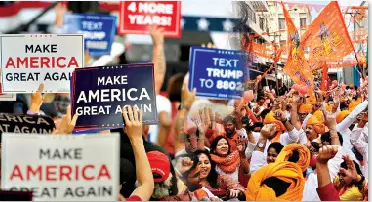


The rise of Donald Trump’s MAGA movement in the United States and the dominance of Hindu nationalism under India’s BJP are often treated as unrelated stories. One is described as an American crisis. The other is India redefining itself after colonialism. But when viewed together, they reveal something larger: politics in many democracies is shifting away from solving problems and toward fighting symbolic enemies.
Laura Field’s book Furious Minds, which examines the American intellectual right, helps explain this shift. Although she focuses on the United States, the emotional logic she describes is visible in India as well. Both movements draw strength from a similar story: the majority believes it has been humiliated, ignored, or displaced. The promise offered is restoration — a return to greatness. But restoration needs a villain. It needs someone to blame.
In the United States, immigrants — especially Mexicans and Muslims — have often been presented as symbols of invasion and disorder in Trump-era rhetoric. His famous 2016 campaign speech describing Mexican migrants as criminals and rapists, and later warnings of an “invasion” at the border, turned immigration from a policy debate into a question of survival. Supporters heard a call to defend the nation. Critics heard language historically associated with exclusion and fear.
A similar pattern appears in India. Within parts of Hindu nationalist discourse, Muslims are increasingly portrayed as demographic or cultural threats. Speeches by the BJP and its affiliates’ leaders linking Muslim population growth to anxiety about identity may not directly order violence, but they shape perception. They teach audiences to interpret neighbours as enemies or adversaries. In a tense environment amplified by social media, that perception can spread quickly. Mob attacks, economic boycotts, and public humiliation do not appear out of nowhere. They grow in an environment where hostility starts to feel normal.
What makes identity politics especially dangerous is how it moves from abstract ideas onto real bodies. When minorities are repeatedly described as threats, visible identity markers — a beard, a name, clothing, an accent — stop being neutral. They become signals that attract suspicion. Reporting in India has shown victims being singled out because they were identifiable as Muslims. In the United States, Black Americans often describe how their bodies are read through racial fear in encounters with police. Violence does not always require orders from above. It grows from perception. Once identity itself becomes politicised, ordinary visibility becomes vulnerability.
The problem is not that minorities cause national decline. The problem is that minorities become convenient explanations for complicated anxieties. Economic change, cultural shifts, and uncertainty about the future are hard to understand. Blaming a visible group feels simpler. It gives people emotional clarity. Anger feels justified. Unity feels urgent. But the burden of that clarity falls on communities already vulnerable to discrimination.
Another striking feature is silence from the top. In both countries, central leaders often keep a distance from the most extreme rhetoric within their movements. Trump alternated between condemning violence and repeating language that framed opponents as existential enemies. In India, Prime Minister Narendra Modi has rarely intervened directly in incidents involving anti-Muslim rhetoric or vigilante attacks. Supporters argue that a national leader cannot control every statement in a vast democracy.
Critics respond that silence sends its own message. In identity-driven politics, what leaders do not say can matter as much as what they do.
The deeper lesson is uncomfortable. Democracy cannot survive on rules and institutions alone. Elections, courts, and procedures are essential, but they are emotionally thin. People want dignity, memory, and meaning. They want to feel they belong to a story larger than themselves. When governments focus only on administration — budgets, policies, efficiency — identity-driven movements fill the emotional gap.
But the opposite danger is just as real. When politics becomes only about identity — about who belongs and who does not — democracy turns into a permanent struggle over enemies. Cooperation collapses. Every disagreement feels like betrayal. Society stops resolving shared problems and starts fighting itself.
A stable democracy requires balance. It must provide effective governance and a sense of belonging. It must allow pride without demanding hatred. Greatness built on domination is fragile because it depends on fear. Greatness that can tolerate disagreement is slower and messier, but it lasts longer.
If politics ignores people’s need for meaning, identity entrepreneurs will always outcompete cautious administrators. But if politics becomes nothing but identity, democracy risks turning into endless civilizational warfare.
Views expressed are personal. The writer has worked in senior editorial positions for many renowned international publications



