Rewriting the Rules of Governance
Five years after its launch, Mission Karmayogi is reshaping India’s civil services through continuous learning, citizen-centric governance and a sharper institutional vision for Viksit Bharat 2047
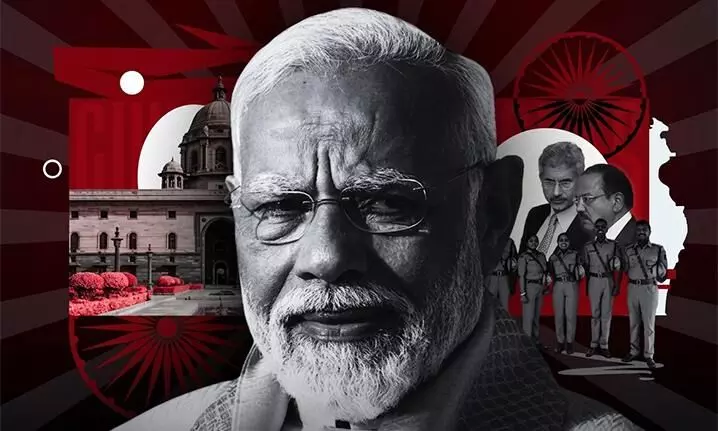


Imagine a district collector in a remote corner of Rajasthan who has just been handed charge of an ambitious welfare scheme he knows little about. A decade ago, his only recourse would have been a dog-eared government manual, a senior colleague who might be free after three meetings and a lunch, or the distant promise of a training programme that might arrive in a year or two — if at all. Today, he opens his phone, logs on to iGOT — the Integrated Government Online Training platform — and within minutes is navigating a structured, competency-linked course tailored to his exact need. By evening, better informed and more confident, he chairs the first beneficiary meeting of the scheme. The change seems small. In truth, it is seismic.
This is the quiet revolution that Mission Karmayogi has been engineering since its launch five years ago — not with fanfare, but with the patient, purposeful work of building a new kind of civil servant for a new kind of India.
To understand why this matters, one must first reckon with the context. India in 2047 — the Viksit Bharat our Prime Minister envisions — is not a destination we shall simply arrive at. It is a destination we must build, brick by careful brick, through the institutions and individuals that govern the republic. And the single most important variable in that equation is not capital, not technology, not even policy. It is the capability — the trained, motivated, citizen-centred capability — of roughly 3.5 crore public servants who wake up each morning and make the Indian state function.
For much of independent India’s history, the model for building that capability was what might be called episodic: a young officer joining service would receive formal training at the start, perhaps a mid-career course here and there, and would otherwise be expected to learn by doing — and by watching. In a stable, slow-moving world, this was adequate. In an era of artificial intelligence, climate disruption, demographic pressure, and cascading technological change, it is plainly insufficient. The pace at which governance challenges evolve has simply outrun the pace at which old-fashioned training systems could respond.
Mission Karmayogi was conceived as the answer to this mismatch. Launched in 2021, and anchored institutionally by the Capacity Building Commission (CBC) — established in April of that year — it set out to do something genuinely ambitious: transform the learning culture of the Indian civil services from a periodic, compliance-driven exercise into a continuous, role-based, self-directed journey of growth. The shift, as the Commission describes it, is from being a Karmachari — a functionary who follows rules — to becoming a Karmayogi: a public servant animated by purpose, service, and excellence.
Five years on, the numbers are instructive. Over 1.5 crore government officials are now active learners on the iGOT platform — a figure that would have seemed fantastical at inception. Across more than 4,600 competency-linked courses, these officials have logged upward of 8.3 crore course completions. In the last National Learning Week alone, participation generated 4.5 million hours of course enrolments and 3.8 million hours of actual learning. These are not abstract statistics. Each hour logged represents a public servant somewhere in India — a revenue inspector in Chhattisgarh, an urban local body officer in Pune, a health worker in Manipur — investing in their own ability to serve their fellow citizens better.
What makes the iGOT platform genuinely transformative is not its scale alone, but its architecture of access. It is available anytime and anywhere, on a smartphone or a desktop, in multiple languages, personalised to the learner’s professional profile. Courses are updated every three to six months, ensuring that content on how to deploy AI tools in governance or how to navigate new financial regulations stays current. The platform, in other words, is not a digital library gathering dust — it is a living, adaptive ecosystem of learning. Consider what this means for a junior Anganwadi worker in a tribal district who receives a module in her own language explaining the latest protocols for child nutrition assessment. She need not wait for a trainer to travel to her block. She learns, and she acts. That is the democratic dividend of this mission.
The Capacity Building Commission, as the strategic custodian of this ecosystem, plays the role of architect and conductor simultaneously. It identifies what competencies are needed across the vast spectrum of public roles — from a Secretary framing national policy to a panchayat functionary implementing it at the village level. It sets quality standards for the nation’s training institutions through the National Standards for Civil Services Training Institutions framework, known as NSCSTI 2.0, under which over 200 training institutes across the country have already been accredited. It works with states — all 30 States and Union Territories are now signed on through formal Memoranda of Understanding — to create bespoke Capacity Building Plans that map workforce competencies to organisational goals. And through landmark initiatives like the Rashtriya Karmayogi Jan Seva Programme, it has brought large-scale behavioural training — the subtle but vital art of treating every citizen as the ultimate stakeholder — to over one million certified officials.
This last dimension of the mission deserves particular attention, because it speaks to something that cannot be measured easily in completion certificates or logged hours. One of the deepest aspirations of Mission Karmayogi is a shift in attitude — the movement from a transactional relationship between the state and the citizen to one defined by the spirit of Nagarik Devo Bhava: the citizen as god, as the highest authority to whom the servant of the state is accountable. When citizen-facing officials — those at railway counters, at revenue offices, at health centres — were trained under this philosophy, and citizens were subsequently surveyed, the feedback was striking. They noticed the difference. Not just in efficiency, but in warmth, in attentiveness, in the human quality of the interaction. In an age when AI threatens to automate vast swathes of administrative function, this human layer — empathetic, culturally aware, locally rooted — is not a redundancy but India’s governance superpower.
The mission has also made a conscious effort to honour India’s intellectual inheritance alongside its technological ambitions. Through the Indian Knowledge System Cell, traditional wisdom — in fields ranging from community governance and agriculture to finance and healthcare — is being woven into the fabric of training content, not as nostalgia but as living knowledge. The Amrit Gyaan Kosh repository, with over 70 completed case studies, is building a body of governance wisdom rooted in Indian contexts and Indian solutions. This decolonisation of the administrative mind — returning Indian public servants to a confident engagement with their own civilisational heritage as they navigate modern challenges — is one of Prime Minister Narendra Modi’s defining aspirations, and Mission Karmayogi is operationalising it.
SĀDHANA Saptah — the National Learning Week observed from the 2nd to the 8th of April — is both a celebration of this five-year journey and a recommitment to its unfinished work. The word Sādhana is apt. It means dedicated practice, the disciplined daily effort of one who seeks mastery not through a single act of brilliance but through sustained devotion to craft. As we inaugurate the week with a National Conclave of Civil Services Training Institutions, bringing together nearly 700 senior officials in person and over 3,000 virtually, we are not merely marking an anniversary. We are setting our compass for the next five years — towards a future in which every civil servant at every level is a continuous learner, a citizen-champion, and a confident steward of India’s aspirations.
The goals of Viksit Bharat 2047 — from universal health coverage to net-zero commitments, from digital public infrastructure to global manufacturing leadership — will not be met by policy alone. They will be met by people: by the district official who understands the scheme well enough to implement it with precision, by the urban planner who can deploy spatial data tools, by the frontline health worker who communicates a public health alert in a way her community trusts. Mission Karmayogi is building that cohort — not for tomorrow, but for the decades ahead.
In the long, luminous arc of India’s governance story, this may well be the chapter in which the state finally learned to learn.
Views expressed are personal. The writer is the Union Minister of State for Science & Technology and Earth Sciences