
Racism Isn’t Fringe Anymore!
As the world steps into a new year, what should have been a moment of renewal is overshadowed by escalating racial hatred, xenophobic politics and far-right mobilisation across Europe and the US
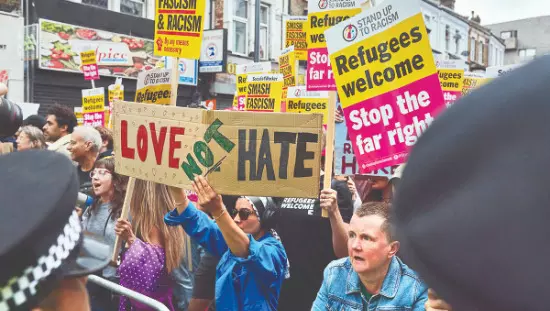


As we enter a new year, one would hope for renewed compassion and collective wisdom. Yet, Europe and the United States instead seem to carry forward a troubling surge in racial hatred and anti-immigrant hostility. In recent times, a substantial increase in racial violence against Asians, especially Indians, Latinos, Africans and non-whites, has been seen across Europe and the US. In England and Wales, more than 115,000 hate crimes were recorded until March 2025, a 2 per cent increase over the previous 12 months. In July 2024, the streets of the UK witnessed anti-immigrant and anti-Muslim violence. This September, more than 1,00,000 people, led by far-right activist and convicted fraudster Tommy Robinson, marched through the streets of London, sloganeering “We want our country back.” French far-right politician Eric Zemmour joined the rally and addressed the crowds with an inflammatory speech on the “great replacement” of European people by people coming from the south and of Muslim culture.
In the US, over 700 anti-immigration demonstrations occurred across all 50 states by mid-2025, often escalating into violence against Indians and ethnic minorities, frequently overlapping with anti-immigrant sentiment. In the EU, over 10,000 racially motivated crimes occurred during 2024–2025 across the Union, with violence comprising 40–50 per cent of the cases.
Racial discrimination, once a dormant feature of Western societies, has now emerged as a dominant political narrative. According to Gary Younge, a professor of sociology at the University of Manchester, unlike before, racial tension intermingled with xenophobia has acquired a global dimension, with the same talking points like the “great replacement” of “indigenous” white people and the perceived threat to women in Europe, particularly from Black men, showing up on social media feeds and in discourses in the US, Ireland, the UK and across Europe.
The surge in racial hatred is evidently fueled by far-right political groups such as Germany’s Alternative for Germany (AfD), France’s National Rally, and the Fidesz party of Hungarian Prime Minister Viktor Orbán, who believe in and propagate ultranationalism, authoritarianism, nativism and social conservatism. According to Jill Lawless (AP, December 14, 2025), the “conspiracy theory” apparently received approval from the Trump administration, as his new national security strategy describes Europe as facing “economic decline” and “civilizational erasure” because of immigration and the loss of national identities.
The political atmosphere of discontent ahead of the EU elections in June 2025, resulting from economic stagnation, migration pressures and disillusionment with centrist coalitions, was channelled into anti-migrant campaigns through increased mainstreaming of racist, xenophobic and Islamophobic narratives, thanks to far-right groups. Apparently, it paid off. At the June 6–9 European Parliament elections, Le Pen’s National Rally secured 31.5 per cent of the vote, more than double the meagre 14.6 per cent Macron’s party managed to get. The anti-immigrant far-right Alternative for Germany (AfD) came second with 16 per cent in Germany, beating Chancellor Olaf Scholz’s Social Democrats, drawing massive support in the former East Germany and among young voters. By December 2025, forecasts indicate that these parties will lead polls in key economies such as Germany, France, and the UK, hold power in at least seven countries, and control over 214 EP seats. Analysts fear that a far-right takeover of Europe through national politics appears entirely plausible. Evidently, the successful political experiment by Donald Trump in the 2024 election showed the way. The resurgence of far-right ideology is reshaping the political narrative so much so that it is influencing even centre-right parties on issues like “remigration.”
However, the far-right’s conspiracy theory of the “Great Replacement,” portraying Indian engineers and techies as “job stealers,” is nothing more than propaganda, for the facts stand in stark contrast. The contribution by immigrants over the years to the economies of both the US and the EU has been phenomenal. As per data from the Congressional Budget Office (CBO), OECD and EU Commission, immigrants play a crucial role in expanding the economies of both the EU and the US in terms of labour force expansion, tax payments, innovation, entrepreneurship and consumer spending. They made up 19.2 per cent of the US labour force in 2024 (up from 9.8 per cent in 1994), with an LFPR of 67 per cent, higher than the 62 per cent of native-born workers.
Indian immigrants, mainly in STEM fields, are a vital economic asset to both the United States and the European Union, driving growth through high earnings, innovation, entrepreneurship and fiscal surpluses. As of late 2025, the Indian diaspora numbers about 5.2 million in the US and over 2 million across the EU (including the UK). Nineteen per cent of the tech workforce of the US is comprised of Indian immigrants, contributing to the sector’s USD 1.8 trillion GDP share. Indian-Americans co-founded 72 of 648 US unicorns (valued at USD 3.8 trillion collectively), including Stripe and Zoom. Nearly half (46 per cent) of 2025 Fortune 500 companies were founded by immigrants or their children, with Indians prominent (e.g., CEOs of Google and Microsoft). Immigrant-founded firms created 1,200 jobs each on average, totalling millions. Overall, immigrants, mostly Indians, added USD 1.7 trillion to US economic activity in 2023, in addition to creating 23 per cent of patents—30 per cent in strategic industries including AI and semiconductors. Likewise, Indian firms invested €10B+ in the EU (2024), with startups in the UK/EU expanding via €42.6B India–UK trade (8 per cent YoY). Diaspora networks support 31,000+ Indian-linked tech startups globally.
The International Convention on the Elimination of All Forms of Racial Discrimination (ICERD) and the International Covenant on Civil and Political Rights (ICCPR) prohibit any form of discrimination based on race, colour, descent, ethnicity, gender, political opinions or any other factor and mandate the signatories to ensure protection to immigrants. But unfortunately, compliance in Western nations leaves much to be desired. Ironically, the erstwhile colonial powers who siphoned off enormous wealth and resources from colonies of the South and trafficked coloured people for indentured labour are now drawing plans on “remigration” and “deportation” of refugees and migrants from those very colonies, which are sovereign states today. While immigrants stand on a high moral ground, history does not forgive the host countries for their unethical conduct, which, in Shakespeare’s words, is “the most unkindest cut of all.” It is contextual here that at the CHOGM last year, most heads of state from Europe, except British PM Keir Starmer, tendered an apology for their historical crimes in their erstwhile colonies of the Global South and assured reparations.
The tragedy is that when refugees, in spite of the Geneva Convention (1951) and its Protocol (1967), are denied basic human rights, even immigrants who have acquired citizenship are also targeted for persecution. Umberto Pellecchia, an anthropologist, says that when race becomes a reason not just for discrimination but for denying even basic aid, the whole framework of humanitarian neutrality and access is at risk. It is imperative to move beyond technical solutions to crises and embrace a more politically and historically informed approach to humanitarian engagement.
Racial hatred and the anti-immigrant political agenda of the far-right pose a potential threat to human rights, global peace and the world economy at large. Pressing matters such as climate action and aid and relief in conflict zones will drastically suffer. In today’s interdependent existence of nations, there can be no place for hatred of any kind, and the far-right’s xenophobic agenda will only prove self-destructive. While the UN has a pertinent cause of action with regard to compliance with its conventions, the originating countries of the South must pursue the matter continuously at diplomatic levels to reassure the safety and security of refugees—legal and illegal—tourists and immigrants in host countries.
Views expressed are personal. The writer is a former Additional Chief Secretary of Chhattisgarh



