Playing Both Sides, Losing Both
Pakistan’s attempt to position itself as a mediator in the Iran conflict reveals contradictions, internal tensions, and a risky overestimation of its strategic relevance
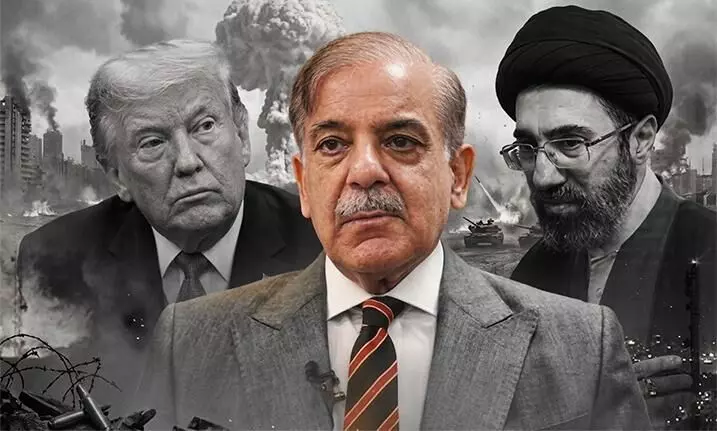


Pakistan, almost a non-descript nation in geopolitics, is trying to come to the limelight by attempting to engage itself in several activities to be seen as a relevant country “resolving” the ongoing military conflict in Iran. However, it seems to be contradicting its position by expressing conflicting views on the Iran-Israel-US military quagmire, as evident in the recent statement of Asim Munir, telling Shia clerics in Pakistan that those who “love Iran so much” should go there. Munir’s outburst, perhaps tactless, was at the GHQ, which shows his arrogance and disrespect for Iran and the Shia clergy.
Reacting to this, the clerics said that Munir’s remarks appeared to blame the protests across Pakistan, triggered after the US and Israel killed Ayatollah Ali Khamenei, on the Shia community. Coincidentally, the army chief’s remarks were made on the same day Pakistan joined a bloc of Arab and Islamic countries in condemning Iran’s retaliatory strikes across the Gulf—a move that underscored the country’s shifting regional posture. Shia leaders present at the gathering said publicly after the meeting that Munir linked the unrest in Gilgit-Baltistan directly to the Shia leadership’s influence and held all members of the community collectively responsible for violence carried out by some. Leaders of the community found the framing both offensive and far removed from historical realism.
Subsequently, Shifa Najafi, a prominent Shia leader, provided a complete account of the meeting, saying that there are Shias in the Pakistan Army as well. The country was formed by Jinnah, who was a Shia himself. The military’s official account clarified that the gathering struck a different note, saying Munir had urged religious leaders to promote national unity and cautioned against sectarian divisions and external interference. Pakistan is second only to Iran in being home to the Shia community. Though a minority, the community is estimated to make up about 15 per cent of the country’s population. The unrest that Munir pointed out began in March, when demonstrations erupted across Pakistan following Khamenei’s death.
Significantly, the timing of Munir’s remarks sits within a broader shift in Pakistan’s regional calculus. Islamabad has long tried to balance its relations between Iran and the Gulf states, but has, in recent months, moved perceptibly closer to Saudi Arabia and its allies. The paradigm shift has not been without internal contradictions. Even as Pakistan joined the March 19 condemnation of Iran, Deputy Prime Minister and Foreign Minister Ishaq Dar separately described the attacks on Iran as “unwarranted” and called for an immediate return to negotiations. We can, therefore, see an internal contradiction.
On the other hand, Asim Munir called (March 22) US President Donald Trump to discuss the Iran crisis and offered mediation, which was carried in the Financial Times, London. Pakistan is trying to position itself as a potential intermediary in the escalating tensions between the United States, Israel, and Iran, offering to host talks amid apprehensions about a wider regional conflict. Earlier, Prime Minister Shehbaz Sharif separately spoke with Iranian President Masoud Pezeshkian. It is worth recalling that, over the past few months, US President Donald Trump has publicly referred to Munir as his favourite Field Marshal. Pakistani officials have even proposed Islamabad as a neutral venue for potential talks between US and Iranian representatives, indicating the country as a “discreet and credible” diplomatic bridge.
Meanwhile, in a separate development, the United States’s Director of National Intelligence (DNI), Tulsi Gabbard, has placed Pakistan alongside Russia, China, North Korea, and Iran as a country whose advancing missile capability could eventually put US territory within reach. Presenting (March 18) the 2026 Annual Threat Assessment (ATA) before the Senate Intelligence Committee, she said that five countries were “researching and developing an array of novel, advanced or traditional missile delivery systems with nuclear and conventional payloads that put our homeland within range.” On Pakistan specifically, Gabbard averred that Pakistan’s long-range ballistic missile development could potentially include ICBMs with a range capable of striking the homeland. The written assessment went further, placing Pakistan across multiple threat categories. On missiles, the ATA stated that Pakistan “continues to develop increasingly sophisticated missile technology that provides its military the means to develop missile systems with the capability to strike targets beyond South Asia.”
Very significantly for India, the ATA referenced last year’s Pahalgam attack in Kashmir as an example of how violence by armed groups can spark crises, while claiming that President Trump’s intervention de-escalated the most recent nuclear tensions. Gabbard’s remarks were framed around the future potential of Pakistan’s missile programme rather than its existing capability. But even from that futuristic prism, experts question the logic of the US intelligence assessment. Pakistan’s longest-range operational missile, the Shaheen-III, has an estimated range of roughly 2,750 km, sufficient to cover all of India.
Here, it is pertinent to mention that in January last year, senior US officials, speaking incognito at a briefing for non-governmental experts cited by the Arms Control Association, assessed that Pakistan’s ability to field long-range ballistic missiles was “several years to a decade away.” Gabbard’s latest testimony suggests that the assessment has not significantly changed. Washington has nonetheless been closely monitoring Pakistan’s missile programme.
According to a well-known Pakistani security analyst, Muhammad Amir Rana, the ATA also reflects views long held by analysts who shape public discourse and are taken seriously by policymakers in Islamabad. Since the Iran-Israel-US crisis escalated last June, some security experts have warned that Iran’s collapse could bring Israel closer to Pakistan’s strategic horizon. Israel and Pakistan see threats in each other as a result of ideological, strategic, and regional factors. Israel’s close links with India and Pakistan’s strong military capabilities and ties with the Gulf states have perhaps contributed to such a view.
Pakistan’s offer to mediate to end the hostilities between Iran, Israel, and the US, as well as to host the mediation in Islamabad, shows that Munir, in particular, is trying to occupy centre stage by emerging as a leading mediator or negotiator. However, his wishful thinking seems misplaced. The US clubbing Pakistan with China, Russia, Iran, and North Korea in the missile-centric assessment is not far from a realistic assessment. The US has raised the red flag on Pakistan’s missile-building capacity, which merits close attention. Allowing Pakistan to woo the US for any mediation on the Iran conflict could perhaps be an error of judgment, leading to serious implications, which only time will tell.
Views expressed are personal. The writer is a retired IPS officer, Adviser NatStrat, and a former National Security Advisor in Mauritius