Peace for Sale?
Donald Trump’s proposed Board of Peace for Gaza raises a troubling question — can stability be bought, or must it be earned through legitimacy and trust?
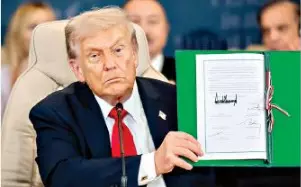


When Donald Trump unveiled his proposed “Board of Peace” to oversee Gaza’s post-war transition and reconstruction, the question many diplomats quietly asked was not whether Gaza needs help — but what kind of help this board really represents. Framed as a bold alternative to what Trump calls the failures of the United Nations, the initiative promises decisive leadership, rapid funding, and fewer bureaucratic delays. Yet its structure — permanent seats reportedly priced at $1 billion after an initial three-year term, a chairman inherited with sweeping veto powers, and only hazy accountability mechanisms — has raised an unavoidable suspicion: is this peace-building, or diplomacy redesigned in the image of Trump’s transactional business model?
That suspicion has only deepened as details of the board’s charter have emerged. Rather than dispersing authority among participating states, the document concentrates power firmly in the hands of the chairman. Unlike the United Nations Security Council, where five permanent members share veto power based on post-World War II political realities, the Board of Peace appears to hinge permanence and influence almost entirely on financial contribution — and ultimate approval on Trump alone. Under the proposed rules, the chairman would not only exercise veto authority over decisions but also retain the power to remove member states, effectively making participation conditional on continued favour from the board’s head.
Critics argue that this model risks transforming international peace efforts into a pay-to-play enterprise, where wealth buys access and loyalty substitutes for legitimacy. The deeper problem, they say, is not merely cost, but concept. By attaching permanence to a $1 billion fee, the board commercialises international stability itself. Paul Williams, a professor of international affairs, has warned that the proposal turns peacekeeping into a transactional venture. Trump’s model bases its influence on financial wealth alone — raising the prospect that authority over Gaza’s future could be bought rather than earned.
The most immediate reason many governments have declined to participate is also the most controversial: the price of entry. Under the draft charter, countries seeking permanent membership must contribute $1 billion to retain their seat beyond an initial three-year term — a requirement many diplomats view as fundamentally incompatible with the principles of multilateral governance.
For smaller and middle-income states, the fee is not merely high; it is exclusionary. Several governments have privately indicated that tying permanence to such a sum effectively locks them out of meaningful influence from the outset. Even among wealthier nations, officials have bristled at the idea that decision-making authority over Gaza’s future should be determined by financial capacity rather than political legitimacy, regional responsibility, or humanitarian commitment.
European resistance has been particularly strong. France and other EU governments have signalled that they will not join a body where influence is explicitly monetised. Diplomats from these countries argue that post-conflict reconstruction should be guided by international law and inclusive institutions, not by what one official described as “a membership model closer to a private club than a peace council.” The concern is not simply budgetary; it is philosophical. A pay-to-play structure, critics warn, risks turning Gaza into a donor-managed project rather than a society rebuilt with and for its people.
There is also a strategic dimension to the refusals. Governments worry that paying $1 billion for permanence could expose them to political pressure or loss of autonomy, particularly given that the board’s chairman retains unilateral veto power and the authority to expel members. In that context, the fee looks less like a contribution to peace and more like a buy-in to a system where financial commitment does not guarantee influence — or protection from arbitrary decisions.
Meanwhile, several key U.S. allies have reacted coolly — even bluntly — to the Board of Peace charter’s terms. France has been the most explicit. Speaking during a debate with lawmakers, Jean-Noël Barrot made clear that Paris would not participate. “At this stage, France cannot accept,” he said, adding that the board’s mandate goes well beyond the framework for rebuilding and administering post-war Gaza endorsed by the United Nations. Barrot said that the charter is “incompatible with France’s international commitments — and in particular its membership in the United Nations, which obviously cannot be called into question under any circumstances.”
His remarks crystallised a broader European concern: that the $1 billion fee is not merely a funding mechanism, but a signal that the Board of Peace is designed to bypass established multilateral institutions rather than reinforce them.
Finally, many countries fear the precedent such a model would set. If peace initiatives begin auctioning permanent seats while concentrating veto power in a single, permanent chairmanship, what stops future crises from being managed by similar pay-walled councils? For states already wary of efforts that weaken the United Nations system, the USD 1 billion requirement has become a red line — a symbol of how the Board of Peace departs from collective problem-solving and drifts toward transactional power politics.
Gaza’s reconstruction will require urgency, resources, and leadership. But it will also require legitimacy, restraint, and shared authority. Without those, a board built on money, vetoes, and permanence risks being remembered not as a breakthrough for peace — but as another experiment where power, not people, set the terms.
Views expressed are personal. The writer has worked in senior editorial positions for many renowned international publications