
Opening Salvo for 2026
Amit Shah’s Bengal and Tamil Nadu tour signals BJP’s early election mode for 2026, deploying contrasting strategies across two of India’s toughest political battlegrounds
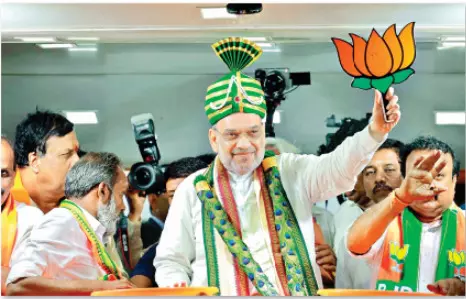


In the volatile world of Indian politics, timing is everything. While most political parties are still calibrating their compasses for the future, Union Home Minister Amit Shah has already sounded the war cry for the 2026 Assembly elections. Between December 29, 2025, and January 5, 2026, Shah undertook a whirlwind tour of West Bengal and Tamil Nadu— two of the BJP’s toughest ideological battlegrounds.
To the casual observer, these were routine organisational visits. A closer examination of the itinerary, the rhetoric, and the internal directives, however, reveals a meticulously calibrated blueprint for electoral domination—one that eyes a “two-thirds majority” in West Bengal and an “outright victory” in Tamil Nadu. Shah is not merely visiting these states; he is fundamentally re-engineering the BJP’s approach to its most formidable challenges, marking the Party’s formal transition into full election mode for the 2026 Assembly polls. While the ambition remains identical, the strategies deployed in Kolkata and Chennai are strikingly distinct.
In West Bengal, Shah’s December visit to Kolkata functioned as an unofficial campaign launch. The intensity of his schedule—marathon meetings with party leaders, elected representatives, and RSS functionaries—reflected a party seeking to translate its expanding vote share into a governing majority.
His approach in Bengal has been direct, confrontational, and deeply rooted in the state’s demographic fault lines. By invoking high-profile cases—from alleged scams to incidents of violence against women—Shah positioned the BJP as both a law-and-order alternative and a moral corrective to the incumbent government. The emphasis on infiltration and border fencing further reinforced a national security narrative tailored to Bengal’s unique geopolitical context.
Equally significant was the organisational blueprint Shah unveiled. Drawing from the “Bihar model,” the BJP is betting heavily on micro-level electoral management. With booth committees formed in 65,000 of the state’s 81,000 polling booths and the deployment of Vistaraks across all 294 Assembly constituencies, Shah is attempting to convert a dramatic surge in vote share, from 17 per cent in 2014 to 39 per cent in 2024, into a decisive seat tally.
This is not merely administrative data; it is the backbone of what Shah envisions as a “two-thirds majority” victory. The party appears focused on ensuring last-mile voter mobilisation—an area where it believes previous elections slipped through its grasp. By framing infiltration not merely as a local demographic concern but as a national security threat, promising a “national grid” that even a bird cannot breach. Shah has elevated the discourse, positioning the BJP as the sole guarantor of the state’s safety and integrity.
If Bengal is about organisational muscle, Tamil Nadu is about recalibration and alliances. Shah’s January visit to the southern state reflected a clear-eyed assessment that defeating the DMK requires consolidation of anti-incumbency votes rather than a solitary contest. Acknowledging the complex Dravidian political landscape that has long kept national parties at bay, Shah signalled a decisive pivot—from isolation to coalition-building.
This shift in tone is critical in a state where the BJP has historically struggled to expand beyond the margins. Shah’s critique of the DMK government mirrored his Bengal strategy, centring on allegations of corruption, misuse of central funds, failure to fulfil electoral promises, and social instability. However, the real thrust in Tamil Nadu lay in alliance arithmetic. Meetings with AIADMK leaders, outreach to the PMK, and exploratory signals towards emerging players such as the Tamilaga Vettri Kazhagam suggest that the BJP views consolidation of anti-DMK votes as the decisive factor in the southern battle.
The emphasis on community-based political calculus, particularly involving Vanniyar, Thevar, and other influential social groups, reveals a distinctly pragmatic approach. Shah’s insistence that alliances be driven by “electoral math and not sentiment” underscores the BJP’s willingness to subordinate ideological rigidity to political viability. The narrative remains tightly focused on the DMK’s alleged “misrule,” with repeated references to the ₹39,000-crore Tasmac liquor scam and entrenched dynastic politics.
Taken together, Shah’s twin-state engagements reveal a calibrated national strategy adapted to sharply different regional realities. In West Bengal, the BJP is preparing for a high-polarisation, governance-versus-misrule contest backed by formidable organisational machinery. In Tamil Nadu, it is positioning itself as the driving force behind a potential mega-coalition, leveraging caste dynamics and local alliances to breach a long-standing Dravidian fortress.
Whether these strategies translate into electoral breakthroughs remains uncertain. But one conclusion is unmistakable: with Amit Shah at the helm of planning and execution, the BJP has fired the opening salvo of the 2026 Assembly battles—early, assertive, and unmistakably strategic.
Views expressed are personal. The writer is an Assistant Professor at Jindal Global Law School, OP Jindal Global University



