
New Era of Indian Trade
The India–EU Free Trade Agreement signals a decisive shift in India’s economic confidence, linking ambition, diplomacy and domestic industry to a new era of global trade leadership
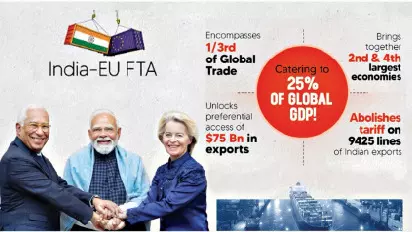


The conclusion of the India–European Union Free Trade Agreement on 27 January 2026 marks a defining moment in India’s economic diplomacy. Negotiated between the world’s 4th and the 2nd largest economies, which together account for nearly 25 per cent of global GDP, the agreement represents the most comprehensive and ambitious trade pact India has ever undertaken. With over 99 per cent of Indian exports by value set to gain preferential access to the European market, the India–EU FTA marks a clear shift in how India engages with global trade and investment flows.
This deal, globally hailed as the “mother of all trade deals”, goes well beyond conventional tariff reduction by establishing modern disciplines covering trade in services, mobility of skilled professionals, digital trade, and regulatory cooperation, hence reflecting the realities of a 21st-century economy. In doing so, it positions India not merely as a participant, but as a country that will shape the rules of global trade.
Leadership That Turned Stalemate into Success
The significance of this achievement becomes clearer when viewed against the long history of stalled negotiations. Discussions on the India–EU Bilateral Trade and Investment Agreement (BITA) had begun as early as 2007, only to be suspended in 2013 after years of inconclusive engagement.
Now, under the decisive leadership of Hon’ble Prime Minister Shri Narendra Modi, negotiations were relaunched in May 2021 with a focused and outcome-oriented approach, ultimately culminating in the successful conclusion of the FTA. What changed was not the potential of the partnership, but the intent and decisiveness of the leadership guiding it. Central to this effort was the role played by Hon’ble Union Minister of Commerce and Industry Shri Piyush Goyal, who steered these negotiations and ensured that India secured a balanced and ambitious agreement while safeguarding the interests of domestic industry, particularly labour-intensive and manufacturing sectors.
A Landmark Trade Pact: Scope, Scale, and Strategic Impact
What stands out immediately is the sheer scale and scope of the India–EU FTA, which underscores its strategic importance. Together, India and the European Union represent a combined market that accounts for nearly one-third of global trade and about one-quarter of global GDP, underlining the agreement’s systemic importance to the global economy. Bilateral goods trade between India and the EU stood at approximately USD 136.5 billion in 2024–25, with Indian exports accounting for USD 75.8 billion. Under the agreement, tariff liberalisation spans nearly all industrial sectors, with immediate duty elimination on more than 70 per cent of tariff lines, hence delivering a significant boost to our export competitiveness.
Beyond goods, the FTA creates robust frameworks for services, digital commerce, regulatory cooperation, and skilled mobility, helping Indian enterprises integrate more deeply into European value chains. This will support job creation, innovation, and diversification of India’s trade basket, while at the same time strengthening supply-chain resilience and long-term economic cooperation between the two partners.
It is this broader, people-centric vision of trade that defines the spirit of the agreement. As our Prime Minister Shri Narendra Modi underlined, this is “Free Trade for an Ambitious India, Free Trade for Aspirational Youth, and Free Trade for an Aatmanirbhar India.” The India–EU FTA, therefore, is not just about expanding markets, but about empowering India’s youth, enterprises, and industries to compete with confidence on the global stage while strengthening the foundations of Aatmanirbhar Bharat.
Textiles and Apparel: A Breakthrough for India’s Flagship Sector
Our textiles and apparel sector is the cornerstone of the country’s manufacturing economy and a major source of employment. The European Union forms India’s second-largest market for textiles and apparel. Until now, Indian exporters faced average duties of up to 12 per cent, placing them at a disadvantage compared to competitors such as Bangladesh, Vietnam, and Turkey. This FTA eliminates these duties across all textile and clothing tariff lines, granting zero-duty access to a market that is worth nearly USD 263.5 billion. India’s current textile exports to the EU, valued at around USD 7.2 billion, are therefore poised for rapid expansion as our producers achieve parity in pricing and competitiveness. Enhanced market access is expected to drive higher production, deeper supply-chain linkages, and greater participation of MSMEs and labour-intensive clusters, hence giving a big push to employment generation.
This breakthrough aligns seamlessly with our Hon’ble Prime Minister’s Vision 2030 for India’s textiles sector, which aims to expand the industry from USD 176 billion to USD 350 billion and raise exports to USD 100 billion. With the guidance of Hon’ble Union Minister of Textiles Shri Giriraj Singh, the Indian textiles sector is well-positioned to fully leverage the opportunities created by this transformative agreement.
India’s Expanding Trade Footprint and the Textile Opportunity
The India–EU FTA also marks India’s eighth Free Trade Agreement since 2021, highlighting a decisive shift in India’s trade engagement with the world. Beginning with the Mauritius CECPA (2021), which was India’s first-ever trade agreement with an African nation, the momentum continued with the UAE CEPA (2022), followed by the Australia ECTA (2022), which gave Indian exporters zero-tariff access to the Australian market. This was followed by the EFTA TEPA (2024/25) and the UK CETA (2025), under which 99 per cent of Indian exports received tariff-free access. The Oman CEPA (2025) complemented this, offering India its largest-ever tariff coverage in the Gulf region. The New Zealand FTA (2025) became India’s fastest trade deal, with the two countries reaching an agreement in just over nine months. Now, with the India–EU FTA, we stand at the pinnacle of this journey.
Trade as a Pillar of Viksit Bharat @2047
The India–EU Free Trade Agreement is not merely a commercial accord; it is a powerful statement of India’s rise, anchored in decisive leadership, strategic clarity, and an unwavering confidence in the nation’s capabilities. European Commission President Ursula von der Leyen has rightly observed: “When India succeeds, the world is more stable, more prosperous, and more secure.” The India–EU FTA gives concrete shape to this belief, reflecting a partnership built on trust, shared prosperity, and long-term goals.
As India advances towards the goal of Viksit Bharat @2047, this landmark agreement strengthens India’s position as a global economic powerhouse. It is Modi’s move to firmly place India as a confident economic partner on the world stage — one that negotiates from strength, delivers outcomes, and expands opportunity for its people.
Views expressed are personal. The writer is the Minister of State for Textiles & External Affairs (MEA)



