
Netaji’s Kabul Sojourn
Beyond the famous escape, Bose’s hidden months in Kabul reveal a story of disguise, diplomacy and peril in a city teeming with spies
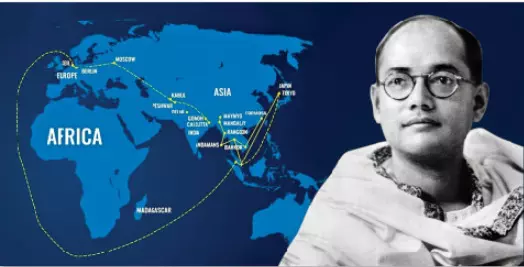


Although the escape of Netaji Subhash Chandra Bose from Calcutta to Kabul is well documented, not much is known about his brief stay in Kabul and about how he travelled from there to the then USSR en route to Germany.
Netaji arrived in Kabul in late January 1941 and left Kabul around mid-March 1941 for his onward journey to the Soviet Union. After a very difficult journey undertaken by truck, van, cart, bus, and even on foot, Netaji arrived in Kabul from Peshawar in disguise. He was escorted through the rugged terrain of the frontier areas to Kabul by his close associate Shri Bhagat Ram Talwar, alias Rahmat Khan.
Arriving in Kabul, Netaji initially stayed in a serai near the Lahori Darwaza in the old city under very difficult conditions. He realised that he could not remain undetected for long in the serai and eventually shifted to the house of Shri Uttam Chand Malhotra, who owned a shop in Kabul and whose brother was a friend of Bhagat Ram. Shri Malhotra not only gave Netaji shelter in his house, but he and his wife, Smt. Ramo Devi took great care of him and ensured total secrecy.
Afghanistan in 1941 was an independent nation ruled by King Zahir Shah. However, there was a strong influence of British intelligence in Kabul. Italy, Germany, and the Soviet Union also had their legations/embassies in Kabul and had their own spheres of influence. On arrival in Kabul, Netaji initially tried his best to obtain support from the Soviet Embassy in Kabul for his travel to the Soviet Union, from where he had expected to continue his struggle against British imperialism. However, by early 1941, the Soviet Union was no longer in a position to help the cause of Indian independence since it itself was facing an imminent invasion from Germany (Germany did eventually invade the Soviet Union in June 1941). However, the Soviet Union was willing to provide Netaji safe passage through Soviet territory for his travel to Germany.
Meanwhile, British intelligence was in hot pursuit of Subhas Bose and was determined to prevent him from leaving Afghanistan. Netaji managed to contact the Italian Consul General in Kabul, Signor Pietro Quaroni, who not only later hosted him in the Italian legation in Kabul but also provided him with a new identity. Quaroni provided a passport to Netaji in the name of one Orlando Mazzotta to enable him to travel to Moscow en route to Berlin. Netaji left Kabul for the Soviet border around 18th/19th March 1941, accompanied by Italian diplomats in a vehicle arranged by Signor Quaroni.
There were two possible routes that Netaji could have taken to the Soviet Union: one via Mazar-i-Sharif in northern Afghanistan and another via Herat in western Afghanistan. The former would have led him to Soviet Uzbekistan, and the latter to Soviet Turkmenistan.
In 1941, the Kabul–Mazar-i-Sharif route involved crossing the high Hindu Kush Mountains through the Khawak and Anjuman Pass. At that time, the Salang Tunnel did not exist — the Salang Tunnel was built much later in the mid-nineteen sixties. The road journey along this route would have been very arduous, but it would have been relatively safer than the road route to Herat via Kandahar, which has traditionally been a volatile and strife-torn area. Moreover, Russian influence in northern Afghanistan was strong, and it would have been easier to avoid British surveillance along the Mazar-i-Sharif route rather than along the Herat route.
While on an assignment with UNDP in Afghanistan during the period 2011–13, I got an opportunity to know more about the Afghan episode of Netaji’s escape from Calcutta to Berlin in 1941.
In 2011, Kabul was a very dangerous place, with frequent bomb blasts, suicide attacks, and attacks on foreign installations. It was a city of intrigue where danger loomed everywhere and at all times. There were a lot of restrictions on travel, even within the city. Fortunately, my work in Afghanistan required me to interact extensively with Afghan government officials. Although none of the persons with whom I interacted had ever heard of Subhash Chandra Bose, an Afghan friend promised to find out more about him and to also locate the house of Uttam Chand Malhotra where Netaji had stayed. It was through his efforts that one day, accompanied by him, I visited the Mohalla Hindu Guzar area in Shor Bazar, located in the old part of Kabul. In 1941, this was the locality where most Indian businessmen and traders used to live.
The lanes of Shor Bazar are very narrow and lead to a big wholesale grain market. Some old buildings still exist in the area, although many of the original houses have been demolished or rebuilt. Unfortunately, I was unable to locate the house of Shri Uttam Chand Malhotra. It would have probably changed hands over the years and may have been demolished or rebuilt. With the help of my friend, I was able to speak with the inhabitants of the area, but apart from getting to know from them that a famous Indian freedom fighter had lived in the locality long years ago, I was unable to elicit more precise information. Although disappointed with the failure of my mission, I felt privileged to have visited the place where an important episode of our freedom struggle has taken place. I felt that a plaque ought to be installed in Shor Bazar just to record the event for posterity.
I next tried to get access to the Afghan Government archives, but I drew a blank. Due to years of war and strife in Afghanistan and with frequent regime changes, there appears to be hardly any information available in the Afghan archives of the events of the 1940s.
I was fortunate to be posted to Mazar-i-Sharif in July 2011. Mazar-i-Sharif is the capital of Balkh Province. It is the gateway to Uzbekistan. Soon after arriving there, I visited the border town of Hairatan, which lies on the banks of the River Amu Darya. The city of Termez, in Uzbekistan, lies right across the River Amu Darya opposite Hairatan. There is a bridge across the river, which was built by the Soviet Union during its occupation of Afghanistan. This bridge did not exist in 1941, and maybe another wooden bridge suitable only for crossing on foot had existed at that time.
The road from Mazar-i-Sharif to Hairatan has been witness to many historic events since ancient times. Many invaders, such as the Persians, Greeks, Arabs, Mongols, Timurids, and in the modern era, the Russians and the Americans, have traversed this road while storming into Afghanistan. It is widely believed that our own revolutionaries fleeing from British rule had found refuge in Mazar-i-Sharif while waiting to cross the Hairatan border to enter the Soviet Union. I think that, in all probability, Netaji would have crossed into Soviet Uzbekistan from the Hairatan border for his onward journey to Moscow and from there to Berlin. We will, however, never know for sure unless declassified information is obtained from the Russian archives.
Netaji Subhash Chandra Bose chose the wrong side during the Second World War, but even in defeat, his dream of an independent India was achieved. History is usually unkind to losers. The Afghanistan episode of Netaji Subhash Chandra Bose will probably soon be forgotten. But surely he deserves better.
Views expressed are personal. The writer is a former IAS officer who served with UNDP in Afghanistan from 2011 to 2013



