
Moral Void in Indian Politics
Across democracies, the growing vacuum between ethics and power is weakening institutions, distorting public trust and redefining politics as a pursuit of survival over principle
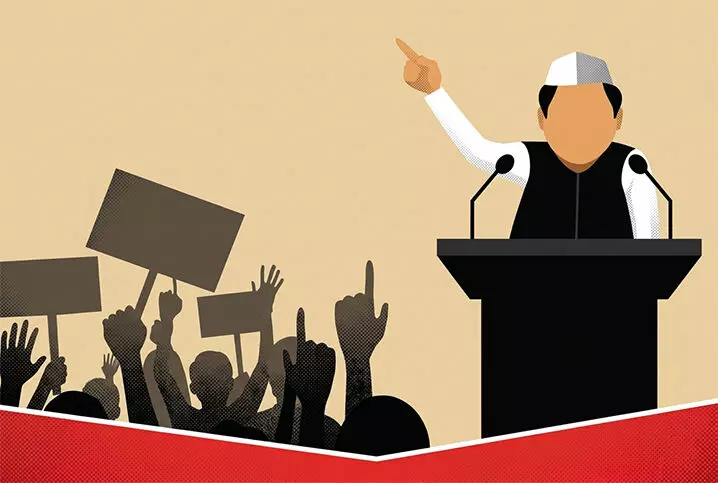


The erosion of political morality has become a defining crisis of the 21st century. While developing nations grapple with the overt shadows of corruption, money, and muscle power, developed democracies face a subtler but equally corrosive decay through populism, misinformation, and hyperpolarisation. Increasingly, leaders justify unethical manoeuvres as “political necessities.” However, power divorced from morality breeds systemic corruption, erodes public confidence, and fractures the social contract.
As the Corruption Perceptions Index suggests, the success of nations—particularly the Nordic model—stems not from inherent perfection but from a sustained ethical culture reinforced by civic education and robust accountability. In contrast, populist regimes often personalise power, prioritising loyalty over integrity and temporarily masking institutional decline with charismatic leadership.
The Philosophical Divide: From Plato to Machiavelli
The tension between ethics and governance is ancient. Classical philosophers like Plato and Aristotle viewed politics as a moral endeavour—a means to a higher philosophical end. In the Greek city-state, the state was holistic, touching all spheres of human life through a moral lens.
The Great Divorce occurred with Niccolò Machiavelli. In The Prince (1532), he famously argued that a ruler “must learn how not to be good,” separating political efficacy from private morality. Today, this Machiavellian “carte blanche” appears well-entrenched, where electoral success at any cost is the only metric that matters. Yet, politics is fundamentally a public trust. The authority to make binding decisions—enforced by the state—demands a moral compass because those decisions dictate the fortunes of millions.
The Grand Indian Tradition: Politics as Dharma
India’s heritage offers a powerful counter-narrative to Machiavellian pragmatism. In the Indian tradition, ethics is synonymous with culture—a deep-seated “concern for others.” This is reflected in the essence of the Bhagavatham: helping others is merit; hurting others is sin. This universal morality mirrors the Ten Commandments, the Sermon on the Mount, and the Eightfold Path of Buddha.
Historically, Indian governance was anchored in legitimacy and moral authority:
* Ancient Republics: The egalitarian spirit of the Vrijjis and Malls.
* Asoka’s Dhamma: A welfare-oriented “paternal despotism” focused on public duty.
* The South Indian Legacy: The vibrant democratic institutions of the Pallavas and Cholas.
* Justice as Foundation: The Tamil tradition of the Kannagi–Pandya episode, where justice is the sole anchor of a legitimate throne.
This legacy was inherited by India’s first generation of modern leaders. Figures like Dadabhai Naoroji, Gopal Krishna Gokhale, and Subhas Chandra Bose were men of unshakeable principle. Towering above all was Mahatma Gandhi, who advocated for a “Kingdom of Heaven in politics,” maintaining that truth and non-violence were the only bulwarks against political decay.
The Contemporary Decay: Money, Muscle, and Markets
Despite this rich heritage, modern Indian politics faces a severe ethical deficit. The partition era saw the first major retreat of moral politics as communal passion and sectional interests surfaced. Over decades, the compulsions of electoral survival have sharpened primordial loyalties and opened the gates for the “criminalisation of politics.”
The statistics from the 2024 Lok Sabha (18th Lok Sabha) are sobering:
* Criminal Records: 251 members (46 per cent of the House) face declared criminal charges. The share of MPs facing serious charges has more than doubled since 2009.
* Plutocracy: 93 per cent of elected MPs are “crorepatis” (millionaires), up from 82 per cent in 2014, highlighting the increasing role of wealth in securing office.
As Anthony Downs (1957) postulated, many politicians are now motivated solely by the “income, prestige, and power” of office rather than a desire to implement policy. This shift toward self-centeredness is further exacerbated by neoliberal policies that prioritise individual gain over collective welfare.
The Path to Renewal
The consequences of this divorce between politics and ethics are disastrous: systemic corruption, the exploitation of religious and cultural fault lines, and a growing “trust deficit” among the youth. The “Gen Z” revolutions across South Asia serve as a stark reminder that when the social contract breaks, the public may rise in revolt.
To restore the soul of the nation, we must move beyond viewing the nation as a “piece of earth” and see it as a living entity that requires moral ignition.
* Institutional Self-Regulation: The formation of Ethics Committees in the Rajya Sabha is a positive step toward internal accountability.
* Role of Media and Civil Society: Media must shift its focus toward narrating examples of integrity, however small, while civil society must be engaged to sensitise the electorate.
* Educational Enlightenment: Only a “moral awakening” through education can foster a citizenry that demands concern for others over narrow partisan gains.
* Legal Fortification: Strong legal measures are required to battle unethical governance and ensure the engine of Viksit Bharat (Developed India) is fueled by integrity.
Conclusion
Politics empowers the people, but without ethics, it becomes a mere mechanism for the gain of a few. For India to flourish, its leaders must return to the Gandhian ideal that politics and ethics are the two interlinked pillars of a just society. The journey toward a morally grounded democracy will take time, but it is a relentless battle we must win to preserve the very fabric of our republic.
Views expressed are personal. Felix Raj is the Vice Chancellor, Prabhat Kumar Datta is an Adjunct Professor, both at St. Xavier’s University, Kolkata



