
Is Pakistan wooing Bangladesh?
Pakistan intensifies diplomatic, cultural and economic outreach to Bangladesh, raising questions about regional alignments, historical memory and Dhaka’s evolving foreign policy priorities
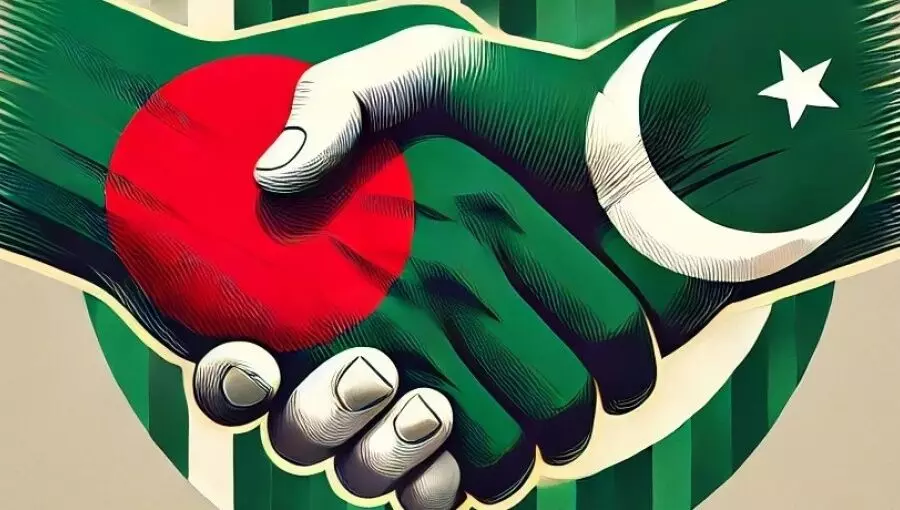


There are incessant overtures on the part of Pakistan to woo Bangladesh. This process had vigorously begun soon after the interim government was in place in Dhaka in the aftermath of Hasina’s downfall in early August 2024. Then, the government under Yunus saw a series of exchanges of visits between Pakistan and Bangladesh, including high-level military delegations, massive concessions in customs and excise duties on both sides, relaxations of visa policies, as well as restoration of direct air links, including to and from Karachi and Dhaka. Apart from this, Bangladesh also saw an attempt by some forces to resurrect Mohd Ali Jinnah, who was a sworn Bangla hater and promoter of Urdu, causing massive anti-Urdu violent agitation in the early 1950s. To expand further, Dhaka recently witnessed a programme commemorating Jinnah on his 76th death anniversary, with active participation by local Bangladesh High Commission officials.
The above was unprecedented in Bangladesh, and not only that, but there were also visible attempts on the part of some pro-Pakistan elements who tried to name one of the university hostels after Allama Iqbal, a move hitherto not seen in Bangladesh. Simultaneously, there were well-organised attempts to vandalise Tagore’s ancestral properties as well as targeting film icon Satyajit Ray’s grandfather’s house. These were not routine and bore footprints of possibly subtle Pakistani designs to bring both the countries together by reviving Jinnah, the founder of Pakistan, as well as the decimation of the original Indian culture, which has always been the bulwark of Bangladesh. Besides these, the erstwhile head of the interim government, Muhammad Yunus, met the Pakistani Prime Minister more than once at different fora, and a clear bonhomie was spotted. This perhaps happened because soon after Hasina’s exit, there was a strong anti-India sentiment prevailing in Bangladesh, when the political dispensation, media and a large section of people seemed to be hostile.
Now, with Tarique Rahman as the new Prime Minister, we see that the Pakistani government has extended an invitation to visit Pakistan for its Independence Day celebrations and witness the Pakistan Day Parade. While a formal nod is still awaited, the Secretary General of the ruling Pakistan Muslim League (PML-N), Professor Ahsan Iqbal Chaudhary, who attended the oath ceremony (February 17) of Tarique Rahman, renewed the invitation to him on behalf of Prime Minister Shehbaz Sharif to visit Pakistan at the earliest. The invite was believed to have been accepted by the Bangladeshi leader. Bangladesh High Commissioner in Islamabad Muhammad Iqbal Hussain Khan also maintained that the government and people of Pakistan are keen to further strengthen ties between the two “brotherly” countries. This is a clear indication that the wooing continues.
Optimists also assess that, as two of the most populous economies in South Asia, Pakistan and Bangladesh stand to benefit greatly from increased coordination. Both nations possess growing consumer markets, expanding industrial bases and ambitious development agendas. Enhanced trade between them might open new opportunities for exporters, investors and entrepreneurs. Improved connectivity — whether maritime, digital or commercial — can reduce costs and increase market access both ways.
Bangladeshi watchers are also hopeful that, alongside economic collaboration, people-to-people contact will be crucial in strengthening ties. Cultural exchanges, academic partnerships and tourism initiatives can build familiarity and goodwill between the citizens of both nations. Expanding educational scholarships and research partnerships would not only enhance knowledge sharing but also reinforce long-term institutional connections. This seems to be another indicator that Pakistan is relentlessly pursuing its overtures, though the hopes could be misplaced.
The invitation extended to Prime Minister Tarique Rahman appears to be more than symbolic. It also perhaps represents an opportunity to chart a new phase of engagement characterised by economic pragmatism, youth empowerment and regional connectivity. Through shared development aspirations and practical cooperation, both governments can translate diplomatic goodwill into tangible progress — at least this is hoped for by Pakistan and a section in Bangladesh.
In the meantime, according to some analysts, as South Asia navigates a shifting global economic landscape and evolving geopolitical dynamics, constructive intra-regional relations are becoming increasingly important. Pakistan’s outreach to Bangladesh reflects an understanding that long-term stability and prosperity are unattainable without sustained dialogue and cooperation. If high-level engagement continues and mutual development remains a shared objective, Pakistan and Bangladesh can build a durable and mutually beneficial partnership that advances their national goals while contributing to the progress of the wider region. This is certainly optimistic, yet it needs very careful study while exercising abundant caution.
Further, Islamabad is believed to have allocated 500 scholarships for Bangladeshi students, with 75 already travelling to Pakistan for higher education, and has proposed closer coordination between national data and statistics institutions in both countries. Pakistan is also pushing Bangladesh to hold joint celebrations to mark the 150th birth anniversary of poet Allama Iqbal. This is yet another move by Pakistan to bring Bangladesh into its cultural fold in the name of cultural and literary exchanges.
Meanwhile, Bangladeshi and Pakistani watchers are intently waiting for the outcome of the decision on the part of Tarique Rahman on whether he undertakes the visit to Pakistan to attend the latter’s Independence Day celebrations in Islamabad. As is known, the new Bangladesh Prime Minister has decided to visit Bhutan as his first external trip after taking over the high office. If at all he goes to Pakistan before India, it would mean that the Pakistani overtures to Bangladesh have been squarely responded to and one can safely assume that both the countries are now on a path to restore impaired bilateral relations. However, a majority of Bangladeshis are yet to forget the Pakistani atrocities on Bengalis in the run-up to the liberation struggle, which also saw a genocide for which Pakistan has not yet tendered an apology despite repeated calls by Bangladesh for nearly 55 years.
Views expressed are personal



