Elections, Faith, Faultlines
As campaigning intensifies, Bangladesh faces a volatile mix of political uncertainty, communal resurgence, strained ties with India and deepening engagement with Pakistan
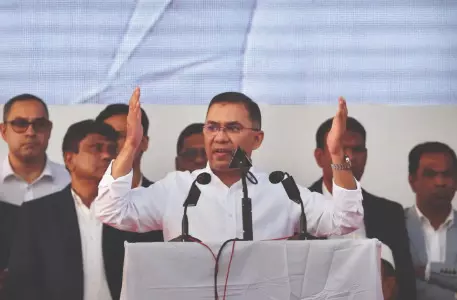


Bangladesh election campaigning is steadily picking up momentum as Bangladesh Nationalist Party (BNP) Chairman Tarique Rahman completes one month of his return to Dhaka after nearly 17 years of exile in the UK. After his mother, Khaleda Zia’s burial, he seems to have settled down very fast, gradually reorganising his party, which was almost leaderless. Having aged and being away from grassroots politics for nearly two decades, Tarique Rahman is touching base, delivering lectures and contacting party rank and file in order to instil discipline. Simultaneously, the new party chairman is meeting ambassadors and high commissions of different countries, holding parleys to strengthen bilateral relations. Till now, he has been able to establish good rapport with these heads of mission. These include the Indian and Pakistani High Commissions, as well as Turkey and other countries.
These overtures notwithstanding, Tarique is keeping his cards close to his chest, keeping everybody guessing. For example, what is his election strategy towards Jamaat-e-Islami (JeI), as the latter is sending mixed signals to the electorate as well as the BNP on whether it will be an ally of the BNP in the elections or go on its own, or whether it will contest the elections at all? It is also not yet clear what the equations with other parties will be, though these should hopefully become clearer soon. This said, the pro-Islamic fundamentalist parties appear to be coming together, giving rise to speculation about a strong functional rapport among them to drive the country towards an exclusive Islamic governance. A few analysts are even saying that pro-Islami outfits are thinking of pressurising the interim government to work towards the imposition of Shariat law or even the formation of a “revolutionary” council. This may appear utopian, but given the Islamic character and the wave prevailing in the country since Hasina’s exit, communal forces are on the rise and such utopian thinking cannot be altogether wished away. Communal frenzy has also been noticed following a renewed anti-minority campaign unleashed in the recent past, in which a number of Hindu individuals have been brutally killed. Minorities are now living in a state of fear and uncertainty.
Amid these developments, Indo–Bangladesh relations have taken an all-time beating. Bangladesh has further restricted visa issuance for Indian nationals, extending the curbs to its deputy high commissions in Kolkata, Mumbai and Chennai. The Ministry of Foreign Affairs confirmed the decision on January 7, stating that the restrictions came into effect from January 8. Under the latest measures, all categories of visas except business and employment visas have been strictly suspended. According to the ministry, consular and visa services have ceased at the Bangladesh Deputy High Commission in Kolkata, while tourist and other visa services for Indian nationals have also been suspended at missions in Mumbai and Chennai. Diplomatic sources said the decision was taken in view of “security” considerations amid ongoing tensions between the two countries.
This tension apart, the recent controversy over the exclusion of a Bangladeshi cricketer from an Indian Premier League (IPL) tournament in India has further hit Indo–Bangladesh ties. Bangladesh reacted sharply, condemning the Board of Control for Cricket in India (BCCI), with Sports Advisor Asif Nazrul calling for the country’s T20 World Cup matches to be moved out of India. He has also asked for Bangladesh’s World Cup fixtures to be relocated to co-host Sri Lanka due to “safety concerns”. Further, the advisor announced that he has requested the Ministry of Broadcasting to ban the telecast of the IPL within Bangladesh. This represents a complete politicisation of sport vis-à-vis Indo–Bangladesh relations, further distancing the two countries and minimising any chances of an improvement in ties, at least for now.
While Indo–Bangladesh relations are witnessing a new low, Bangladesh and Pakistan continue to keep their ties warm, as demonstrated by the regular exchange of visits at different levels and the easing of restrictions on various deals. Pakistan is taking full advantage of the widening gulf between India and Bangladesh, and Pakistani media also appears upbeat, openly rejoicing over this development. However, matters crossed a line when Pakistan-based terror outfit Lashkar-e-Taiba (LeT) welcomed the strengthening diplomatic and military engagement between Pakistan and Bangladesh. Its deputy chief, Saifullah Kasuri, praised what he termed renewed closeness between Islamabad and Dhaka. According to media reports, Kasuri, a senior LeT operative designated by the United Nations and identified as the mastermind of the Pahalgam terror attack, congratulated both countries on improving ties and described the formal start of trade between Pakistan and Bangladesh as “commendable” and highly “appreciable”.
In this context, the endorsement is seen as carrying strategic significance. Kasuri portrayed the Pakistan–Bangladesh engagement as a positive realignment for the Muslim world, echoing LeT’s long-standing ideological narrative directed against India. According to intelligence inputs, his remarks indicate that Pakistan-based terror groups view emerging regional diplomatic openings as potential operational opportunities, particularly to expand jihadist influence beyond Kashmir into wider South Asian alignments.
Recently, the LeT deputy chief publicly acknowledged the group’s links with the Pakistan Army, exposing the nexus between the military and terror outfits that India has long alleged. Counter-terror agencies believe the statement signals an effort to widen the theatre of terrorist activity from Kashmir to sympathetic regional networks, making the evolving Pakistan–Bangladesh engagement a matter of heightened concern for Indian and international security agencies.
In another Pakistan–Bangladesh-related development, Bangladesh is on a procurement spree to modernise its ageing air force. After signing a Letter of Intent with a European consortium to acquire 14 Eurofighter Typhoon multi-role fighter jets and considering a proposal to procure 20 Chinese Chengdu J-10CE multi-role fighter jets by 2027, Dhaka has now expressed “potential interest” in procuring JF-17s from Islamabad. A high-level delegation led by Air Chief Marshal Hasan Mahmud Khan, Chief of Bangladesh’s Air Force, visited Islamabad on January 6 and met counterparts to discuss collaboration and cooperation. Pakistan’s military press wing, Inter-Services Public Relations (ISPR), disclosed in a statement that Air Chief Marshal Zaheer Ahmed Babar Sidhu and his Bangladeshi counterpart held talks on the procurement of the JF-17, jointly developed by Pakistan and China. The discussions also covered training, maintenance, support and broader cooperation between the two air forces.
Given the heated pitch of election canvassing, Bangladesh’s acerbic hostility towards India and its increasing closeness to Pakistan, it appears that communal forces may gain the upper hand over the interim government. Should they succeed in their designs, minorities will continue to remain unsafe and increasingly insecure, while Indo–Bangladesh relations are likely to drift further apart. This is also expected, in all likelihood, to trigger pronounced anti-India rhetoric in a series of hate-filled election speeches by poll contestants ahead of February 12.
Views expressed are personal. The writer is a retired IPS officer, Adviser NatStrat, and a former National Security Advisor in Mauritius