Echoes of Iraq in Iran
The deepening US-Israeli conflict with Iran resonates with the fragile intelligence claims and strategic overconfidence that once justified the invasion of Iraq and destabilised an entire region
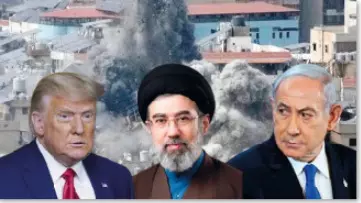


The Middle East has seen its share of wars justified by shaky premises. Still, the escalating US-Israeli confrontation with Iran risks repeating one of the most consequential strategic errors of recent history. The invasion of Iraq in 2003 was launched amid claims of imminent threats and hidden weapons programs that ultimately proved unfounded. Today, many of the arguments being advanced in favour of military action against Iran carry a similar fragility. The consequences, if the conflict deepens, could be equally destabilising.
To understand the stakes, one must first examine the United States’ reasoning. Much of the rhetoric surrounding the confrontation rests on claims that collapse under scrutiny. American officials have suggested that Iran posed an imminent threat, yet no credible evidence has surfaced that Tehran was preparing a pre-emptive attack against the United States. Assertions that Iran was on the verge of striking American territory are equally implausible. Iran’s ballistic missiles have a range of roughly 1,800 miles, sufficient to threaten regional adversaries but far from capable of reaching North America. Moreover, intelligence estimates have long indicated that Iran remains years away from developing intercontinental ballistic missiles.
Other accusations have been similarly misleading. Claims that thousands of American casualties in Iraq were caused by Iranian-manufactured improvised explosive devices distort the historical record. The overwhelming majority of such weapons were built by Iraqi insurgent groups, many of whom were themselves hostile to Iran. Likewise, the suggestion that Iran had any role in the 2000 attack on the USS Cole is historically inaccurate; that attack was carried out by al-Qaeda, a militant organisation that regards Iran as an ideological adversary.
Human rights criticisms of Iran are more credible. The Iranian government’s repression of dissent, particularly during recent waves of protest, has been severe. However, the moral force of these criticisms is weakened by the United States’ long-standing alliances with other governments that have carried out comparable or even greater repression. Washington maintains close ties with states such as Saudi Arabia, Egypt, and the United Arab Emirates, whose records on democratic freedoms are similarly troubling. Calls for democratic change in Iran, therefore, appear selective and strategic rather than principled.
Indeed, calls for the Iranian public to rise against their government during active military bombardment are unrealistic. History suggests that external attacks tend to strengthen, not weaken, domestic support for embattled governments. During the NATO bombing of Serbia in 1999, the opposition movement against Slobodan Milošević was temporarily weakened as the population rallied in defence of the country. A similar dynamic could unfold in Iran, where nationalist sentiment often runs deeper than ideological divisions.
The debate surrounding Iran’s nuclear program further illustrates the contradictions in the case for war. Iranian leaders have repeatedly stated that they do not intend to develop nuclear weapons, a pledge reinforced by religious edicts and diplomatic commitments. More importantly, the 2015 Joint Comprehensive Plan of Action (JCPOA) imposed stringent limits and monitoring mechanisms that made the construction of a nuclear weapon extremely difficult. That agreement collapsed after the United States unilaterally withdrew from it in 2018. Negotiations aimed at reviving the deal had reportedly made progress earlier this year, suggesting that diplomacy had not been exhausted.
If the nuclear issue does not fully explain the push toward confrontation, what does? Part of the answer lies in strategic opportunity. Iran has been weakened in recent years by internal unrest and by setbacks among its regional partners. The fall of Syria’s Assad government in late 2024 removed Tehran’s most reliable state ally in the region, while groups such as Hezbollah and the Houthis have suffered significant military losses. Domestically, the Iranian regime faces widespread dissatisfaction following harsh crackdowns on protests.
Weakness does not necessarily translate into imminent collapse. Iran’s political system is not centred on a single leader but rather on a network of powerful institutions, including the Revolutionary Guard, the clerical establishment, and various security bodies. Even dramatic events, such as the deaths of senior leaders, are unlikely to dismantle this institutional framework. The state has evolved into a highly militarised authoritarian system with multiple centres of power that share an interest in preserving the existing order. Benjamin Netanyahu has long advocated a more aggressive approach toward Iran, viewing Tehran as Israel’s primary strategic threat.
Nevertheless, attributing American policy entirely to Israeli pressure oversimplifies a far longer history. US hostility toward Iran predates the current crisis by decades. In 1953, the United States helped overthrow Iran’s democratically elected prime minister, Mohammad Mossadegh. During the Iran–Iraq War of the 1980s, American forces engaged Iranian naval targets and even shot down a civilian airliner. Washington has repeatedly supported regional rivals of Iran, including Gulf monarchies and Saddam Hussein’s Iraq.
These policies suggest that the confrontation is rooted less in short-term alliances than in a broader strategic logic. Iran remains one of the few major states in the Middle East capable of challenging American dominance. For decades, US strategic thinking has emphasised maintaining overwhelming military and political superiority, a doctrine sometimes described as “full spectrum dominance.” In this context, weakening Iran may be seen as a way to prevent any rival power from emerging in the region.
Such a strategy carries profound risks. Prolonged bombing campaigns rarely achieve regime change on their own. More often, they devastate civilian infrastructure and deepen humanitarian crises. A severely weakened Iran could become politically fragmented, with competing factions, ethnic groups, ideological movements, monarchists, and religious forces struggling for power. Rather than stabilising the region, such fragmentation could create another protracted conflict zone.
In Vietnam, American policymakers framed the conflict as part of a global ideological struggle against communism. Yet the insurgency was driven as much by nationalism as by ideology, and external intervention ultimately strengthened local resistance. Iran may present a similar dynamic. While its government is defined by religious authority, it also draws legitimacy from a deep sense of national independence rooted in centuries of history.
Iran is not a small client state that can be easily reshaped by external pressure. It is an industrialised country of more than ninety million people with a long tradition of statehood stretching back millennia. Attempts to coerce or destabilise such a society through military force alone are unlikely to produce the desired outcome.
Wars launched with confident predictions often end with unexpected consequences. The deeper the United States and Israel become involved in a confrontation with Iran, the more unpredictable the regional and global repercussions will be. Strategic overreach has humbled great powers before. If history is any guide, the attempt to impose order through force may once again produce instability far beyond what its architects intended.
Views expressed are personal. THE WRITER WRITES ABOUT POLITICS, MATERIAL CULTURE, AND ECONOMIC HISTORY