Dhaka’s New Radical Reality
Bangladesh’s crisis is no longer episodic unrest—it reflects a historic shift in identity, power and ideology. For India, this is not a neighbour’s problem; it is a strategic alarm bell
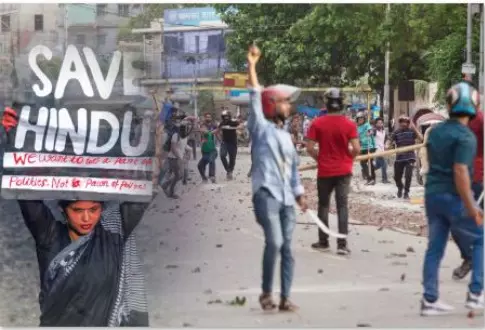


Indo-Bangladesh relations, historically a cornerstone of South Asian stability, currently face their most formidable strategic challenge since the 1971 Liberation War. This volatility reached a breaking point following the tragic death of Sharif Osman Hadi, a prominent youth leader and spokesperson for the influential protest platform InqilabMoncho. Shot in mid-December 2024 in Dhaka’s Paltan area, Hadi succumbed to his injuries on December 18, 2025, after being airlifted to Singapore. In the immediate aftermath, radical groups—fueled by a potent mix of grief and anti-India sentiment—claimed that the assailants had escaped across the border to find sanctuary. This sparked a wave of night-long mayhem across major cities.
The symbols of cultural and diplomatic friendship bore the brunt of this resentment. The Indira Gandhi Cultural Centre was ransacked, and Chhayanaut, a bastion of Bengali heritage and secular tradition, was vandalised. Perhaps most disturbingly, the burning of Rabindranath Tagore’s books at various protest sites served as a symbolic rejection of the shared cultural history of the two Bengals. This indicates a targeted hatred toward the secular identity of the nation, marking a departure from the moderate, syncretic values that traditionally defined the region.
Clash of Civilisations
The current crisis in Bangladesh underscores the enduring validity of Samuel Huntington’s 1993 thesis in The Clash of Civilizations, which predicted that religion-based conflicts would dominate 21st-century politics. Huntington argued that in the post-Cold War world, the primary sources of conflict would be cultural and religious rather than ideological or economic. In the Bangladeshi context, we see the manifestation of Paul Brass’s perspective: that Islamic ideology is often a social construct sponsored by the elite in pursuit of specific political objectives.
Practice proves this perspective, as religion has been instrumentalised to consolidate power and mobilise the masses. Islamic militancy turned out to be a burning issue by the end of the 20th century, and it continues unabated into 2025. South Asia is now grappling with an ever-expanding footprint of IS (Islamic State) ideology. While the IS-Khorasan group remains at loggerheads with the Taliban in Afghanistan, its radical ideology has crept into the minds of South Asian Muslims, particularly in regions where there is no resistance from the moderate clergy or traditional parental peer groups to counter extremist narratives.
Birth of Bangladesh and Islamic Radicalisation
The roots of this radicalisation are deeply intertwined with the nation’s political history. Bangladesh emerged as an independent state in 1971 on the back of secular nationalism, but almost all subsequent governments have fallen back on Islam as a tool for legitimising their governance. From 1975 to 1990, the military regimes systematically “Islamized” the country, attempting to shape popular culture to suit their authoritarian needs. Instead of immediately introducing a formal Islamic state, they were interested in diffusing Islamic discourse so deeply into society that democratic and secular discourses would remain unnoticed or marginalised.
Bangladesh witnessed a paradigmatic shift between 1991 and 2006, marked by the rise of democratic institutions. However, the two major political parties—the Bangladesh Nationalist Party (BNP) and the Awami League (AL)—captured power in alternating elections by making tactical alliances with Islamist groups. This “mainstreaming” of radical agendas owes much to Jamaat-e-Islami (JeI), an organisation that originally opposed the liberation of Bangladesh. JeI was highly active in militia activities, which subsequently gave birth to other, more violent radical groups. By the end of the 1990s, the Islamist political movement had gained enough momentum to raise serious doubts about the long-term viability of secularism in Bangladesh.
Growth of Radical Islamisation
Influenced by concurrent events in the Middle East and Afghanistan, militant groups in Bangladesh became increasingly keen on establishing a Sharia-based system. These groups aggressively opposed Bengali culture and secular activities, viewing them as “un-Islamic.” The youth, particularly those who received an education focused solely on Islamic culture without broader social integration, emerged as the most vulnerable demographic.
Those affiliated with extremist networks often provide purposeful, literalist interpretations of the Qur’an to ‘motivate’ and recruit individuals. Local and international media have frequently identified certain madrasas as central nodes for radicalisation, mirroring patterns seen in Pakistan. The rise of this radical politics is inextricably linked to an environment shaped by authoritarian tendencies, widespread corruption, and favouritism, where Islamist terrorism is presented as a “pure” alternative to a failing secular state.
Political Transition and the 2024–2025 Consolidation
The political change in August 2024, following the ouster of Sheikh Hasina, led to a rapid consolidation of radical forces. Under the current interim government led by Chief Adviser Muhammad Yunus, several radicals and convicted terrorists have been released and are now operating freely. Public concern has been heightened by reports of high-profile militants, such as JMB’s second-in-command, Golam Sarowar Rahat, appearing in proximity to government officials.
Indian security agencies have noted that JeI continues to exhort its supporters to establish an Islamic state. Meanwhile, Hizb-ut-Tahrir (HuT), a pro-caliphate transnational organisation that played an instrumental role in the 2024 change, has emerged from the shadows. Influential advisors within the current regime, such as Asif Nazrul and others, have faced scrutiny regarding their affiliations or perceived leniency toward such groups. Furthermore, the revival of the dormant Harkat-ul-Jihad-al-Islami Bangladesh (HuJI-B) has added a dangerous new dimension to the internal security landscape.
Rohingya Refugees and the Pakistan Pivot
Adding to this complex web is the presence of over 1.3 million Rohingya refugees. Prone to radicalisation due to their displaced status, these populations are being targeted by the Pakistan-backed Arakan Rohingya Salvation Army (ARSA). ARSA is reportedly seeking control over refugee camps to strengthen links with drug syndicates and build a dedicated cadre of radicalised Rohingyas to be used against India at an opportune moment.
Simultaneously, there has been a significant upswing in bilateral ties between Bangladesh and Pakistan. The resumption of direct trade after a 50-year hiatus, including a major government-to-government rice deal in early 2025, speaks to the strength of this new tie. High-level military meetings, including visits by Pakistan’s Chief of Army Staff General AsimMunir to sensitive areas near the Indian border in January 2025, carry heavy implications. Pakistan-based terrorist outfits like Lashkar-e-Tayyaba (LeT) and Jaish-e-Mohammed (JeM) are likely making use of these shifting dynamics to restore old links with Bangladesh-based terror groups for anti-India activities.
The Road Ahead
With a shared 4,096 km border, India cannot remain indifferent while China and the United States compete for influence in the region. The forthcoming elections, scheduled for February 2026, are unlikely to bring a radical transformation back toward secularism, as the declining strength of the Awami League further empowers non-secular and radical leaders.
The ultimate goal for many of these radicalised actors is to ensure that religious minorities, particularly Hindus, leave the country to facilitate the creation of a mono-religious Islamic State. Global public opinion must be mobilised to fight against this design, as the destabilisation of Bangladesh has serious international implications. India must utilise its economic and military strength, coupled with proactive diplomacy, to navigate this generational challenge and prevent a strategic vacuum on its eastern frontier.
Views expressed are personal. Fr. Felix Raj is the VC, and Prabhat Kumar Datta is an Adjunct Professor, both at St. Xavier’s University, Kolkata